Background Blur: Why Can a Camera Do It in One Shot, While a Phone Has to Calculate It?
A good portrait often looks like this: the person is crisp, the lights behind them melt into soft round discs, and a messy background fades into a haze. With a camera you get this almost without trying; with a phone you often switch on “portrait mode” and let the phone calculate it. What’s the physics behind it?
A quick guess
Two things are often said: “The smaller the f-number, the blurrier the background,” and “A phone and a camera are both f/1.8, so they should look the same.”
Each is only half right. An f-number is a ratio, not the actual size of the opening. What really decides how blurred the background gets is the actual diameter of the lens’s opening, how wide a scene the picture takes in, and how far away the background is. At the same f/1.8, a phone lens’s opening is a few millimeters across; a camera lens’s is several centimeters.
Why the background blurs
A lens gathers light that spreads out from a point and brings it back to a point. But it can do that for only one distance at a time: focused on the person, the light from every point on them comes together on the sensor; the light from a distant lamp comes together sooner, at a point in front of the sensor, then spreads out again and lands on the sensor as a disc. Focusing means moving the lens back and forth to choose which distance comes together exactly on the sensor.
The discs in a photo are those out-of-focus bright points: blur discs. How blurred the background gets comes down to how big they are. Photographers also talk about “bokeh,” which means a bit more: not just how blurred, but how the out-of-focus areas look, such as the discs’ shape, whether their edges are soft or hard, and how smoothly they blend. More on that later.
It’s all about the lens’s opening
There’s a very visual way to see how big a disc is.
Of the light a distant lamp sends out, only one beam gets into the lens: it starts at the lamp and widens as it goes, until at the lens it is exactly as wide as the opening, like a cone with its tip on the lamp. Call it the “light cone.” The lens is focused on the person, so the plane where the person stands is printed sharply in the photo; the circle the cone cuts out as it passes through that plane is printed too, just as it is, and becomes the blur disc. For a distant lamp, that circle is almost as big as the opening. So:
Blur disc as a share of the frame ≈ the diameter of the lens’s opening ÷ the width the picture covers where the person stands
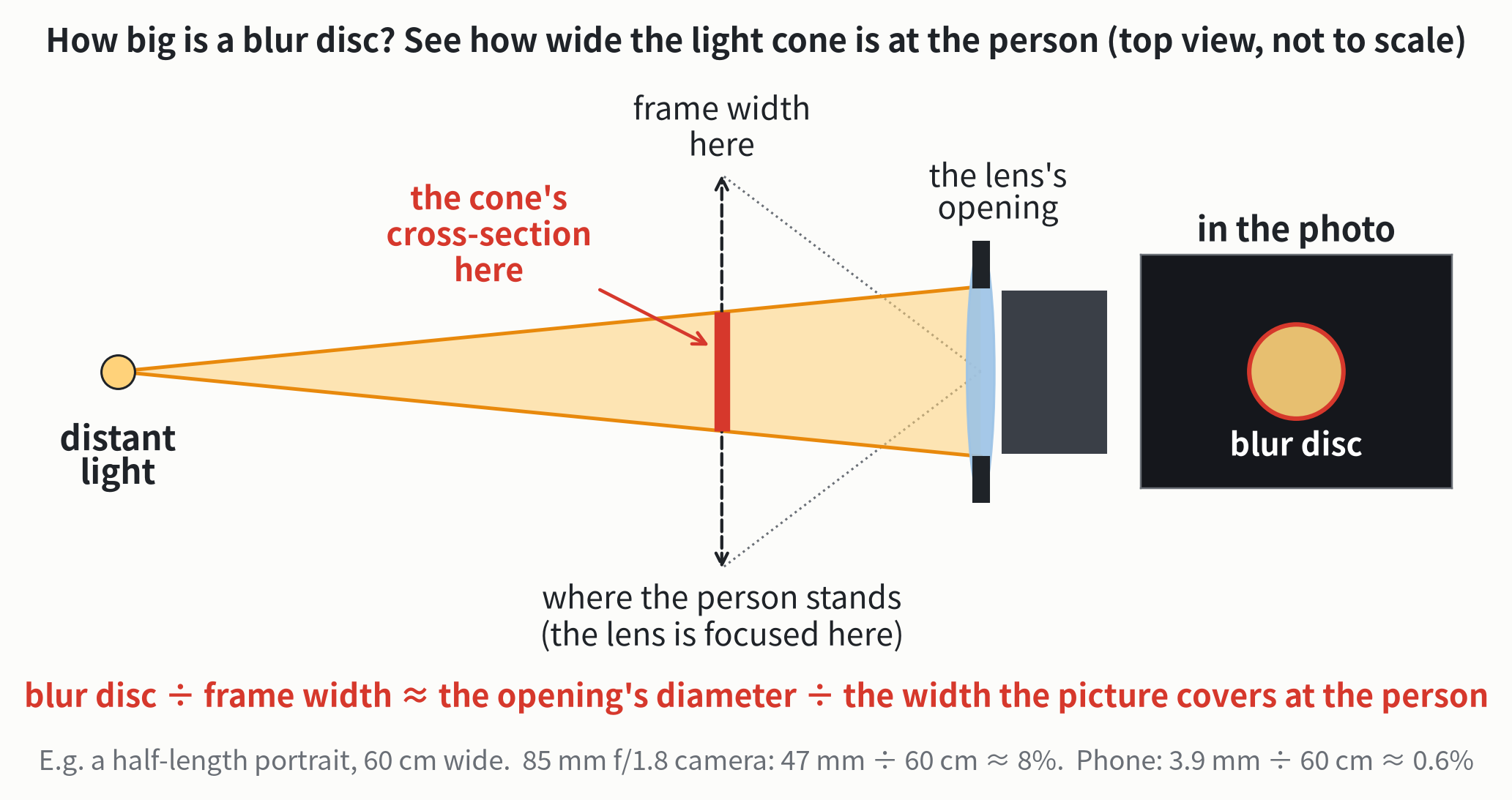
“The lens’s opening” means the real diameter of the aperture. A number like f/1.8 is the f-number: the focal length divided by the opening’s diameter. Take the iPhone 17 Pro’s main camera: its real focal length is about 6.9 mm (worked out from its equivalent focal length) and its aperture f/1.78, so its opening is only about 3.9 mm; an 85 mm portrait lens on a camera at f/1.8 has an opening of about 47 mm, 12 times the phone’s. For the same 60 cm wide half-length portrait, with the background far away, the phone’s discs take up just 0.6% of the frame, so you can hardly see any blur; the camera’s take up 8%, and the lights behind turn into big round discs.
Note that this comparison assumes the same framing (the picture covering the same width) and a distant background. Change the framing, or bring the background closer, and the numbers change; the size of the opening is only one of the factors. So whenever you compare blur, say how wide the picture is, how far away the person is, and how far behind them the background is.
The diagram also shows four ways to blur the background more:
- ① Open the aperture: a bigger opening makes a wider cone.
- ② Step closer: the picture covers a narrower scene, so the same cone takes up more of it.
- ③ Put the background farther behind the person: the farther the lamp, the closer the cone at the person comes to the full width of the opening.
- ④ Use a longer lens, and step back so the person is the same size: at the same f-number, a longer focal length means a bigger opening.
A phone can use these tricks too; they just do much less. But there are two cases where even a phone gets genuine optical blur:
- Close-ups of small things: a dozen or so centimeters from a flower, the picture covers only about 20 cm, and with the background far away the discs reach 1.9% of the frame, three times their size in a half-length portrait. But the closer you are, the thinner the slice that’s sharp, so focus with care.
- Portraits with the telephoto: the iPhone 17 Pro’s 4x telephoto (100 mm equivalent, f/2.8) has a real focal length of about 16 mm and an opening of about 5.8 mm, half again as wide as the main camera’s. For the same framing, the background blurs a little more.
Why cameras take good photos more easily
The basic reason cameras do better is that their sensors and lenses are much bigger. A full-frame camera’s sensor is 36 × 24 mm; the iPhone 17 Pro’s main sensor is about 10 × 7.5 mm, about 3.5 times narrower. For the same picture at the same f-number, the bigger sensor pairs with a focal length 3.5 times longer, so the opening is 3.5 times wider and its area about 12 times larger: in the same exposure time, the whole picture collects about 12 times as many photons.
Note that each small patch of the sensor doesn’t get any more light. At the same f-number and exposure time, the exposure per unit area is the same, and the two pictures come out equally bright; the extra photons come from the bigger sensor’s extra area.
How Does a Phone Take a Photo? said: “And whether a photo looks clean often depends less on how many pixels there are than on how many photons each pixel collects.” Compare the two pictures at the same size, and every patch of them has about 12 times the photons. The random spread goes as one over the square root of the number of photons, so the grain is about 3.5 times finer (√12 ≈ 3.5). This compares pictures at the same size, not single pixels: a big sensor can have more pixels, so each one needn’t get 12 times as many. And with its big opening, the background blurs naturally too.
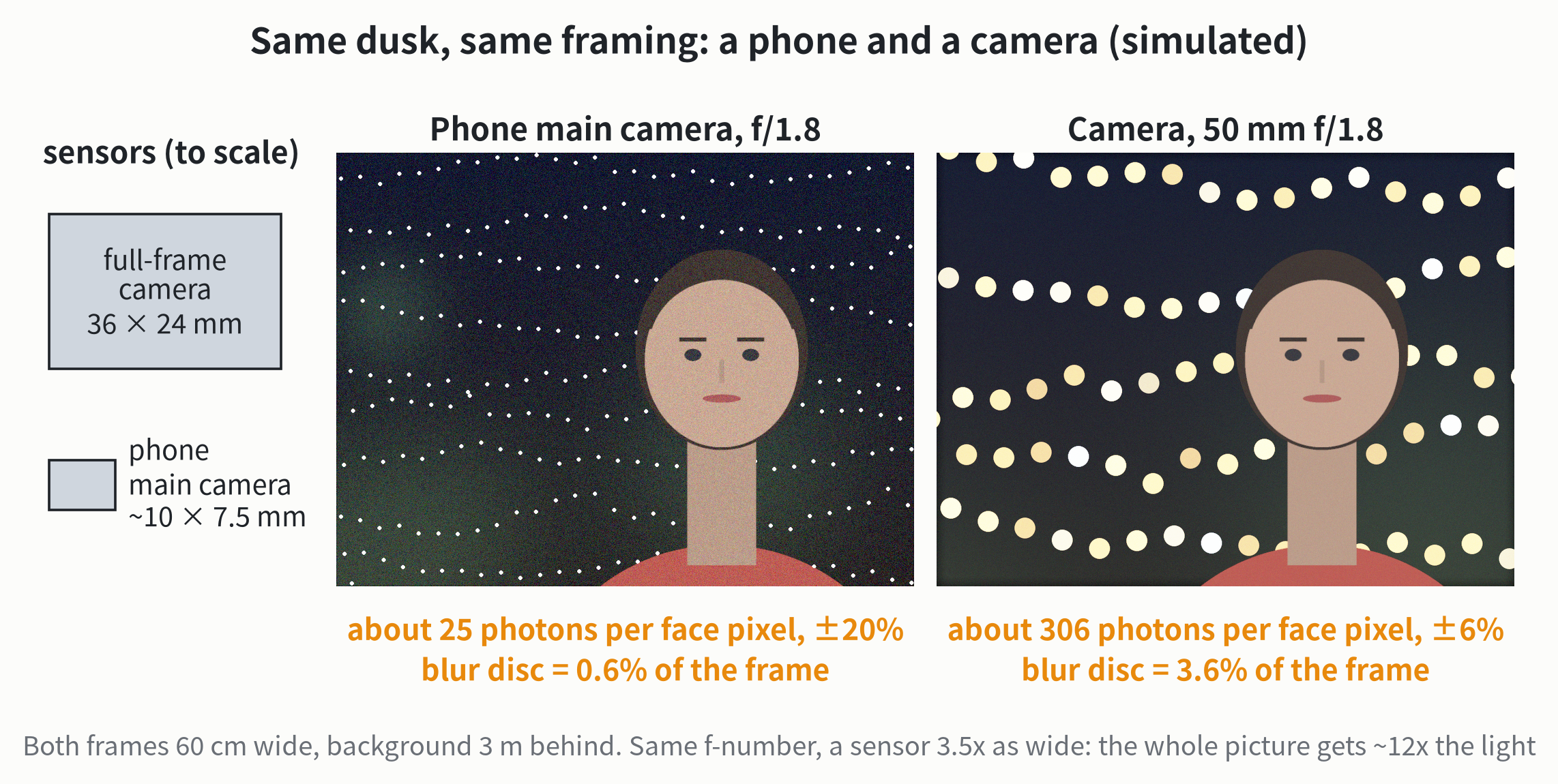
That’s why people say a phone main camera’s f/1.8 gives about the same blur and depth of field as f/6 on a full-frame camera (1.8 × 3.5): its “equivalent aperture.” It means the blur matches, and so does the total number of photons in the picture, but not the exposure settings: at the same exposure time, a phone at f/1.8 and a camera at f/1.8 give equally bright pictures; a camera at f/6 gives a much darker one, and needs a longer exposure or a higher ISO.
Phones have been catching up fast:
- Bigger and bigger sensors: ten years ago, a phone’s main sensor was only about 5 mm wide; today’s flagships are around 10 mm.
- One press of the shutter, many shots: the phone lines them up and stacks them to gather enough photons, so there’s less grain in the dark.
- Apertures that change: the iPhone 18 Pro, announced in September 2026, is the first iPhone whose main camera has a variable aperture: six blades, with four settings, f/1.48, f/1.8, f/2.8 and f/4. At f/1.48 it lets in about 40% more light than at f/1.78. Apple hasn’t published the real focal length; if it’s about the same as the previous model’s, the opening is still only about 4.6 mm (an estimate), and the discs only about 20% bigger than the iPhone 17 Pro’s.
A phone is only about a centimeter thick, with no room for an opening several centimeters across. So in good light, phones and cameras are now close; but for background blur, a phone mostly still has to calculate.
Bokeh: the look of the blur
Beyond how blurred, how good the bokeh looks depends on what the discs look like. They aren’t always round. An out-of-focus bright point spreads out into the shape of the aperture’s opening.
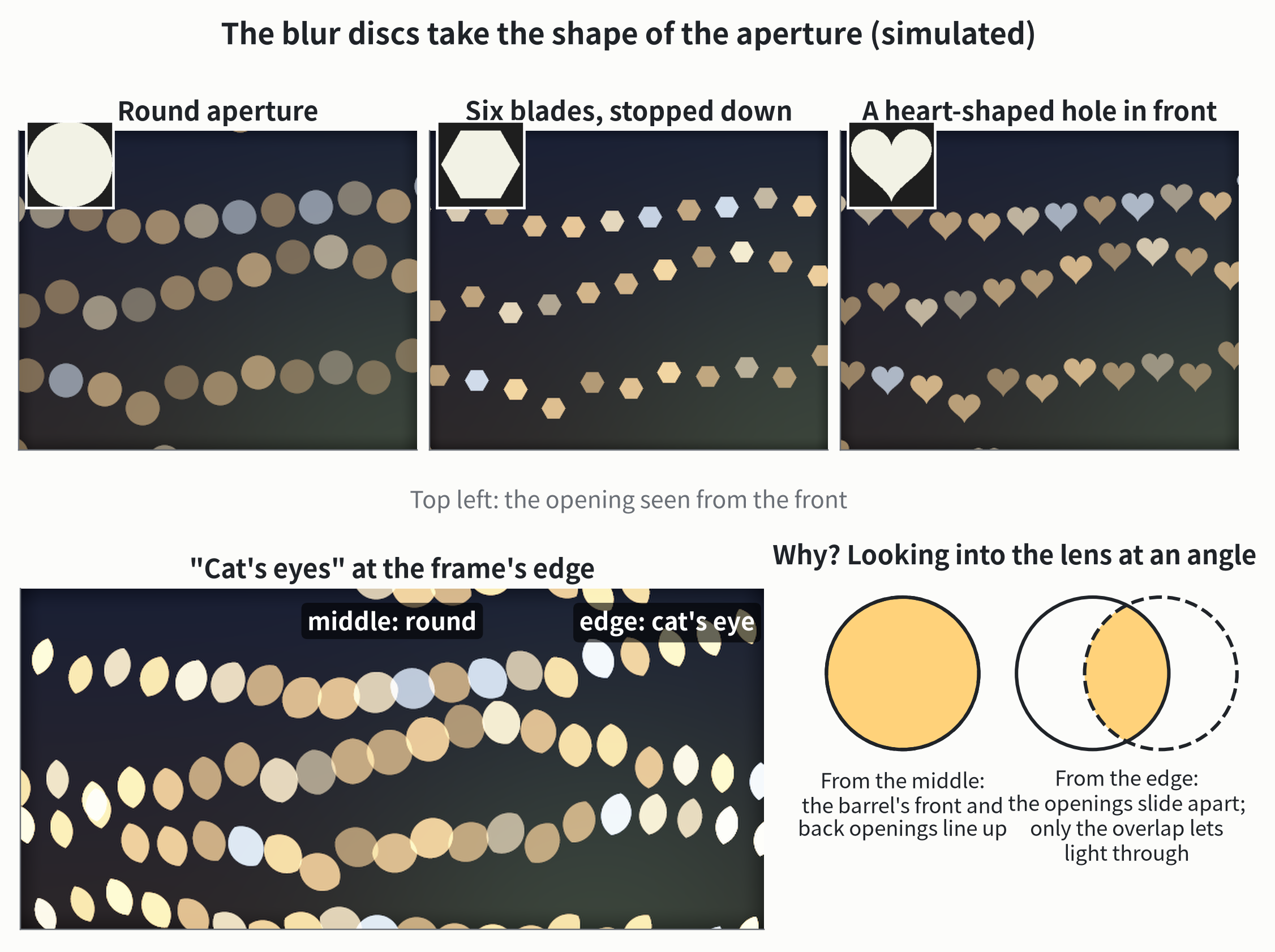
Good lenses use curved aperture blades, and plenty of them, to keep the discs round. Whether a disc’s edge is soft or hard also depends on the lens design: soft edges that melt into each other give the “creamy” look people love; bright-edged discs, or ones with rings inside, make a background look busy.
The background matters too. Specks of light, and sunlight peeking through leaves, turn most easily into lovely discs; a background that’s farther away and cleaner in color makes the person stand out.
How a phone calculates its blur
A phone’s opening is too small to blur much optically, so it first works out how far away each part of the picture is, then blurs the distant parts layer by layer: that’s “portrait mode.”
There are several ways to work out distance: two cameras side by side; “dual pixels,” which split each pixel in two; AI that recognizes where the person and their hair are; and, on Pro iPhones, a LiDAR scanner that measures distance with laser light. Real phones often combine several. Two cameras are the easiest to understand: two lenses a little apart see slightly different pictures: nearby things shift a lot between them, distant things only a little. Hold up a finger and close each eye in turn: the finger jumps against the background, and the closer it is, the more it jumps.
Working out distance is hardest in fine details: hair, the rims of glasses, a clear glass often come out wrong, so hairs get wiped out or a ring of unblurred background clings to the head. Look closely at a portrait-mode photo and you can often spot the giveaway in places like these.
LiDAR sends out its own light, so it measures distance even in the dark; AI helps trace fine edges such as hair. Since the iPhone 15, whenever a person, cat or dog is in the frame, the phone quietly records distances too, so you can turn on the blur after taking the photo, and even change who’s in focus.
In one sentence: out-of-focus bright points spread into discs, each disc being the circle the light cone cuts out where the person stands; how big a share of the picture it takes up depends on the diameter of the lens’s opening and how wide a scene the picture covers. A camera’s big sensor and lens give it a big opening and plenty of photons, so the background blurs naturally and the grain is fine; a phone’s opening is just a few millimeters, so it stacks many shots to make up the photons, and works out distances and then blurs the background itself to make up the blur.
How do we know?
- Get real blur from your phone: turn off portrait mode, get within a dozen or so centimeters of a flower with the background far away, and tap the flower to focus. Then step back a meter and shoot the same flower, and compare the backgrounds.
- Compare the main camera and the telephoto: take a portrait with each, with the person the same size in the frame, and compare the backgrounds.
- Make heart-shaped bokeh: you need a camera with interchangeable lenses. Cut a heart about a centimeter across out of black card, hold it in front of the lens, open the aperture all the way, focus on something close and let distant fairy lights go out of focus: the discs become little hearts. A phone lens’s opening is too small for this to work.
- Find portrait mode’s mistakes: use portrait mode on someone with fluffy hair, or someone holding a glass, and zoom in on the edges.
What we still don’t know
Calculated blur looks more and more real, but around hair, glass and smoke it still often fails to fool a careful eye. Can a phone, by computation alone, take pictures exactly like a big lens? Engineers are improving the algorithms and trying new kinds of lenses too, such as “metalenses” that use nanostructures instead of glass. The question doesn’t have an answer yet.
For the curious: the blur formula, simulations and data
Working out the light cone. The lens is focused on a person at distance , a lamp is at distance , and the opening has diameter . The cone from the lamp to the opening cuts out, where the person stands, a circle of diameter . If the picture covers a width there, then
For a distant background the bracket is close to 1, which gives the rule in the text. Working out the disc on the sensor directly from the thin-lens equation gives the same result. Neither the sensor size nor the focal length appears: a camera blurs more because, for the same picture, its opening is bigger. , where is the focal length and the f-number.
The phone’s numbers. iPhone 17 Pro main camera: 24 mm equivalent, f/1.78, a 1/1.28-inch sensor (about 10 × 7.5 mm), real focal length about 6.9 mm, opening about 3.9 mm. 4x telephoto: 100 mm equivalent, f/2.8, a 1/2.55-inch sensor (about 6 mm wide), real focal length about 16 mm, opening about 5.8 mm. Real focal lengths are worked out from the equivalent focal lengths and the sensor sizes. The iPhone 18 Pro’s main camera has four apertures, f/1.48, f/1.8, f/2.8 and f/4; its focal length is assumed to be the same as the previous model’s.
Settings for the “four ways” animation. The camera is full frame (36 mm wide). Steps (phone | camera): start, frame 60 cm wide, background 1 m behind the person, phone at f/1.78, 0.46% | 50 mm f/8, 0.55%; ① camera opened to f/1.8, 0.46% | 2.5%; ② frame 40 cm wide, 0.76% | 4.3%; ③ background 10 m behind, 0.94% | 6.6%; ④ phone 4x telephoto, camera 85 mm f/1.8, 1.3% | 10.7%.
Settings for the phone-and-camera comparison. Both pictures cover a 60 cm wide scene with the background 3 m behind. For the same picture, the light collected from the person is proportional to (opening diameter ÷ distance)², that is, to (sensor width ÷ f-number)²: at f/1.8, full frame gets times as much as the phone. Photon counts are drawn from a Poisson distribution. “Per pixel” means per pixel once both pictures are scaled to the same size. The phone’s count on the face (about 25) is a typical dim-light value chosen for the comparison.
Simulation method. The background is strings of small lights on a plane; each light is drawn as a disc in the aperture’s shape, with its brightness spread out so its energy is conserved; the person in front stays sharp. Diffraction and aberrations are left out. Cat’s eyes are approximated as the overlap of two circles. Portrait mode: two lenses 1 cm apart, the person at 0.41 m and the background at 3.41 m; the shift is inversely proportional to distance, so they differ by 3.41 ÷ 0.41 ≈ 8 times; the “calculated distances” are worked out on a coarse grid, so fine hairs aren’t resolved.
Other. The HTC One M8 (2014) already used two cameras to work out distances; Apple’s iPhone 7 Plus (2016) made portrait mode popular; Google’s Pixel 2 (2017) used dual pixels plus machine learning; Pro iPhones have had LiDAR since the iPhone 12 Pro (2020); since the iPhone 15 (2023), portrait blur can be added after the shot.