Why Do Autumn Leaves Turn Yellow and Red, Little by Little?
For about ten years, we drove up to Northern Michigan almost every fall to see the colors. This year it didn’t work out. But the trees outside our door are turning too, and our little one keeps asking questions: on the same tree, why are some leaves still green, some already gold, and some deep red? Even on a single leaf, the edges often turn yellow first while stripes of green linger along the veins. A leaf doesn’t change color overnight. It changes a little at a time.
Why?
Take a guess
Many people’s first answer is that the cold “freezes” the leaves yellow or red. Others think that in autumn, leaves grow new yellow color.
In fact, the yellow was there all along. It was hidden under the green all summer. To see why, we first need to ask a different question: what is the color we see, anyway?
A leaf’s color is the light it doesn’t eat
Sunlight looks white, but it is all the colors of the rainbow mixed together. When light hits a leaf, the pigments inside “eat” (absorb) some colors and put that light to work. The light that isn’t eaten bounces back into our eyes, and that is the color we see.
A leaf has three main pigments, and each has its own taste:
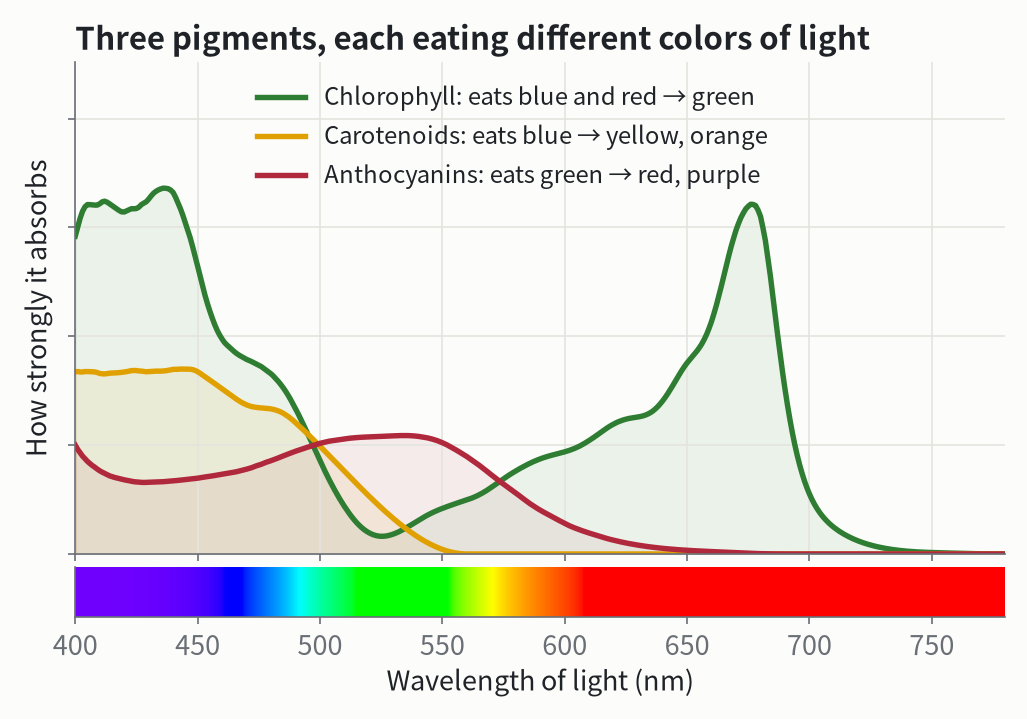
- Chlorophyll eats blue and red light but leaves green alone. The green light bounces back, so summer leaves look green. The light it eats powers photosynthesis.
- Carotenoids, the same family as the color in carrots and corn, eat only blue light, leaving yellow and orange.
- Anthocyanins, the same family as the color in red cabbage and blueberries, eat exactly the green light, leaving red and purple.
Plot the light each kind of leaf sends back, and the colors explain themselves:
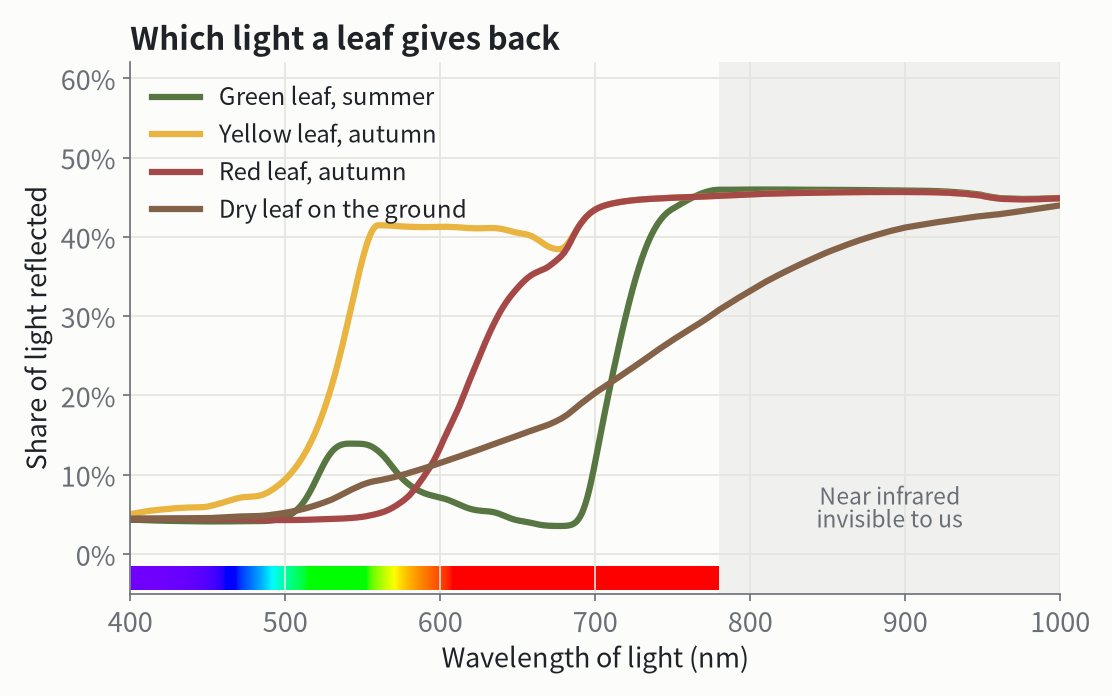
A summer leaf has just a small bump around green; nearly everything else is eaten, so a summer leaf is actually a fairly dark green. A yellow autumn leaf reflects plenty of green, yellow, orange and red, and only refuses blue, so it looks bright gold. A red leaf refuses green as well, leaving only orange and red.
There is one more surprise on the right side of the chart. In near-infrared light, which our eyes can’t see, every leaf reflects almost half the light, whatever its color. That has nothing to do with pigments: the light bounces again and again between the cells and the tiny air spaces inside the leaf. If we could see near-infrared, a summer forest would glow almost white.
Why it happens little by little
In autumn the days get shorter and cooler, and trees start getting ready for winter. Before the leaves fall, a tree takes its chlorophyll apart and pulls the valuable nitrogen and other nutrients back into its branches and roots, saving them for next spring.
In summer a leaf has several times more chlorophyll than carotenoids, so the yellow stays completely covered. As the chlorophyll drops day by day, the yellow underneath shows through day by day. Some trees, such as maples, also make new anthocyanins at this time, adding a layer of red.
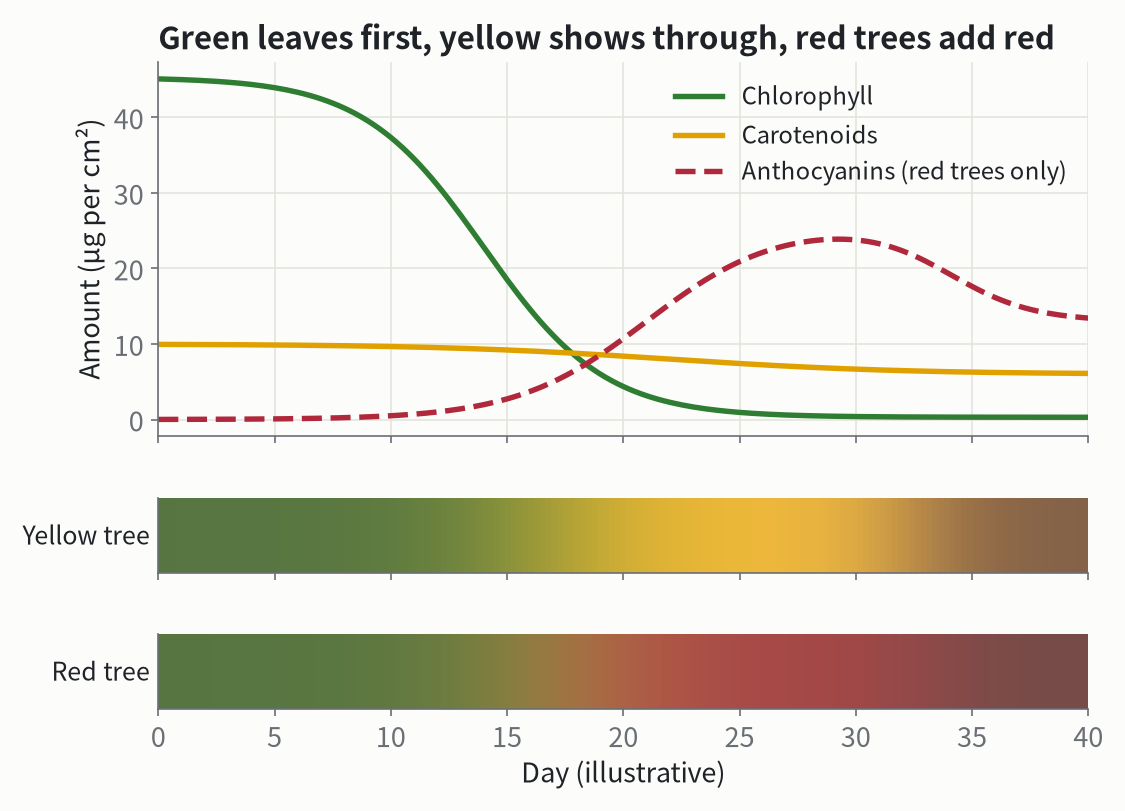
The amounts change smoothly, so the color changes smoothly too. That is why we see a gradual shift.
The red-tree strip hides a detail. For a few days, while some chlorophyll is still there and anthocyanins have already appeared, the leaf passes through a dull, brownish color. Both pigments are eating light at once: chlorophyll takes the red, anthocyanins take the green, and little is left to bounce back. Here colors don’t add; they subtract.
Now look at a single leaf over time. Different parts of a leaf change at different speeds: the edges go first, and the areas along the veins often stay green the longest.
In the end the leaf’s cells die and dry out, and their contents oxidize to brown. The reds and yellows fade, and it becomes a dry leaf on the ground.
In one sentence: a leaf’s color is the light it doesn’t eat. In autumn, leaves stop eating red light and the yellow that was always there shows through; some trees also give their leaves a pair of red “sunglasses” that eat green light.
How do we know?
- Measure the spectrum. A spectrometer measures how much light a leaf reflects at each wavelength, giving curves like the ones above. All the curves and colors in this article come from PROSPECT, a leaf-optics model widely used in remote sensing that was built and tested on measurements of many real leaves.
- Separate the pigments. You can do this at home. Cut up a few leaves, mash them in a little rubbing alcohol, and dip the end of a strip of coffee filter into it. As the alcohol climbs the paper, it carries different pigments to different heights, and even a green leaf shows a band of yellow. That is the most direct proof that the yellow was there all along. (Alcohol is flammable; kids should do this with an adult.)
- Watch from space. Satellites measure both the red and the near-infrared light that leaves reflect. More chlorophyll eats more red light, so the gap between the two grows. In autumn, scientists use this gap to watch fall color sweep across satellite maps, from north to south and from mountaintops down into the valleys.
What we still don’t know
Why chlorophyll fades is fairly well understood. But why would a tree spend energy making anthocyanins in leaves it is about to drop? That is still an open question. The main ideas:
- Sunscreen. While chlorophyll is being taken apart, a leaf is especially easily damaged by strong light. Red anthocyanins may act like sunscreen, protecting the leaf until the tree has finished pulling the nutrients back.
- Cold and stress protection. They may help the leaf hold out a few more days in the cold.
- A signal to insects. Bright red might tell aphids looking for a place to lay eggs for the winter, “I’m healthy, go elsewhere.”
Each may be partly right. It is also why years with plenty of sunshine and cool nights that stay above freezing tend to bring especially bright reds.
Next time you see a leaf that hasn’t finished turning, stop and take a look: where did it turn yellow first, where is it still green, and where has it already gone red?
For the curious: how these figures were computed
The leaf model. PROSPECT-D (Féret et al., 2017) treats a leaf as a stack of N absorbing plates. Each plate’s absorption is the sum of concentration × specific absorption coefficient for chlorophyll, carotenoids, anthocyanins, brown pigments, water and dry matter. Light passing through one plate follows the Beer–Lambert law averaged over isotropic incidence; reflection and transmission at the surfaces follow the Fresnel equations averaged over directions (Allen 1969, Stern 1964); and the plates are combined with Stokes’ formulas for a pile of plates. This gives the leaf’s reflectance and transmittance from 400 to 1000 nm. Our implementation matches the published reference implementation at every wavelength to within 10⁻¹⁵.
From spectrum to color. The reflectance is multiplied by the spectrum of CIE standard daylight D65 and integrated against the CIE 1931 standard observer’s color-matching functions to get XYZ tristimulus values, which are then converted to sRGB for screens. Every color uses the same exposure factor, as if all the leaves were photographed with the same camera.
The numbers. Summer leaf: chlorophyll 45 and carotenoids 10 µg/cm², leaf structure parameter N = 1.5. The autumn time course (chlorophyll falls first, anthocyanins rise later, then brown pigments increase and water decreases) is illustrative; real timing depends on the species and the weather. In the animation, each spot on a leaf runs on its own clock: slower near the veins, faster at the edges, plus a little random variation.
Data sources. PROSPECT-D specific absorption coefficients: Féret, Gitelson, Noble & Jacquemoud, Remote Sensing of Environment 193:204–215 (2017). CIE 1931 color-matching functions: CVRL, University College London. D65 spectrum: CIE 015.