Why is microwaved food hot outside and cold inside?
How does radio carry sound and data to your phone? said: “The one established effect of phone signals is to warm the body very slightly, the same way a microwave oven heats food.” A microwave oven takes that to the extreme: a roughly 1,000-watt “radio station” shut inside a metal box, there purely to heat food. But anyone who has used one knows that reheated leftovers are often scalding on the outside and still cold in the middle, and one part of a plate bubbles while another stays cold. Why?
A quick guess
You often hear: “A microwave heats from the inside out”; “2.45 GHz is exactly water’s resonant frequency, so it targets water”; “microwaved food picks up radiation.”
None of these is right. Microwaves only get a centimeter or two into food; the inside warms as heat slowly spreads in. And 2.45 GHz isn’t the frequency water absorbs best; as we’ll see, it was chosen precisely because water isn’t so keen on it. As for radiation, when the oven switches off the microwaves are gone, just as no light lingers in a room after you switch off the lamp, and nothing is left behind in the food.
A radio station shut in a box
In 1945 Percy Spencer, an engineer at the American company Raytheon, was testing a magnetron for radar when he noticed the chocolate bar in his pocket had melted. He tried popcorn kernels next, and they popped in front of the magnetron. Two years later the first commercial microwave oven appeared, about as tall as a person and weighing over 300 kilograms.
The magnetron in today’s ovens oscillates 2.45 billion times a second, 2.45 GHz, with a wavelength of about 12 centimeters. A water molecule in food is slightly positive at one end and slightly negative at the other; as the electric field flips back and forth, it twists the molecules back and forth, and the energy turns into heat.
Why 2.45 GHz? Water absorbs most strongly around 20 GHz. But at 20 GHz the microwaves would be used up within half a millimeter, scorching the surface and never reaching the inside. At 2.45 GHz water absorbs “just enough”, and the microwaves get a centimeter or two in. This band is also set aside internationally for industrial, medical and household equipment, so it doesn’t interfere with communications; 2.4 GHz Wi-Fi shares it too, which is why Wi-Fi sometimes slows down when the microwave is on.
Hot spots and cold spots: microwaves bouncing around the oven
The inside walls of a microwave oven are all metal, so the microwaves bounce off them. The outgoing and returning waves overlap: in some places they always reinforce each other and the field is especially strong, a hot spot; in others they always cancel and the field is almost zero, a cold spot. Neighboring hot spots are exactly half a wavelength apart, about 6 centimeters.
A real oven cavity is a box, with microwaves bouncing between its six faces, so the hot and cold spots form a map. Here it is calculated from Maxwell’s equations, looking down into the oven:
The hot and cold spots stay put, and they can be just a few centimeters apart: on the same plate, one bite is hot and the next is cold.
You can find where the microwaves come in on your own oven, too: on a side wall of the cavity (usually the right) there’s a square sheet of mica or plastic, and behind it is the opening of the “waveguide” that brings the microwaves in from the magnetron. If it gets greasy it can spark, so keep it clean, but don’t peel it off.
The turntable: it evens out each ring, but the center doesn’t move
That’s what the turntable is for: to carry the food through hot and cold spots in turn. Using the map calculated above, compare the same plate held still and turning:
With the plate turning, the underheated share drops from 39% to 0. But there’s one place the turntable can’t help: the center. The very middle of the plate never moves; in this simulation it happens to be lukewarm, but if it sits on a cold spot, no amount of turning will heat it. So when reheating, arrange the food in a ring with the middle empty, and stir it halfway through; it will come out far more even.
The simulation above is just one flat layer. A real cavity is three-dimensional, and the hot and cold spots are also stacked in layers from bottom to top; the turntable only turns sideways and can’t do anything about up and down. So a tall heaped bowl heats unevenly from top to bottom as well, another reason to spread food thin.
Hot outside, cold inside
As microwaves go into food, each layer absorbs part of them: in lean meat only 30% is left 1 centimeter in. The inside depends entirely on heat creeping in from the outer layers. But meat conducts heat slowly: in a minute, heat gets only about 3 millimeters further in.
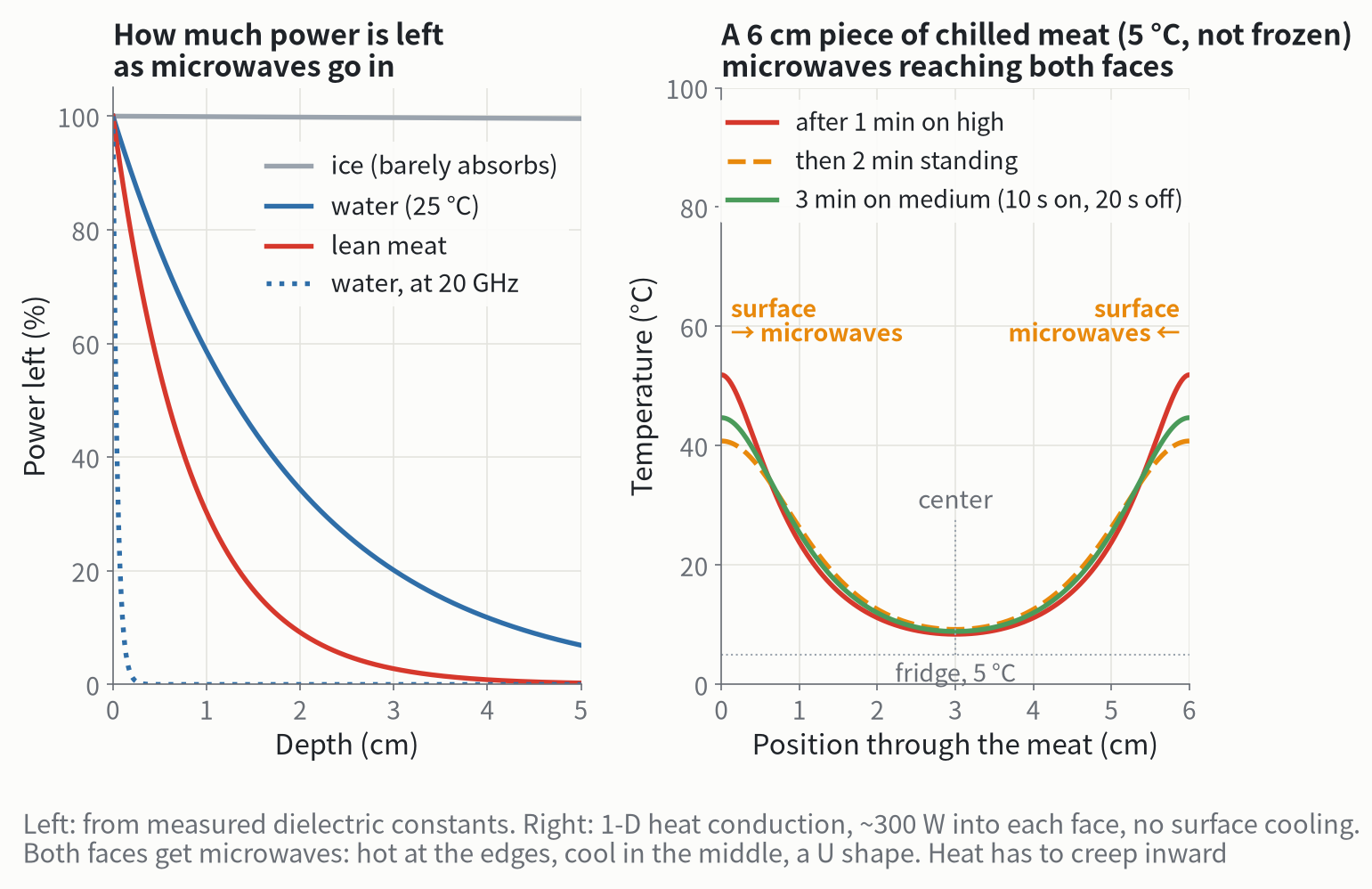
So “medium” power doesn’t weaken the microwaves; it switches the magnetron on and off, leaving time for heat to spread inward. For thick food, though, that helps only a little. What really works is cutting food small and spreading it thin.
Frozen meat is harder still. Ice barely absorbs microwaves (the almost flat grey line on the left): in ice at minus ten-odd degrees, they have to cross about ten meters to fade to a third! But once a small patch thaws into water, it absorbs eagerly, and the hotter it gets the more it thaws: so the outer ring is cooked while the inside is still frozen solid. That’s why the defrost setting cycles on and off at lower power.
Metal, grapes and the door
The oven’s walls are metal, and smooth metal just reflects microwaves. But crumpled foil or the tines of a fork squeeze the electric field onto a tiny point, strong enough to break down the air and throw sparks. So unless the manual says otherwise, keep foil, metal cutlery and dishes with gold or silver rims out of the microwave.
Stranger still: two grape halves touching in the oven give off a ball of plasma. Only in 2019 did physicists in Canada work out why: inside a grape the microwave wavelength is only about 1.4 centimeters, so a grape acts like a tiny microwave cavity of its own, focusing the microwaves onto the point where the halves meet. (Don’t try it at home; it can damage the oven.)
The metal mesh in the door has holes only a millimeter or two across, much smaller than the 12 cm wavelength. How does radio carry sound and data to your phone? said the waves leak through a gap: “once a gap is about the size of the wavelength, it no longer blocks them.” Turn that around: with holes far smaller than the wavelength, the microwaves can’t get out, but light, with wavelengths under a micrometer, passes straight through, so you can watch your food. International standards limit leakage to 5 milliwatts per square centimeter, 5 centimeters from the oven; German measurements typically find about one percent of that.
In a sentence: microwaves bounce around the metal cavity and pile up into fixed hot and cold spots; a turntable evens out each ring but can’t help the center; microwaves only get a centimeter or two in, and the rest depends on heat slowly creeping inward, so food ends up hot outside and cold inside. Cut it small, spread it thin, arrange it in a ring and stir halfway, and it heats evenly.
How do we know? Measure the speed of light with chocolate
- Take out the turntable, set an upside-down plate in its place, and lay a large chocolate bar on it (or a layer of cheese or marshmallows).
- Heat on high for 15 to 20 seconds, and stop as soon as a few spots start to melt.
- Measure the distance between neighboring melted spots, about 6 centimeters: half a wavelength.
- The label inside the door gives the frequency, 2450 MHz. Speed of light = 2 × spacing × frequency = 2 × 0.061 m × 2.45 billion per second ≈ 3 × 10⁸ meters per second.
In a real cavity the hot spots don’t line up as neatly as in a straight line, so your result may be off by 10 or 20 percent, but it gets remarkably close to the speed of light.
What we still don’t know
How to heat food of any shape evenly is still an open problem. A new generation of “solid-state” ovens replaces the magnetron with semiconductors that can change frequency and phase on the fly, steering the hot spots where they’re needed; some can even judge how hot the food is from the microwaves reflected back. How to heat both fast and evenly is something engineers are still working on.
Going deeper: dielectric constants, penetration depth, simulations and data
Wavelength and frequency. cm; hot spots are cm apart. 2.45 GHz (2400–2500 MHz) is an ITU band for industrial, scientific and medical (ISM) use; industrial microwave heating also uses 915 MHz.
Water’s dielectric constant. Debye model ; at 25 °C, , , ps (Kaatze, 1989). At 2.45 GHz, ; absorption peaks at GHz, where . Lean meat is about (typical literature value); ice about (around −12 °C, von Hippel).
Penetration depth. Power falls off as with : water 1.87 cm, lean meat 0.84 cm, ice about 11.6 m, water at 20 GHz 0.47 mm.
Figure 2: the cavity. Seen from above: two-dimensional finite-difference time-domain (Yee grid, transverse magnetic), 32 × 30 cm cavity, 2.5 mm grid, perfectly conducting walls; a 3 cm opening in the right wall driven at 2.45 GHz, ramped up over 3 cycles. The plate is 24 cm across, and the layer of food on it is represented by a conductivity of 0.02 S/m (a thin layer that absorbs a little and hardly changes the field). Absorbed power density . Frames are 13/12 of a cycle apart, so the field appears to swing slowly. A real cavity is three-dimensional and its spots are shaped differently from the 2-D ones, but the physics is the same.
Figure 3: the turntable. The heating map is averaged over the last 12 cycles of Figure 2; the plate turns at 5 rpm for 24 s of heating; “underheated” means getting less than half the plate average. Approximation: the spots don’t change as the food turns; only one flat layer is calculated, not the up-and-down direction.
Figure 4: heat conduction. A 10 × 10 × 6 cm piece of chilled (not frozen) lean meat; one-dimensional heat equation for lean meat with W/(m·K), kg/m³, J/(kg·K), diffusivity m²/s; decays exponentially from both faces with a 0.84 cm penetration depth, 300 W absorbed through each face (10 × 10 cm), starting at 5 °C, no surface cooling. Diffusion length : about 2.7 mm in 1 minute, 8.6 mm in 10 minutes. Results: after 60 s on high, surface 52 °C, center 8 °C; after a further 120 s standing, surface 41 °C; on medium (10 s on in every 30 s) for 180 s, surface 45 °C; the center stays under 10 °C in every case.
Leakage limits. US FDA (21 CFR 1030.10) and IEC 60335-2-25: at most 5 mW/cm² (50 W/m²) 5 cm from the surface. Measurements by Germany’s Federal Office for Radiation Protection average about 1% of the limit.
History and grapes. Spencer’s patent application was filed in October 1945; Raytheon introduced the first commercial microwave oven, the Radarange, in 1947: about 1.8 m tall, 340 kg, drawing about 3 kW, and water-cooled. Grape plasma: Khattak, Bianucci and Slepkov, Proceedings of the National Academy of Sciences 116, 4000 (2019); the wavelength inside a grape is cm.