How does radio carry sound and data to your phone?
How Does Your Phone Know Where You Are? said: “Your phone never sends anything to a GPS satellite, and the satellites can’t see you… Your phone only listens: to the satellites telling the time.” But when you make a call or stream a video, the phone doesn’t just listen; it talks too, sending your voice and data out, then picking the share meant for you out of a crowd of signals in the air. You can’t see or touch any of it. How do the sound and data actually get there?
A quick guess
You often hear: “Radio waves are a kind of sound, just too high-pitched to hear”; “full bars means fast internet”; “phone radiation is like X-rays and damages cells.”
None of these is right. Radio waves aren’t sound but electromagnetic waves, the same family as light: they need no air, travel through a vacuum, and move at the speed of light. That’s how GPS satellites, and probes that have left the solar system, send their signals back to Earth. The bars only tell you how strong the signal is; speed also depends on how many people are sharing it. As for phone radiation, each little packet of its energy is less than a hundred-thousandth of visible light’s, too small to break a single chemical bond; more on that later.
Shake some electrons, and off flies a wave
An electric charge has an electric field around it, and a moving charge also makes a magnetic field. In 1865 the British physicist James Clerk Maxwell wrote the laws of electricity and magnetism as a set of equations and found something remarkable: a changing electric field makes a magnetic field, and a changing magnetic field makes an electric field, each feeding the other, so they can leave the charges behind and travel on their own. He worked out how fast such a wave would go, and the answer was exactly the speed of light. He concluded that light is an electromagnetic wave.
An antenna is just a metal rod, or a few. The transmitter pushes the electrons in it up and down hundreds of thousands to billions of times a second: one moment the top has extra positive charge and the bottom extra negative, the next it’s the other way round. The electric field follows, but news of each change can only travel outward at the speed of light. Far from the antenna the field hasn’t heard yet, while close in it has already flipped, so the field lines get flung off loop by loop and fly away on their own. The animation below is calculated from Maxwell’s equations:
Notice that there are almost no waves straight above or below the antenna, and the strongest go out to the sides. That’s why cell tower antennas are mounted upright: to spread the waves out horizontally, close to the ground, instead of sending them into the sky.
In 1887 the German physicist Heinrich Hertz made electromagnetic waves in the lab for the first time: as sparks jumped between two metal balls, a wire loop with a small gap a few meters away sparked too. He showed the waves could be reflected and focused like light, and measured their wavelength. The unit of frequency, the hertz (Hz), is named after him: one swing a second is 1 Hz; 1 kHz (kilohertz) is a thousand a second, 1 MHz (megahertz) a million, 1 GHz (gigahertz) a billion. In 1901 the Italian Guglielmo Marconi sent a radio signal across the Atlantic.
Wavelength: why antennas come long and short
All electromagnetic waves travel equally fast, so the higher the frequency, the shorter the wavelength: frequency × wavelength = speed of light. FM radio is about 100 MHz, 100 million swings a second, with a wavelength of about 3 meters; a phone signal around 2 GHz has a wavelength of about 15 centimeters.
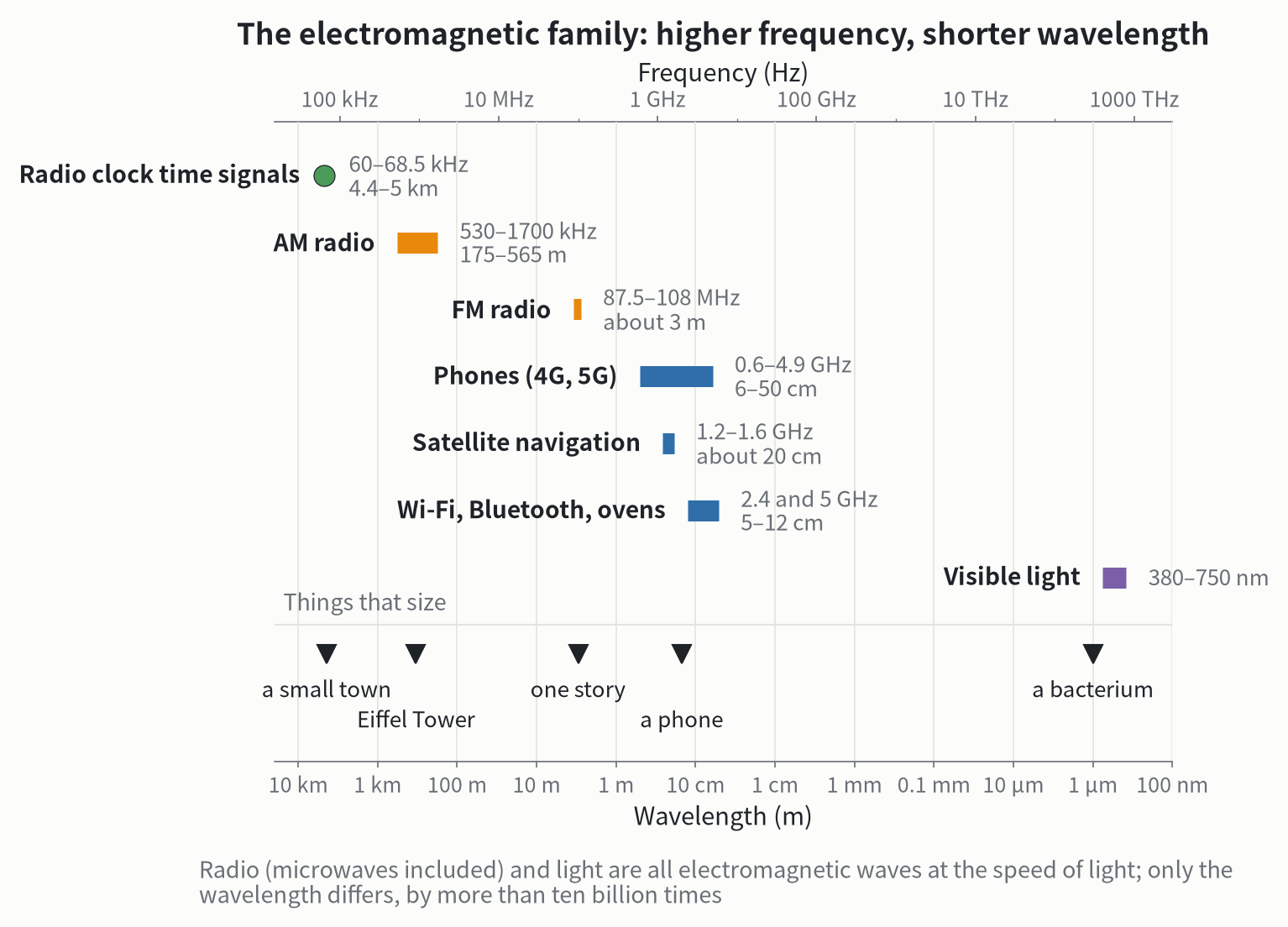
An antenna works best when its length is comparable to the wavelength, commonly half or a quarter of it. It’s the same idea as pushing a swing: the electrons in an antenna have a natural rhythm too, and at the right length they’re in step, so sending and receiving take the least effort. A car’s FM whip antenna is about 75 centimeters, a quarter of 3 meters. A phone’s wavelengths are short, so its antennas are just a few centimeters long and hidden inside: the thin plastic lines across a metal phone frame split it into segments that each serve as an antenna. AM radio waves are hundreds of meters long, which is why AM transmitting towers are a hundred meters or more tall; a radio can’t fit an antenna that long, so it uses a coil wound on a ferrite rod, which is less efficient, but the stations are strong enough.
So why not turn the sound straight into electromagnetic waves? Sound we can hear vibrates 20 to 20,000 times a second. At those frequencies an electromagnetic wave would be 15 kilometers to 15,000 kilometers long, far too long for any antenna; and every station would be crammed into the same frequencies, a hopeless jumble at the receiver.
Letting the sound ride on the wave
Instead, each station picks a higher frequency of its own, called the carrier, and lets the sound change it. The two most common ways:
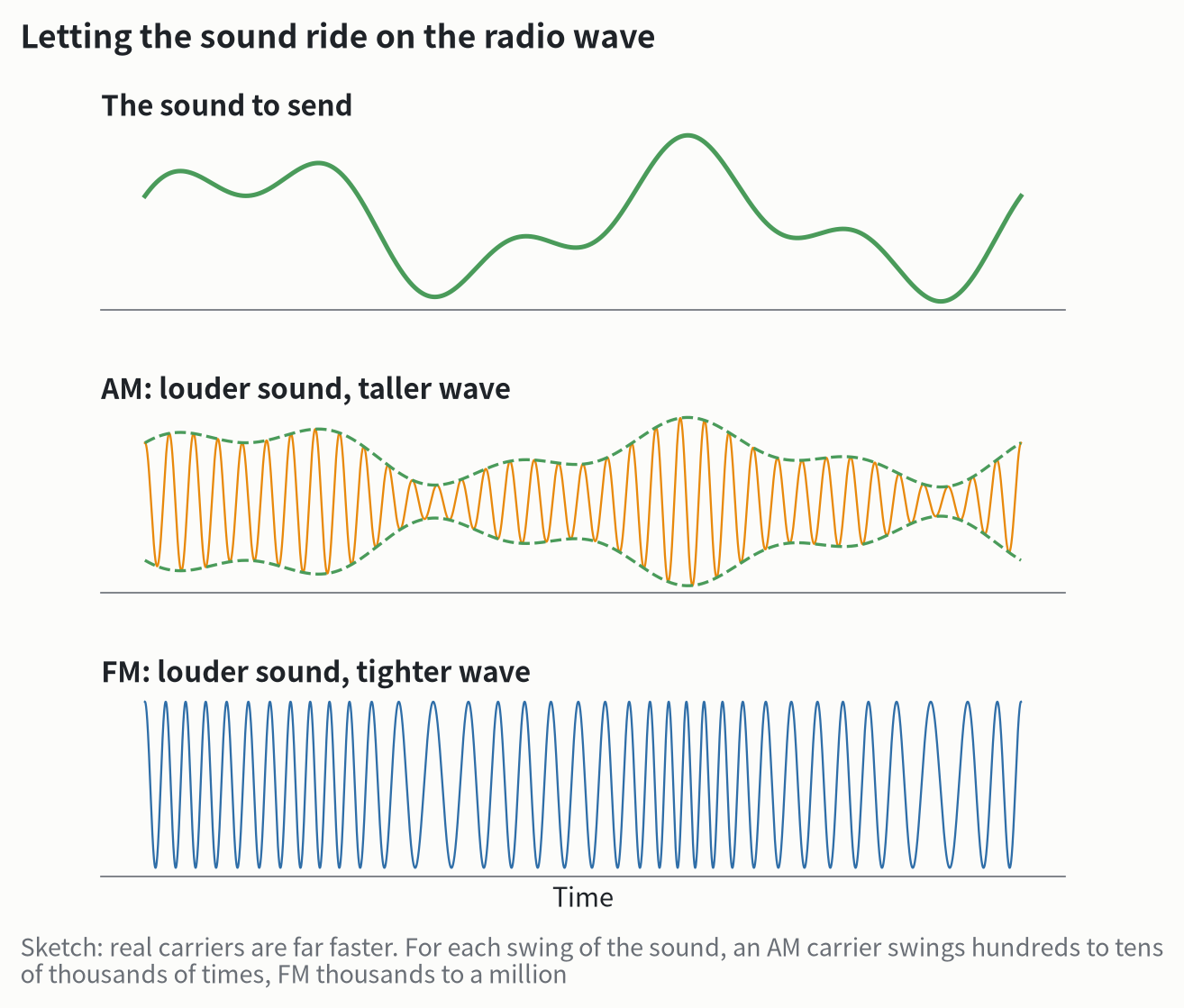
Amplitude modulation (AM): the louder the sound, the taller the wave. AM radio uses it. The radio just traces the wave’s outline, and that outline is the sound.
Frequency modulation (FM): the wave’s height stays the same; the louder the sound, the more tightly packed the waves (the higher the frequency). Interference from lightning or sparking appliances mostly changes the wave’s height, and an FM receiver ignores height and only cares about spacing, which is why FM sounds much cleaner than AM. Each FM station also gets a much wider slot (about 200 kHz, against 9 or 10 kHz for AM), so it can carry higher notes and stereo.
Receiving means undoing this step, which is called demodulation. AM is the simplest: a diode in the radio lets current through in only one direction, which cuts off the bottom half of the wave; a capacitor then smooths out the fast swings, and what’s left is the outline, the sound as an electric current, which drives the paper cone of the loudspeaker back and forth. Early crystal radios used a mineral crystal and a fine wire as the diode and needed no battery at all, running on the tiny bit of energy the station sent. FM needs a special circuit that turns the spacing of the waves into a rising and falling voltage, which then goes to the speaker.
Radio is also far faster than sound. Back when broadcasts were analog, a listener in the back row of a concert hall, 30 meters from the stage, heard the music 0.09 seconds late, while someone 1,000 kilometers away by the radio heard it after just over 0.003 seconds, before the people in the hall.
A sky full of stations: how to pick one
Around you right now are dozens of radio stations, several carriers’ phone signals, the neighbors’ Wi-Fi… All of them hit the antenna at once, and its electrons jiggle a little to each. How does a radio listen to only one?
Rhythm again. Why Are Atomic Clocks So Accurate? said: “A swing has its own rhythm; push in time with it, and every push lands just right and it goes higher and higher. Push a little off the beat, and sometimes you push with it and sometimes against it, and it never really gets going.” Inside the radio is a little circuit of a coil and a capacitor with a rhythm of its own, like a swing. Only the station whose frequency matches can push it higher and higher; the others are out of step and can’t get it going.
Turning the dial turns a variable capacitor. Change the capacitor and the swing’s rhythm changes, matching a different station.
One swing alone isn’t picky enough, though. AM stations are just 9 or 10 kHz apart, and the neighbor still pushes it to about 80%. In 1918 the American Edwin Armstrong invented the superheterodyne: first shift whichever station you’ve chosen to one fixed frequency (455 kHz in American AM radios, 465 kHz in Chinese ones), then sift it through several carefully tuned stages, which cleanly removes the station next door. Radios and phones still work this way today; in a phone, most of the “swings” have become calculations on a chip.
At night, the radio reaches farther
If you’ve used an AM radio, you may have noticed: in the daytime you get only a few local stations, but at night stations hundreds or even a thousand kilometers away pop up one after another.
That’s a “mirror” in the sky at work. How Does Your Phone Know Where You Are? said: “Tens to hundreds of kilometers up, sunlight splits air into charged particles.” That’s the ionosphere. In the daytime its lowest layer, about 60 to 90 kilometers up, absorbs AM waves; once the sun sets that layer quickly disappears, so AM waves can rise to a hundred or two hundred kilometers, bounce back to the ground and land far away. Shortwave can bounce between the ground and the ionosphere several times, halfway around the world.
FM and phone frequencies are much higher and pass straight through the ionosphere into space, so you only receive them within sight of the transmitter: an FM tower covers a few tens of kilometers, and in a city there has to be a cell site every few hundred meters.
How a phone sends data: each beat carries a few 0s and 1s
What a phone sends isn’t sound but data: long strings of 0s and 1s. Its trick is to give the wave many possible “shapes”: at each beat the wave can be a bit stronger or weaker, and can start a bit earlier or later. Draw each shape as an arrow from the center: the longer the arrow, the stronger the wave; the angle the arrow has turned counterclockwise says how much later than the reference wave this stretch of wave starts. One swing of the wave is like one full 360° turn of the arrow, so a turn of 90° means starting a quarter of a swing late. The tip of the arrow is a dot, and each dot stands for one shape. With 64 shapes, each beat carries six 0s or 1s (2 to the 6th is 64).
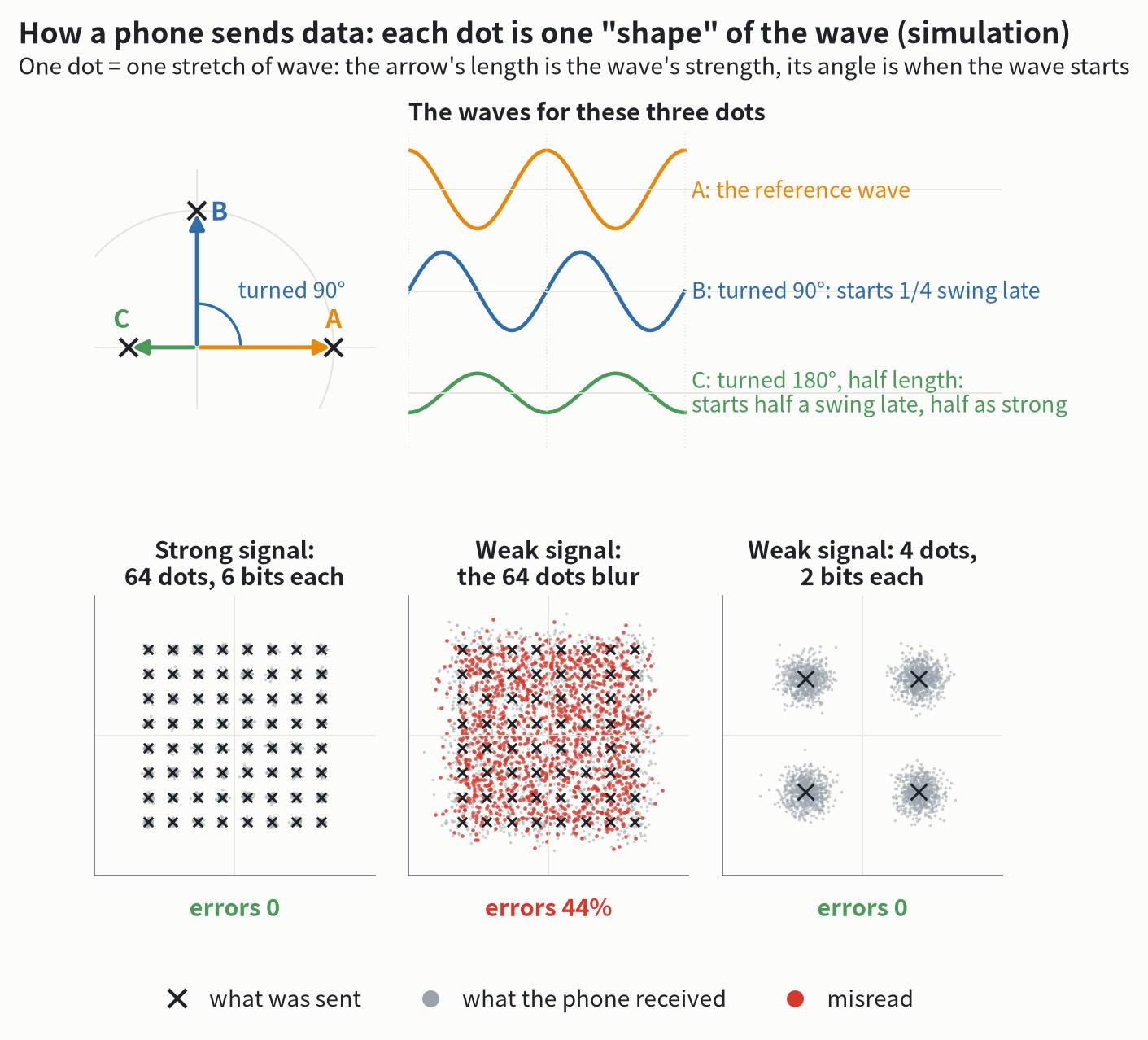
With a strong signal, the phone and the tower use 64 or even 256 shapes, 6 or 8 bits per beat; when the signal weakens and noise blurs the dots together, they fall back to 4 shapes, 2 bits per beat, slower but error-free. The choice is adjusted constantly, as often as every fraction of a millisecond. 5G also sends on thousands of closely spaced frequencies at once, each with 28,000 beats a second, and with several antennas sending and receiving together, a phone can get hundreds of millions of 0s and 1s a second.
This is also why full bars don’t guarantee fast internet: the bars only reflect signal strength. A cell site can send only so much in total, and at a concert or a stadium, with tens of thousands of people using it, each gets a smaller share. With so many phones crowded together, how does a phone know which data is its own? The tower assigns each phone its own “cells” in frequency and time, and the phone reads only those.
How weak can a signal get?
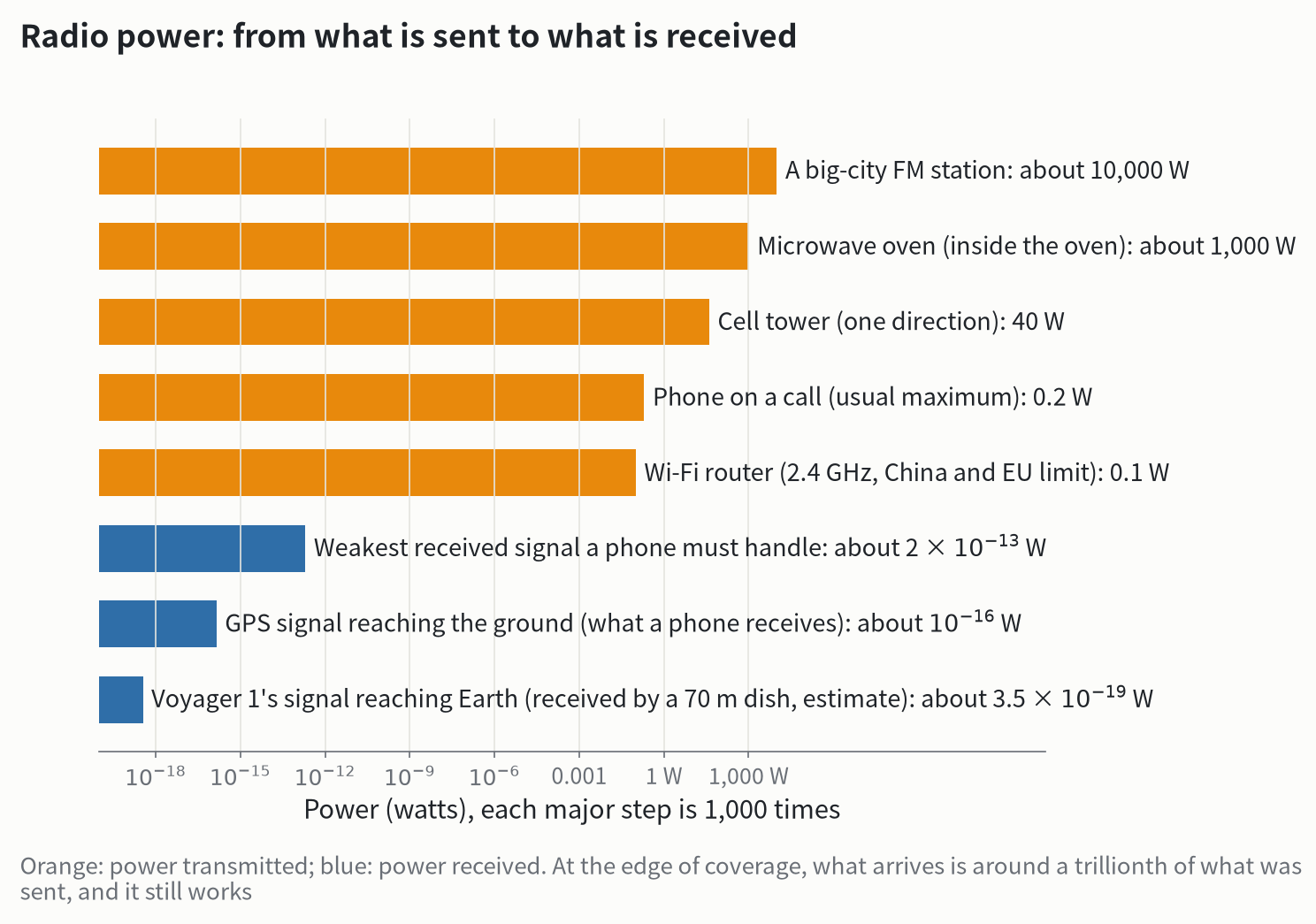
On a call, a phone usually sends at most 0.2 watts, less than the bulb in a small flashlight. And the international standards require a phone to keep working even when the signal it receives is as weak as about 2 × 10⁻¹³ watts, a trillionth of 0.2 watts.
A signal fades with distance: twice as far, and the same antenna picks up only a quarter as much. An elevator is a metal box that radio waves can barely get into; basements and underground garages sit behind thick earth and reinforced concrete, which is just as hard to get through. That’s why many subways and underground malls have small antennas installed specially. The higher the frequency, the worse it gets through walls, one reason 5G needs more cell sites.
It gets fainter still. Voyager 1, launched in 1977, will be exactly one light-day from Earth on November 18, 2026, by NASA’s calculation: its signals take a full day to reach us. Its transmitter puts out only about 22 watts. After a full day’s journey the signal is unimaginably faint: the 70-meter dishes that listen for it on Earth receive a signal of only about 3.5 × 10⁻¹⁹ watts (an estimate), and can still read 160 0s and 1s a second out of it.
Phone radiation: what’s true
Light and radio deliver energy in packets, each called a photon. Whether light can break a chemical bond in a molecule directly depends on whether a single photon carries enough energy, not on how many photons there are: photons with too little energy, however many arrive, only warm things up (only extremely intense lasers can make several photons act together). A photon of visible light carries about 2 electron volts; breaking chemical bonds or damaging DNA generally takes several electron volts or more, which is why ultraviolet light gives you sunburn and X-rays are worse still. A photon of a phone signal carries only about three millionths to two hundred-thousandths of an electron volt, a hundred-thousandth to a millionth of visible light’s, too little to break a chemical bond.
The one established effect of phone signals is to warm the body very slightly, the same way a microwave oven heats food. The body is mostly water, and a water molecule is slightly positive at one end and slightly negative at the other; the wave’s electric field flips back and forth hundreds of millions to billions of times a second, twisting the water molecules back and forth with it and pushing the charged ions in body fluids to and fro, and as they jostle the molecules around them, the wave’s energy turns into heat. A microwave oven, though, shuts about 1,000 watts in a metal box, while a phone usually sends at most 0.2 watts, spreading out in all directions. China’s national standard and the international guidelines limit the heating a phone causes in the head and torso to 2 watts per kilogram, averaged over any 10 grams of tissue (the US limit is 1.6 watts per kilogram, averaged over 1 gram). For comparison, your body at rest produces a little over 1 watt per kilogram of heat on its own.
In 2011 the International Agency for Research on Cancer, part of the World Health Organization, classified radiofrequency electromagnetic fields (“radiofrequency” meaning the frequencies used for radio, here 30 kHz to 300 GHz) as “possibly carcinogenic” (Group 2B). That category means “limited evidence, can’t be ruled out”; it also includes whole-leaf aloe vera extract and traditional Asian pickled vegetables. In 2024 a systematic review commissioned by the WHO pooled decades of studies and found no link between mobile phone use and brain cancer; some scientists have criticized the review, and research continues.
In a sentence: electrons running back and forth in an antenna fling the electric field off loop by loop as an electromagnetic wave traveling at the speed of light; sound and data ride on it by changing its height, its spacing and its timing; radios and phones pick out their own signal from a sky full of them by being in step with it. A signal a trillionth as strong as when it was sent still works.
How do we know?
- See how strong your signal is. The bars are only a rough icon; the actual strength is given in dBm, which compares the power with 1 milliwatt: 0 dBm is 1 milliwatt, each 10 less is ten times weaker, and −100 dBm is 10−13 watts. On most Android phones you’ll find it under Settings → About phone → Status (or SIM status) → Signal strength, as something like “−95 dBm”; menu names differ a little between brands. What it shows is the strength of a “reference signal” in 4G and 5G, somewhat less than the total power the phone receives: around −80 is very good, below −110 is weak. An iPhone doesn’t show it in Settings; open the Phone app’s keypad, type *3001#12345#* (there’s a star at the end too) and press the green call button to enter Field Test mode, then look for RSRP (the layout varies with the iOS version).
- Build a shield. Wrap your phone snugly in several layers of aluminum foil and call it from another phone; it will often come back as unreachable. If the wrapping leaves a gap of a few centimeters, the waves leak through: once a gap is about the size of the wavelength, it no longer blocks them.
- Listen to the radio at night. With a radio that gets AM, sweep the dial once in the daytime and once at night, and count the stations each time.
- Measure a car antenna. Most FM whip antennas are about 75 centimeters, a quarter of an FM wavelength.
What we still don’t know
Usable frequencies are getting crowded. The next generation, 6G, plans to use frequencies above 100 GHz, approaching terahertz (THz; 1 THz is 1,000 GHz), where there’s plenty of free spectrum and room for far more data; but the wavelength is just a few millimeters or less, and a hand or a wall blocks most of it, and how to make it work well in daily life is still being researched.
At the same time, we already use each slice of spectrum close to the theoretical limit. In 1948 the American mathematician Claude Shannon worked out the most data a channel can carry at a given signal strength and noise; the error-correcting codes in 5G already come close to that limit. To send more, we’ll need more spectrum, more antennas and denser cell sites.
And there’s a question people have long been trying to answer: is any other civilization out there using radio too? Astronomers have listened with radio telescopes for decades and have not yet received a single confirmed signal. The “Wow! signal” recorded by an American radio telescope in 1977 appeared only once, and remains unexplained.
Going deeper: antenna fields, modulation, tuning and data
Maxwell’s equations and the speed of light. In a vacuum the electric and magnetic fields obey the wave equation with speed m/s. Maxwell’s 1865 paper “A Dynamical Theory of the Electromagnetic Field”. Frequency and wavelength: .
Figure 1: an oscillating electric dipole. Dipole moment (an antenna much shorter than the wavelength, a Hertzian dipole). The exact solution, near field included: , (real part). The field lines are contours of ; the script checks at random points that is everywhere perpendicular to . Far away only the term remains, and the radiated intensity goes as : zero along the antenna, strongest at right angles to it.
Antenna length. Common designs are the half-wave dipole () and the quarter-wave monopole (, the other half supplied as a mirror image by the ground or a metal case). At 100 MHz m; at 2 GHz, 3.7 cm.
AM and FM. AM: , with the sound and the modulation depth; the bandwidth is twice the highest audio frequency. China’s AM band is 531–1602 kHz with 9 kHz spacing (the Americas use 530–1700 kHz with 10 kHz), audio up to about 4.5 kHz. FM: ; FM broadcasting uses a peak deviation of ±75 kHz and audio up to 15 kHz, so by Carson’s rule the bandwidth is about kHz, with 200 kHz channel spacing. FM band 87.5–108 MHz (87–108 MHz in China).
Figure 4: tuning. Coil µH, variable capacitor 43–391 pF, resonance , covering 531–1602 kHz. With quality factor , a station at frequency is heard in proportion to ; near 1 MHz the bandwidth is 25 kHz and a station 9 kHz away still comes through at 0.81, hence the superheterodyne (intermediate frequency 455 or 465 kHz; 10.7 MHz in FM radios). The six stations’ frequencies and strengths in the figure are made up.
The ionosphere. The ionosphere reflects waves below the plasma frequency Hz ( electrons per cubic meter); in the F layer , so is about 9 MHz, and at a slant it reflects somewhat higher frequencies. In the daytime, electrons in the D layer (about 60–90 km) collide often with air molecules and absorb AM waves; at night the D layer quickly recombines and disappears. FM and phone frequencies are far above and pass straight through.
Figure 5: quadrature amplitude modulation. With shapes, each symbol carries bits: 4 (QPSK) carry 2, 64 carry 6, 256 carry 8. Simulation: 3,000 symbols per case, average symbol energy normalized, complex Gaussian noise added, each decided as the nearest point; at a signal-to-noise ratio of 28 dB, 64 shapes make no errors; at 14 dB, 64 shapes misread 44% and 4 shapes none. Shannon’s limit : about 4.7 bits per hertz at 14 dB, 9.3 at 28 dB. 5G (band n78) uses 30 kHz subcarrier spacing, 3,276 subcarriers in 100 MHz, each with 14 symbols every 0.5 ms, i.e. 28,000 per second; with 256 shapes, one layer carries about bits per second (before overhead), and multiple antennas can send several layers at once. 256 shapes on the downlink are standard in 5G; newer releases support 1,024.
Figure 6: power. dBm is power relative to 1 milliwatt: . A phone (power class 3) transmits at most 23 dBm, 0.2 W (some 5G bands allow 26 dBm, 0.4 W). 3GPP TS 36.101 Table 7.3.1-1: reference sensitivity for band 1 with 10 MHz bandwidth is −97 dBm, about W, the total power at the phone’s antenna. What phone settings display is usually RSRP (reference signal received power), the power of the reference signal on a single subcarrier; a 10 MHz channel has 600 subcarriers, so the total is about dB higher. GPS L1 C/A minimum received power at the ground is −128.5 dBm (IS-GPS-200), about W. Wi-Fi at 2.4 GHz is limited to 100 mW EIRP in China (the same in Europe; the US allows more). The 40 W cell site, 10,000 W FM station and 1,000 W microwave oven are typical values; real ones vary widely. Voyager 1: transmitter 22.4 W at 8420 MHz, 3.66 m high-gain antenna (efficiency taken as 0.55, gain 47.6 dBi), distance one light-day ( m), 70 m receiving dish (efficiency taken as 0.6): W, about −155 dBm. The date of one light-day is NASA’s: November 18, 2026.
Photon energy. : eV at 1 GHz, eV at 5 GHz; green light (540 THz) 2.2 eV. Specific absorption rate limits: China’s GB 21288-2022 and ICNIRP both set 2 W/kg averaged over any 10 g for the head and torso (4 W/kg for limbs); the US sets 1.6 W/kg averaged over any 1 g. An adult’s resting metabolism is about 80 W, about 1.1 W/kg at 70 kg. IARC classification: IARC Monographs volume 102 (2013; meeting in 2011). Systematic review: Karipidis et al., Environment International 191, 108983 (2024).
History. Hertz’s experiments in Karlsruhe, 1886–1888; Marconi, December 12, 1901, from Poldhu in Cornwall, England, to Signal Hill in Newfoundland (now part of Canada), receiving the Morse letter S. Armstrong invented the superheterodyne in 1918 and patented wideband FM in 1933. Shannon, “A Mathematical Theory of Communication” (1948). The “Wow! signal”: August 15, 1977, Ohio State University’s Big Ear radio telescope.