Why Are Atomic Clocks So Accurate?
Our last article, How Does Your Phone Know Where You Are?, said that on GPS satellites “each satellite carries three atomic clocks (rubidium, and on some a cesium clock), one in use and the others as spares.” Your phone finds its place by listening to them tell the time, and a microsecond of clock error means 300 meters of distance error, so these clocks have to be astonishingly good. What kind of clock is an atomic clock, and why is it so accurate?
Take a guess
Two things are often said: “Atomic clocks contain something radioactive and keep time by atoms decaying,” and “An atomic clock is the most accurate clock in the world, so whatever it says is the time.”
Neither is right. There’s nothing radioactive in an atomic clock: the usual atom, cesium-133, is stable and never decays (the radioactive one you hear about in the news is cesium-137, a different kind). Atomic clocks make errors too, and are constantly corrected for tiny effects; and the world’s standard time isn’t set by any one clock, but worked out from hundreds of them together.
A clock is something that counts
Every clock has something inside that swings back and forth regularly, plus something that counts the swings.
A pendulum clock’s pendulum swings once a second. Each swing, a little catch called the escapement lets the gears move on one small step, and the gears turn the hands: the gears are its counter.
A quartz watch has a tiny tuning-fork-shaped piece of quartz, just a few millimeters long, sealed in a metal can the size of a grain of rice. Quartz is crystalline silicon dioxide, the same stuff as rock crystal and sand; watches use quartz grown in factories. It has a special talent called the piezoelectric effect: squeeze it and a voltage appears across it; apply a voltage and it bends. So a circuit can keep “pushing” it to vibrate and also read off every vibration. The quartz vibrates 32,768 times a second, which is 2 to the 15th. The circuit has a chain of “divide-by-two” stages, each passing on one tick for every two it receives: the first turns 32,768 ticks into 16,384, the next into 8,192… after 15 stages exactly one tick a second is left, and it moves the second hand.
What actually gets counted in an atomic clock is also a quartz oscillator (labs often use a hydrogen maser instead). Electronics multiply its frequency precisely up to a microwave oscillating 9,192,631,770 times a second, and hand it to the atoms to check: is it right? The atoms check; the quartz keeps going and gets counted.
A clock is only as good as its “swing” is steady.
Why pendulum and quartz clocks drift
How fast a pendulum swings depends on how long it is. When it’s warm, a steel rod expands a little and the pendulum swings a little slower: for every degree warmer, it loses about half a second a day. That’s why fine pendulum clocks use rods of invar, an alloy that barely expands.
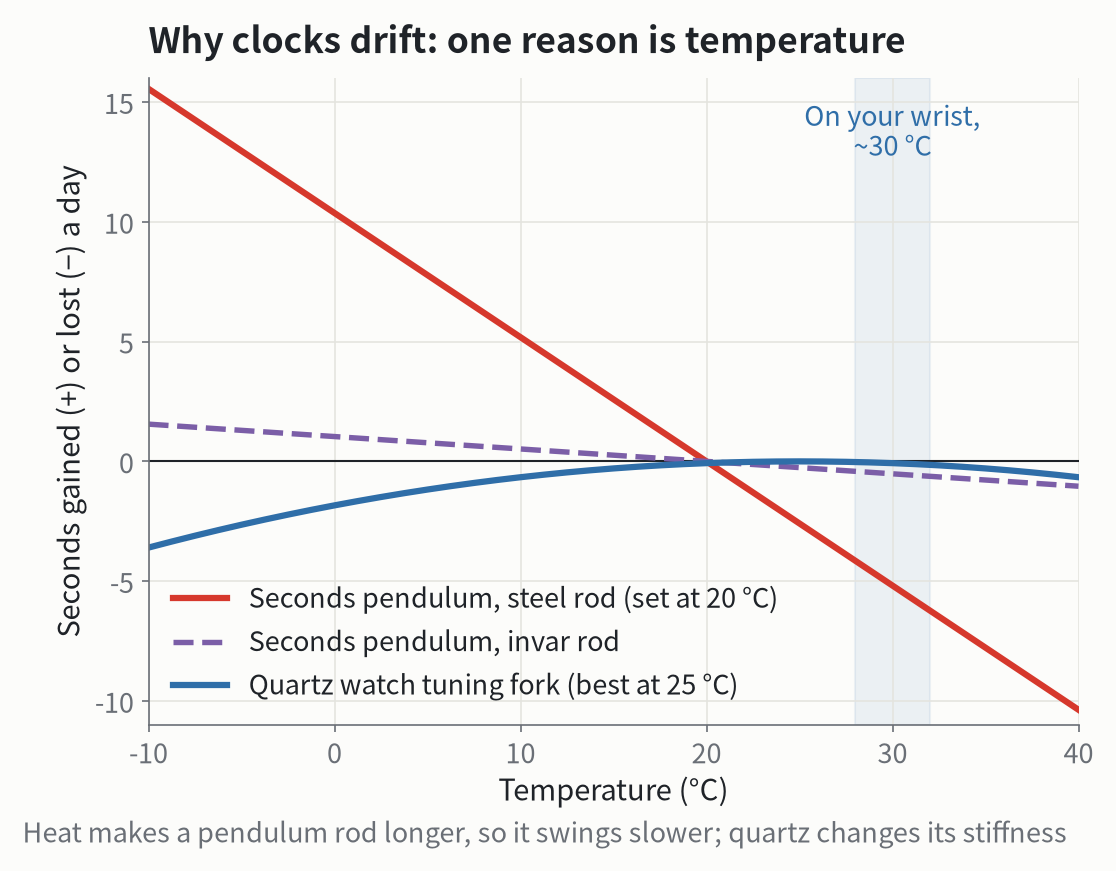
Quartz, too, vibrates at a speed that changes with temperature. Luckily a watch on your wrist stays around 30 degrees, not far from its best 25: an ordinary quartz watch is off by a dozen or so seconds a month.
Besides heat, pendulums hate being jolted, and quartz slowly “ages”; even Earth’s spin isn’t all that regular. What we’d like is a “swing” where every one is identical, unaffected by heat or cold, and never wears out. Nature has one ready: the atom.
Pushing a swing: an atom answers only one rhythm
Atoms of one kind, say cesium-133, are all exactly alike; none is “better made” than another. In the same surroundings they all flip at exactly the same frequency, in Beijing or in Chicago. Whether that will still be true ten thousand years from now is something physicists keep testing, and so far no change has been found.
A cesium atom has a single outer electron, and both it and the nucleus act like tiny compass needles. Whether the two needles point the same way or opposite ways changes the atom’s energy by a tiny amount. Shine microwaves on the atom and it can “flip” from one arrangement to the other. But it’s very picky: only microwaves at exactly 9,192,631,770 oscillations a second will flip it.
It’s like pushing a swing. A swing has its own rhythm; push in time with it, and every push lands just right and it goes higher and higher. Push a little off the beat, and sometimes you push with it and sometimes against it, and it never really gets going.
In 1967, the General Conference on Weights and Measures redefined the second with this number: 9,192,631,770 oscillations of the microwave that flips a cesium-133 atom make one second. Since then, the second has been set not by Earth turning but by atoms.
Cooling atoms: braking with light
If every atom is identical, why cool them? Not to change the atoms, but to slow them down. The longer an atom spends with the microwaves, the more carefully it “checks” them (we’ll see why below). At room temperature cesium atoms move at over 200 meters a second and are through in a flash. The first cesium clock, in 1955, used just such a beam of speeding atoms.
How do you slow atoms down? With lasers. Light comes in photons, and each photon an atom absorbs gives it a push. The push is tiny: one photon changes a cesium atom’s speed by only about 3.5 millimeters a second. But an atom can absorb tens of millions of photons a second, and it adds up. After absorbing, the atom sends the photon off in a random direction, and these recoils average out to nothing.
The trick is to tune the laser slightly redder (lower in frequency) than the color the atom “likes” best (for cesium, 852-nanometer near-infrared light, invisible to the eye). An atom running toward the laser sees the light a little “bluer” because of the Doppler effect, just right, so it absorbs eagerly and gets pushed back again and again; running away, the light is even further off, and it hardly absorbs at all. Shine lasers from six directions, up, down, left, right, front and back, and whichever way an atom runs it hits a brake head-on, like running through honey. In the blink of an eye the atoms go from tens of meters a second to less than a centimeter a second, only about a millionth of a degree above absolute zero. Steven Chu, Claude Cohen-Tannoudji and William Phillips shared the 1997 Nobel Prize in Physics for developing ways to cool and trap atoms with laser light.
The atomic fountain: one toss, step by step
Today’s best cesium clocks are “atomic fountains.” One toss has five steps:
1. Cool and toss. The six laser beams cool a cloud of cesium atoms, and the atoms are all put into the same state (the “unflipped” one). The toss is done with lasers too: make the beams shining upward slightly higher in frequency than the ones shining downward (a few megahertz apart), and the place where the atoms “stand still” in the light is no longer at rest but moving upward at about 4.4 meters a second. Up go the atoms. Then the lasers switch off, and the atoms fly like a thrown ball: up, slowing, and back down from the top.
2. First pass through the microwave cavity. On the way up, the atoms pass through a microwave cavity and get a push from the microwaves, to a “half-flipped” state.
3. Free flight. The atoms rise to the top and fall back, about 0.75 seconds later.
4. Second pass through the cavity. On the way down they pass through the same cavity and get a second push.
5. Lasers count them. The atoms fall back through a laser beam at the bottom. This beam is in step only with “flipped” atoms: they keep absorbing and re-emitting light and glow, while unflipped atoms don’t absorb and stay dark. A light detector measures how bright, which tells how many flipped. Another laser then lights up the unflipped ones too, to measure the total. Divide one by the other, and you have the fraction that flipped.
Why toss only about a meter? Because the time grows slowly with height: to double the time between the two passes, you have to toss four times as high. Toss too high and the cloud spreads out on the way, leaving fewer atoms to count when it returns; and the whole flight tube must be shielded from Earth’s magnetic field and kept at an even temperature. About a meter is a good compromise. Without gravity, in space, atoms can drift slowly through: China’s Tiangong-2 space lab, launched in 2016, carried a clock using cold rubidium atoms that ran in orbit for more than a year.
Why pass through twice: compare two “clock hands”
The secret is step 2. After the first push to “half-flipped” (in quantum mechanics, a “superposition”), the atom is like a tiny clock that starts ticking at its own pace: 9,192,631,770 ticks a second, not one more or less. The microwave keeps ticking at its own pace too. Think of two clock hands: at the first pass, they’re lined up.
For the next 0.75 seconds the atom flies, and the two hands run on their own. At the second pass the microwave gives another push, and the result depends on whether the hands are still lined up:
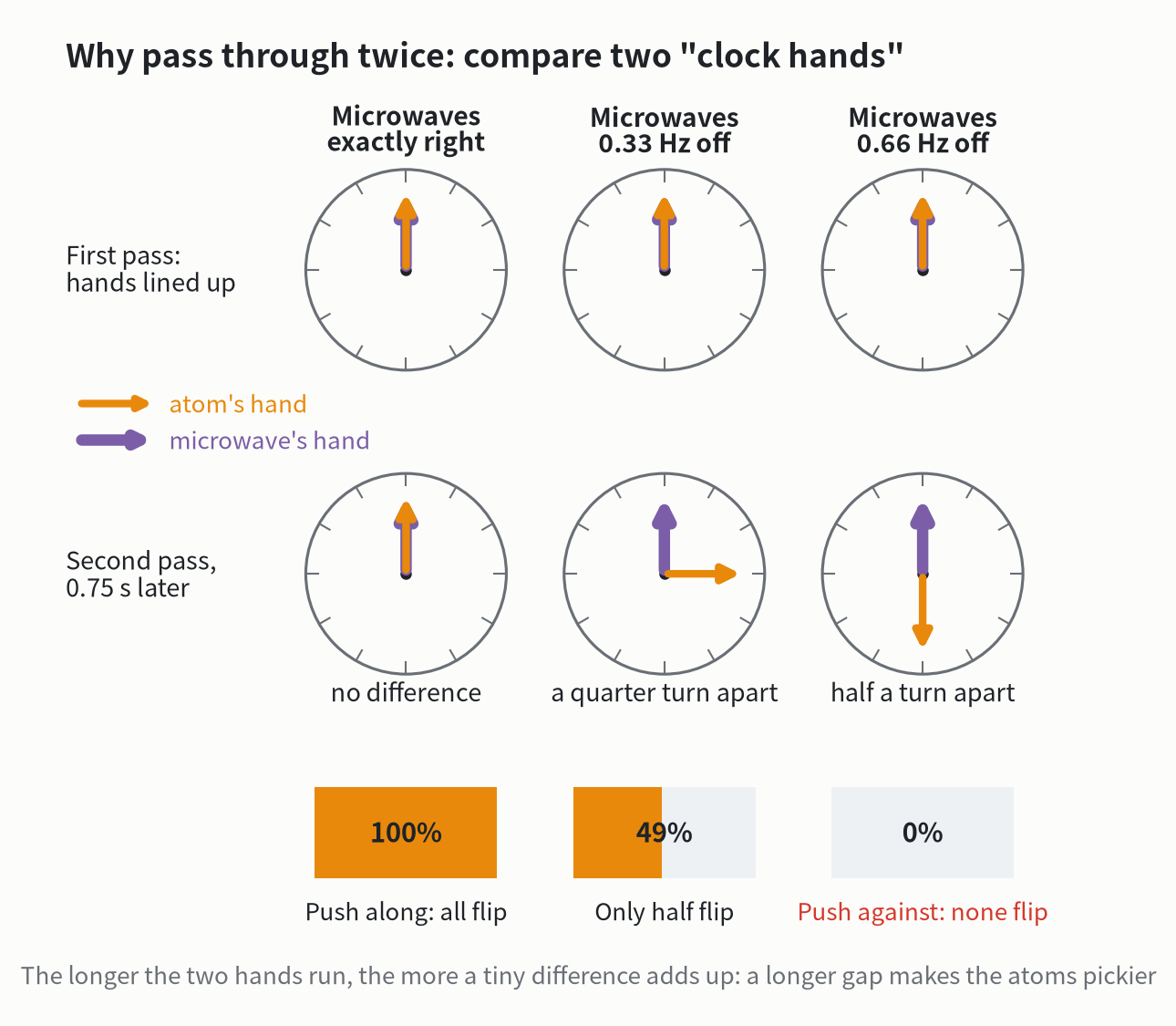
That’s why the longer the gap between the two passes, the pickier the atoms are about frequency. It’s like two people walking side by side: after two steps you can’t tell who’s faster, but after a kilometer even a tiny difference shows. With 0.75 seconds between passes, microwaves just 0.66 Hz off end up exactly half a turn apart, and 0.66 Hz is less than one ten-billionth of 9,192,631,770 Hz. That is also why the atoms have to be cold: the slower they are, the longer the gap.
This method of pushing twice, separated in time, was invented by the American physicist Norman Ramsey in 1949. He won the 1989 Nobel Prize in Physics for it and for its use in the hydrogen maser and other atomic clocks. He shared the prize with Hans Dehmelt and Wolfgang Paul, who developed ways to trap single ions, which today’s most accurate ion clocks rely on.
How an atomic clock checks itself: compare left and right
Now “checking the time” is easy to follow. It isn’t averaging many results; it’s comparing left and right:
Set the microwave a little below what the quartz thinks is the center (0.33 Hz low, exactly halfway up the hill) and toss once; then set it a little above and toss again. If the quartz is exactly right, both tosses flip half the atoms, the same amount. If the quartz is running high, both points shift right: the left one moves nearer the top and flips more, the right one slides to the foot and flips fewer. Whichever side flips more tells you which way the atoms’ real center (exactly 9,192,631,770 Hz) lies; how much more tells you how far off you are. Steer the quartz back right away. Then toss, compare and steer again, over and over.
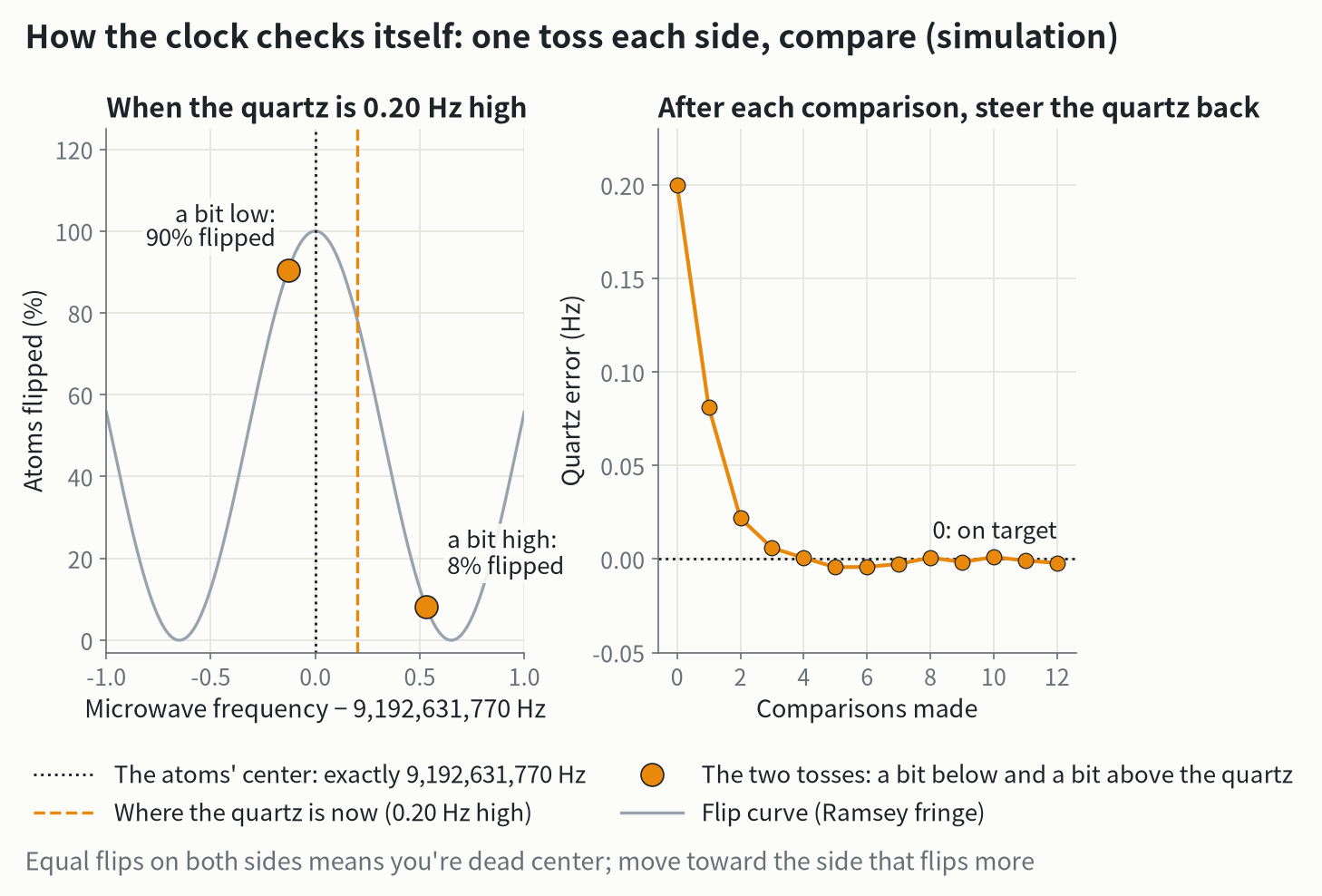
So what runs continuously in an atomic clock, and gets counted, is the quartz or a hydrogen maser; the fountain tosses atoms every second or two to check it. Each check carries a little random error (the number of atoms counted varies), and the longer you keep checking, the more those errors average out: an hour gets you to about 2 × 10⁻¹⁵; a day, about 3 × 10⁻¹⁶; only after a dozen or so days of running do you reach about 10−16, one part in ten million billion.
Another kind of error doesn’t average away however long you measure, and has to be worked out and subtracted item by item: room-temperature heat radiation shifts cesium’s frequency slightly, for example, and the lab’s altitude makes the clock run fast (more on that below). How accurate a fountain really is comes down to how well those corrections are known. So pinning the second down to one part in ten million billion with a fountain takes a dozen days to a month of running, and fountains around the world report their results to the BIPM over periods like that.
From a second in 300 years to not even a second in the age of the universe
In the chart below, the number at each point is “at this clock’s accuracy, how long until it’s off by 1 second.” Huygens’s 1656 pendulum clock was off by about 15 seconds a day, so 1 second every 1.6 hours or so; Harrison’s 1761 marine chronometer, 1 second in about 16 days; the quartz watch on your wrist, 1 second in about 2 days.
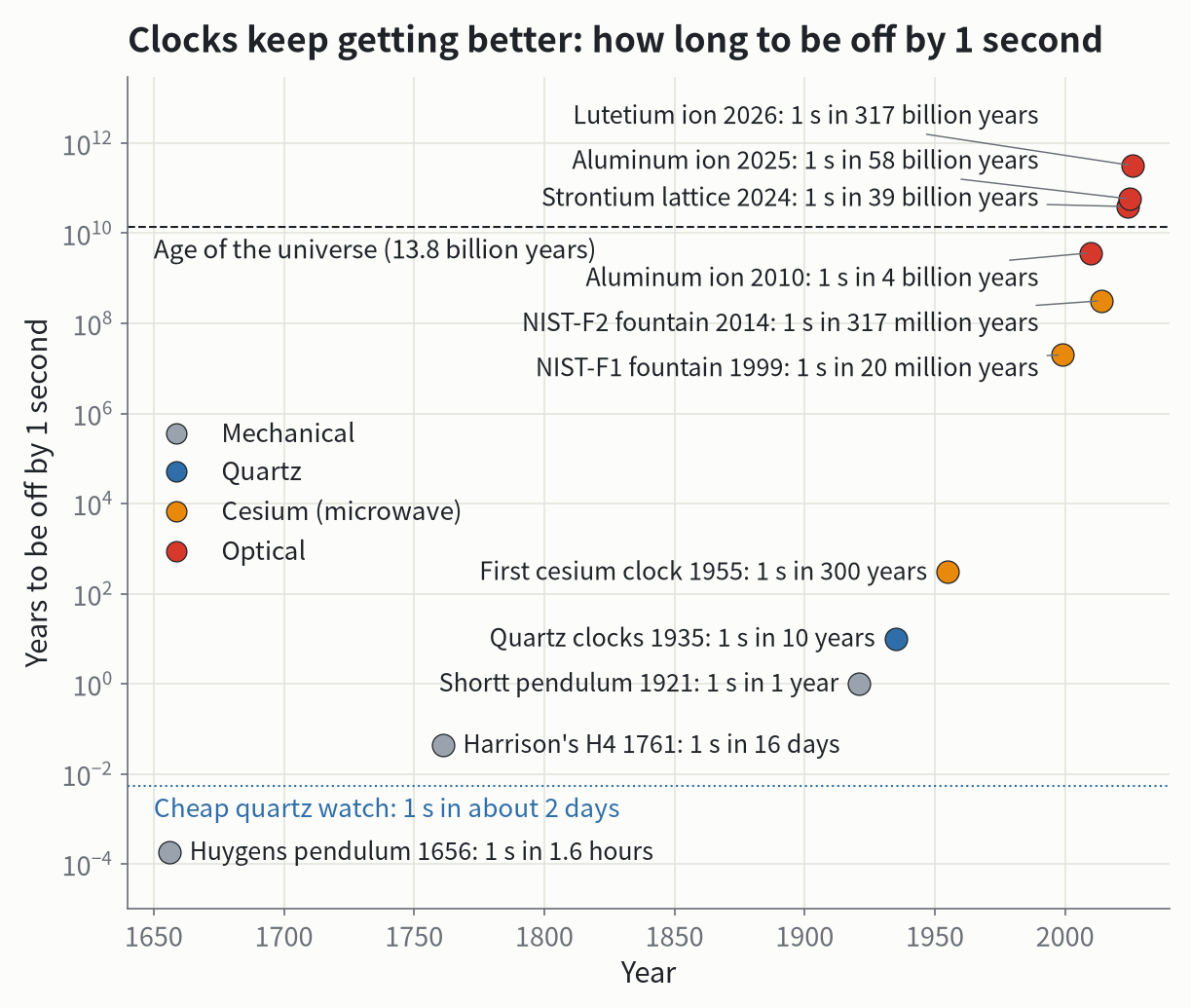
In 1955, Louis Essen and Jack Parry at Britain’s National Physical Laboratory built the first practical cesium clock: off by one second in 300 years, about 30 times better than the quartz clocks of the 1930s. Today’s cesium fountains take hundreds of millions of years to be off by a second.
Better still are optical clocks. Atoms have other “flips” too, answering not to microwaves but to light, tens of thousands of times higher in frequency: one in strontium oscillates about 429 trillion times a second. The finer the ticks within a second, the more precisely you can measure. But light oscillates far too fast for any circuit to count; only around 2000 did the “optical frequency comb,” a ruler made of light, arrive (Nobel Prize in Physics, 2005) and let us count the oscillations of light.
In the last few years the record has kept falling: in 2024, a strontium clock at JILA in Colorado reached 8.1 × 10⁻¹⁹; in 2025, an aluminum ion clock at the U.S. National Institute of Standards and Technology (NIST) reached 5.5 × 10⁻¹⁹; in September 2026, a lutetium ion clock at Singapore’s Centre for Quantum Technologies reported about 1 × 10⁻¹⁹, the lowest yet. At that accuracy it would take more than 300 billion years to be off by a second, over 20 times the age of the universe.
Clocks also come in very different sizes: the best optical clocks fill a whole lab; an atomic fountain with its lasers takes up a room; a commercial cesium clock is about the size of a suitcase and weighs a few tens of kilograms; the smallest “chip-scale atomic clocks” are the size of a matchbox.
The world’s time is worked out by hundreds of clocks together
So which clock is in charge? None of them. Around 80 laboratories worldwide, with about 450 atomic clocks between them, report their readings to the International Bureau of Weights and Measures (BIPM) near Paris. There they are averaged with weights and then calibrated against about 20 of the most accurate cesium fountains and optical clocks, to give International Atomic Time.
International Atomic Time plus leap seconds is Coordinated Universal Time, the time used around the world. Does Earth Really Take 24 Hours to Turn Once? said: “Atomic clocks tick off exactly 86,400 seconds every day, and since 1972 Earth has fallen 27 seconds behind them.” In the U.S., official time is kept by atomic clocks at NIST and the U.S. Naval Observatory.
The time on your phone mostly comes from time servers on the cell network and the internet; those servers in turn get their time from satellites such as GPS, or directly from national laboratories. Trace it back step by step, and it always ends at atomic clocks.
Raise a clock a little, and it runs a little faster
Can Time Really Slow Down? showed that the faster you go, the slower time runs. Atomic clocks are now good enough to see another prediction of Einstein’s general relativity: the higher up, the weaker gravity, and the faster time runs. Einstein worked this out as early as 1907. In 1959, Robert Pound and Glen Rebka at Harvard first measured the effect on the ground, in a tower a little over 20 meters tall.
Atomic clocks have brought it down to everyday scales. In 2010, NIST raised one aluminum ion clock by 33 centimeters and compared it with another next door, and it really did run faster, by the amount general relativity predicts. In 2018, Japan’s RIKEN put two transportable optical clocks at the foot of Tokyo Skytree and on its observatory 450 meters up, and found the upper clock gaining about 4 nanoseconds a day (a nanosecond is a billionth of a second). In 2022, JILA measured, within a single cloud of atoms just 1 millimeter tall, that the top ran faster than the bottom by about 10−19.
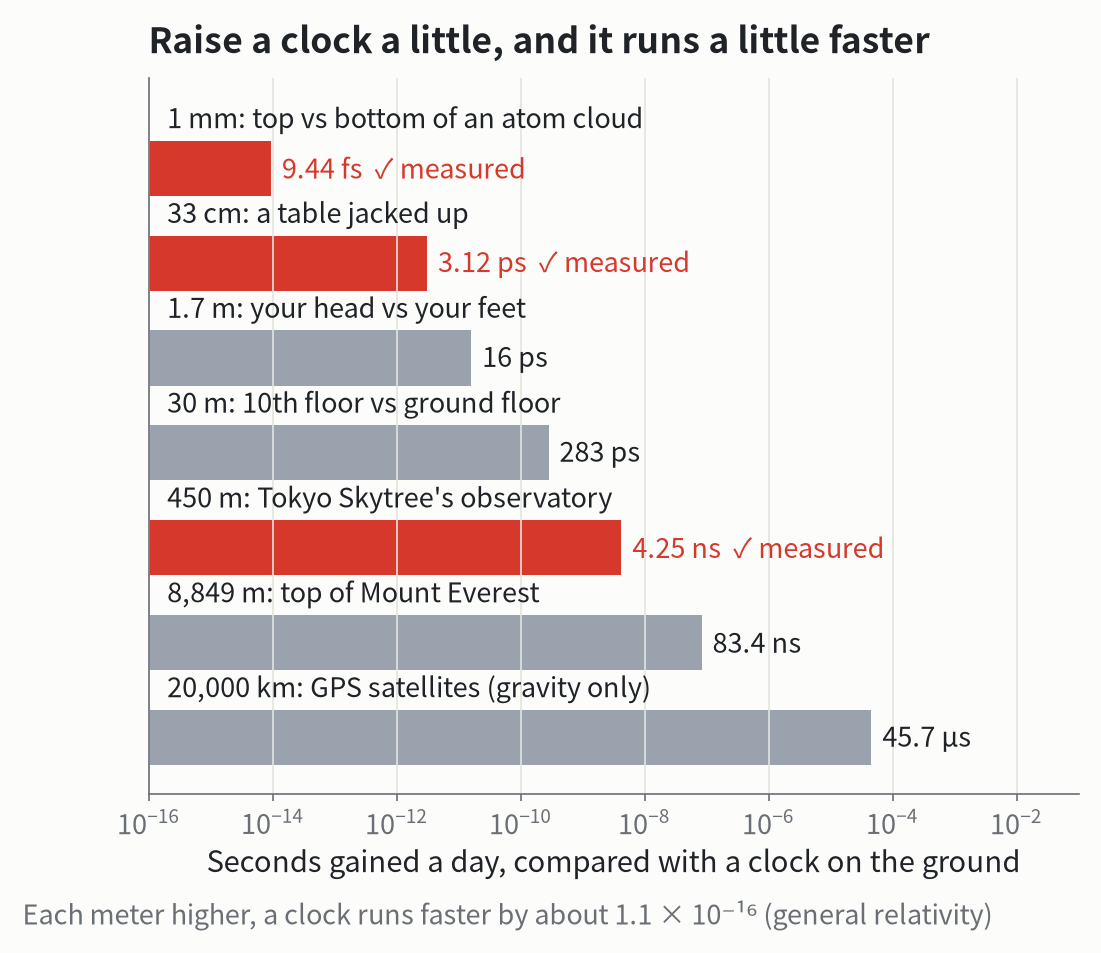
By the same reckoning, your head is 1.7 meters above your feet; over 80 years, it would live about half a microsecond more than your feet. It works the other way too: compare two optical clocks and you can tell how much higher one is than the other, to within a few centimeters.
In one sentence: a clock counts swings; an atomic clock uses atoms to keep its quartz in line, because atoms of one kind are all identical, unaffected by heat or cold, and never wear out. Cool the atoms, toss them up, let them and the microwave run for 0.75 seconds before comparing, and toss once on each side to see which flips more, and you can pin the second down to one part in ten million billion; at that level, even raising a clock 33 centimeters shows relativity at work.
How do we know?
- Check your own time. Open time.gov (run by NIST) on your phone or computer; it shows how many seconds your device is ahead or behind.
- Clocks that set themselves. Some wall clocks and watches, “radio-controlled clocks,” pick up a time signal by radio each night: in the U.S., the 60 kHz signal WWVB from Colorado; in China, the 68.5 kHz signal BPC from Shangqiu, Henan.
- A monthly report card. Every month the BIPM publishes Circular T, listing how many nanoseconds each national laboratory’s time differs from Coordinated Universal Time. Anyone can download it.
What we still don’t know
Optical clocks are already more than a thousand times better than cesium, and sooner or later the second will be redefined with them. But which atom? Strontium, ytterbium, aluminum, lutetium… each has its strengths, and nothing is settled. The 2026 General Conference on Weights and Measures decided to keep preparing, aiming to put forward a new definition at its 2030 meeting.
Another hurdle is sending an optical clock’s time far away to compare it. On one continent you can lay dedicated fiber and send the signal both ways, canceling out changes along the path: in 2016, optical clocks in Paris and in Braunschweig, Germany, were compared this way over more than 1,400 kilometers. On land, the amplifiers along such a fiber are specially built to pass light both ways. Undersea cables have an amplifier every few tens of kilometers that lets light travel only one way, so the outgoing and return signals must use two different fibers, whose changes along the way aren’t the same and can’t be canceled. So across oceans, existing undersea cables mostly can’t be used like that; you have to go through satellites, where the signal crosses the atmosphere and ionosphere and the delay keeps changing, and even comparing for several days only gets you to about 10−16, hundreds of times worse than the clocks themselves.
Further down the road are “nuclear clocks,” which swing not with an atom’s outer electrons but with the nucleus of thorium-229. In 2024, its frequency was measured precisely with a laser for the first time. A nucleus is far smaller than an atom, so outside electric and magnetic disturbances have a harder time reaching it, and it might make a clock steadier still. Clocks this good can also hunt for dark matter, and test whether the constants of physics slowly change over time. So far, no change has been found.
Going further: the definition of the second, Ramsey interference, and the data
The definition of the second. The 13th General Conference on Weights and Measures (1967): the second is the duration of 9,192,631,770 periods of the radiation corresponding to the transition between the two hyperfine levels of the ground state of the cesium-133 atom. Since 2019 it is phrased by fixing the value of this frequency, . The two levels have total angular momentum and : the valence electron’s spin and the nuclear spin “opposite” and “aligned.” Fountains use the sublevels of both, with a weak magnetic field applied, because their frequency hardly depends on the field. The microwave wavelength is 3.26 cm.
Quartz and dividing. ; 15 divide-by-two stages give 1 Hz. A seconds pendulum has period ; the rod lengthens with temperature, , so : for steel, per °C, about 0.52 s a day per °C; for invar, about . A watch’s tuning-fork quartz has , losing about 3.6 s a day at −10 °C. Cheap quartz watches are specified at ±15 s a month (NIST, “The Accuracy and Stability of Quartz Watches”).
The swing. Figure 2 uses a small-angle pendulum (a linear oscillator) with period 1; each push adds the same velocity. In rhythm, the amplitude grows linearly, to about 38° after 12 swings; at 1.18 times the rhythm, the pushes slip in timing and the motion beats, peaking at about 7°.
Laser cooling. Cesium is cooled on the 852 nm D2 line, natural linewidth 5.2 MHz, with a maximum scattering rate of about photons a second; one photon’s recoil is mm/s. Doppler cooling alone reaches about 125 µK; the crossed polarizations of the six beams cool further, to about 1 µK (“polarization-gradient cooling”), where an atom’s speed along one direction is about 8 mm/s. The toss uses “moving optical molasses”: with vertical beams differing in frequency by , atoms move at , so 4.4 m/s needs about 10 MHz (fountains often cross their beams at an angle, which changes the number).
Ramsey interference. Two pulses of length separated by free flight , detuning (angular frequency), Rabi frequency , ; the probability of ending in is
For this is about , with the detuning in Hz; is the angle between the two “hands” in figure 4. Figures 3 to 5: the top of the toss is 0.70 m above the cavity, so s, with ms; launch speed 4.43 m/s, flight 0.90 s. The central fringe has a full width at half maximum of Hz, with the first zero also at 0.66 Hz, of Hz. grows as the square root of the height: toss four times as high and only doubles. The neighboring fringes are almost as tall; the central one is picked out from a much wider scan, where the envelope of the fringes, about or a hundred-odd Hz wide, peaks at the center. Real fountains differ in size; these are typical values.
Locking. Figure 5: measure alternately at Hz; the difference in flipped fractions divided by the slope estimates the frequency error; each step corrects 70% of it, and each measurement has 1.2% random noise.
Stability and accuracy. Random noise falls roughly as with measuring time ; for a cesium fountain it is of order : after an hour, after a day, and after about s (12 days). Systematic corrections: room-temperature thermal radiation shifts cesium by about (NIST-F2 cools the atoms’ flight tube to about −193 °C to reduce it); at NIST in Boulder, about 1,650 m up, gravity shifts the frequency by about . The “years to be off by 1 second” in figure 6 is 1 divided by the published uncertainty.
Data in figure 6. Huygens’s pendulum clock (1656), about 15 s a day; Harrison’s H4 chronometer lost 5.1 s in 81 days on the 1761–62 voyage to Jamaica; the Shortt pendulum clock (1921), about 1 s a year (NIST); quartz clocks of the 1930s, back-calculated from Essen’s cesium clock being “about 30 times better,” about 1 s in 10 years; Essen and Parry’s cesium clock (1955), 1 s in 300 years (Science Museum, London); NIST-F1 (1999), 20 million years; NIST-F2 (2014), about , about 300 million years; aluminum ion clock (Chou et al., Physical Review Letters, 2010), ; strontium lattice clock (Aeppli et al., Physical Review Letters, 2024), ; aluminum ion clock (Marshall et al., Physical Review Letters, 2025), ; lutetium ion clock (Centre for Quantum Technologies and National University of Singapore, Nature, September 2026), about , with two clocks agreeing at the level. The strontium clock transition is about Hz, red light at 698 nm. Sizes: a commercial cesium clock weighs about 30 kg; a chip-scale atomic clock is about 17 cubic centimeters.
Gravitational redshift. For two clocks a height apart, , about per meter. 1.7 m: , about 0.47 µs over 80 years; 450 m: , 4.2 ns a day; the height of GPS satellites (20,000 km, gravity only): , 45.7 µs a day. Experiments: Pound and Rebka, Physical Review Letters 4, 337 (1960), about 22.6 m; Chou et al., Science 329, 1630 (2010), 33 cm; Takamoto et al., Nature Photonics 14, 411 (2020, measured at Tokyo Skytree in 2018), 450 m, agreeing with general relativity at the level; Bothwell et al., Nature 602, 420 (2022), 1 mm.
International Atomic Time. From the BIPM: about 80 time laboratories and about 450 atomic clocks; a free atomic time scale is computed first, then calibrated with about 20 primary and secondary frequency standards to give International Atomic Time (TAI). Coordinated Universal Time (UTC) = TAI − 37 s (since 2017). In 2022 the 27th General Conference decided that, by 2035 at the latest, the allowed difference between UT1 and UTC will be widened. Resolution 4 of the 28th General Conference (2026): keep preparing a new definition of the second, aiming to present it at the 29th meeting in 2030. Fiber comparison: Lisdat et al., Nature Communications 7, 12443 (2016), 1,415 km of fiber between Paris and Braunschweig.
Nuclear clocks. Thorium-229 has a low-lying nuclear excited state at about 8.4 eV, in the vacuum ultraviolet. In 2024, JILA and colleagues compared it directly with a strontium optical clock using a vacuum-ultraviolet frequency comb and measured its frequency (Nature 633, 63).