Does Earth Really Take 24 Hours to Turn Once?
Our last article, Turning the Clocks Back: Why Does It Get Dark So Early in Winter?, said that in December it is about 24 hours and 30 seconds from one solar noon to the next. So how long does Earth itself take to turn once? Why does it spin at all, and will it ever stop?
Take a guess
The most common answer is: “One turn of Earth is one day: 24 hours, to the second.” Another one you often hear: “Earth keeps spinning, so something must be pushing it.”
Neither is quite right. One full turn of Earth against the stars takes only 23 hours 56 minutes, 4 minutes less than 24 hours, and no two days are the same length: they differ by a millisecond or two. As for something pushing it, there isn’t anything. Earth keeps spinning because nothing makes it stop. If anything is at work at all, it is the Moon, and the Moon is putting on the brakes.
One turn takes 23 hours 56 minutes
A “day” usually means the time from one noon to the next, when the Sun is back at its highest in the sky. But while Earth spins, it is also going around the Sun.
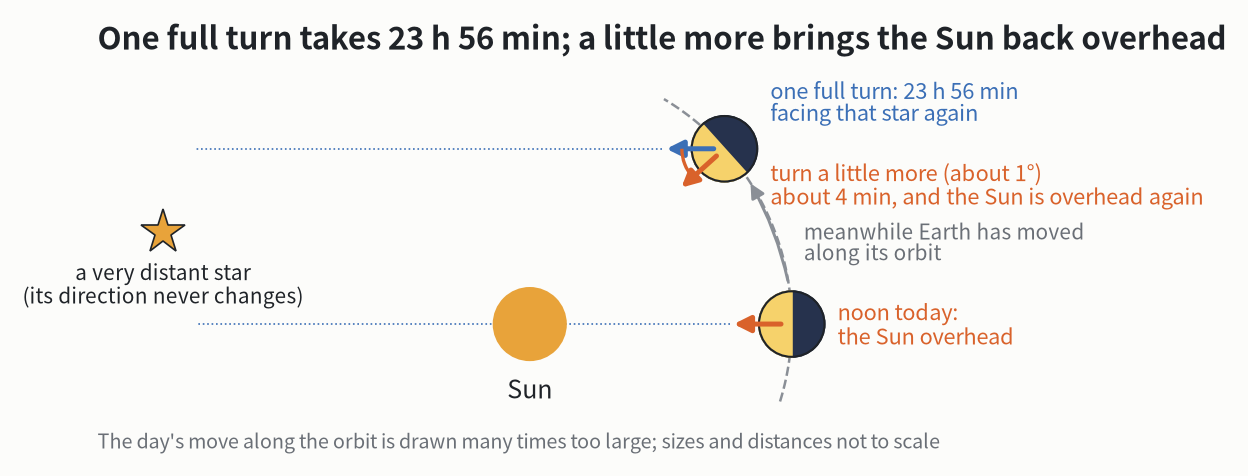
At noon today, someone has the Sun overhead, and a distant star happens to lie in the same direction. After one full turn, which takes 23 hours 56 minutes, this person is facing that star again. But in the meantime Earth has moved along its orbit, and the Sun is no longer in its old direction. Earth has to turn a little more, about 1 degree, which takes about 4 minutes, before the Sun is overhead again.
So one turn against the stars takes 23 hours 56 minutes 4 seconds, which astronomers call a “sidereal day”; the “solar day”, measured against the Sun, is exactly 24 hours on average over a year. In a year, Earth actually turns a little over 366 times against the stars, one more than the number of days: that extra turn is the one trip around the Sun. Earth always turns about its own axis; how many turns it makes depends on what you count them against. Against the distant stars it is a little over 366 a year, the number of turns Earth really makes in space; against the Sun it is one fewer.
Do those 4 minutes pile up, so that noon drifts further and further from 12 o’clock? No. Our clocks were set by the Sun to begin with: 24 hours is the average time from noon to noon, not the time for one turn against the stars. So noon falls at about the same clock time all year, within about half an hour either way; how far it is from 12 o’clock depends on whether the place lies toward the east or the west of its time zone. Against the stars, Earth turns 4 minutes “extra” every day, so each star rises 4 minutes earlier than the night before, coming full circle in a year: that is why the night sky in winter is different from the sky in summer. What really piles up is the milliseconds that come later.
The “little more” Earth turns each day is not quite the same every day either: Earth moves faster and slower along its elliptical orbit, and its axis is tilted. From the formulas for the Sun’s position, the solar day is shortest in mid-September, about 21 seconds short of 24 hours, and longest around the December solstice, about 24 hours and 30 seconds; averaged over the year it is exactly 24 hours. The shortest is not in July, when Earth is farthest from the Sun, but in September: the tilt of the axis matters more than twice as much as the distance, and it makes the solar day shortest around the equinoxes; in September Earth has also only just passed its farthest point and is still moving slowly, so the two together give the shortest solar day of the year. These tens of seconds come from the orbit; Earth’s spin itself does not speed up or slow down because of them.
Why does Earth spin?
The answer begins before Earth was born. Here is a simulation of something you can try at home with a piece of string:
On a smooth table, a ball on a 1-meter string goes around once every 6.4 seconds. Through the hole in the middle, the string is pulled down at a steady speed to 25 centimeters in 5 seconds. With half the string left, one turn takes only 1.6 seconds, 4 times faster; with a quarter left, only 0.4 seconds, 16 times faster.
Why? When the string is pulled in to half its length, two things happen at once: the ball moves twice as fast, and the circle it has to go around is only half as long. Together, one turn takes only a quarter of the time. Why does the ball speed up? While the string is being pulled in, the ball does not move along a circle; it spirals inward at a slant, so part of the string’s pull points along the direction the ball is moving and keeps pulling it forward: the effort of the hand pulling the string becomes the ball’s speed. That is also why the string gets harder to pull the shorter it gets: with a quarter left, the pull needed is 64 times what it was at the start.
A figure skater who pulls in outstretched arms while spinning whirls much faster for the same reason. Physicists call it “conservation of angular momentum”: as long as nothing pushes or drags it from the side, a spinning thing that pulls inward spins faster.
About 4.6 billion years ago there was no Sun and no Earth, only a huge cloud of gas and dust. It was enormous, and it turned so slowly that you could hardly tell: a cloud in space always has a little swirl in it, just as the water in a basin is never perfectly still. Then the cloud began to fall inward under its own gravity. Like the string being pulled in, it got smaller and smaller and spun faster and faster, until it became a flat disk. The middle became the Sun, and the material around it crashed together, lump by lump, into planets.
So Earth was born spinning. While it formed it was hit countless times, and the last big collision very likely knocked off the material that became the Moon; after that, a day was probably only a few hours long. That most of the planets spin the same way is also a trace of that cloud. There are exceptions: Venus spins backwards, and amazingly slowly, taking 243 days to turn once; Uranus spins almost on its side. These are probably due to big collisions early in their lives.
Then why doesn’t Earth stop? On the ground, a spinning top stops because of friction and air resistance; in space there is almost nothing, nothing to drag on it. So it keeps spinning.
No two days are the same length
If nothing pushes it and nothing drags on it, Earth should keep very good time, shouldn’t it? Measure it with atomic clocks, and it doesn’t.
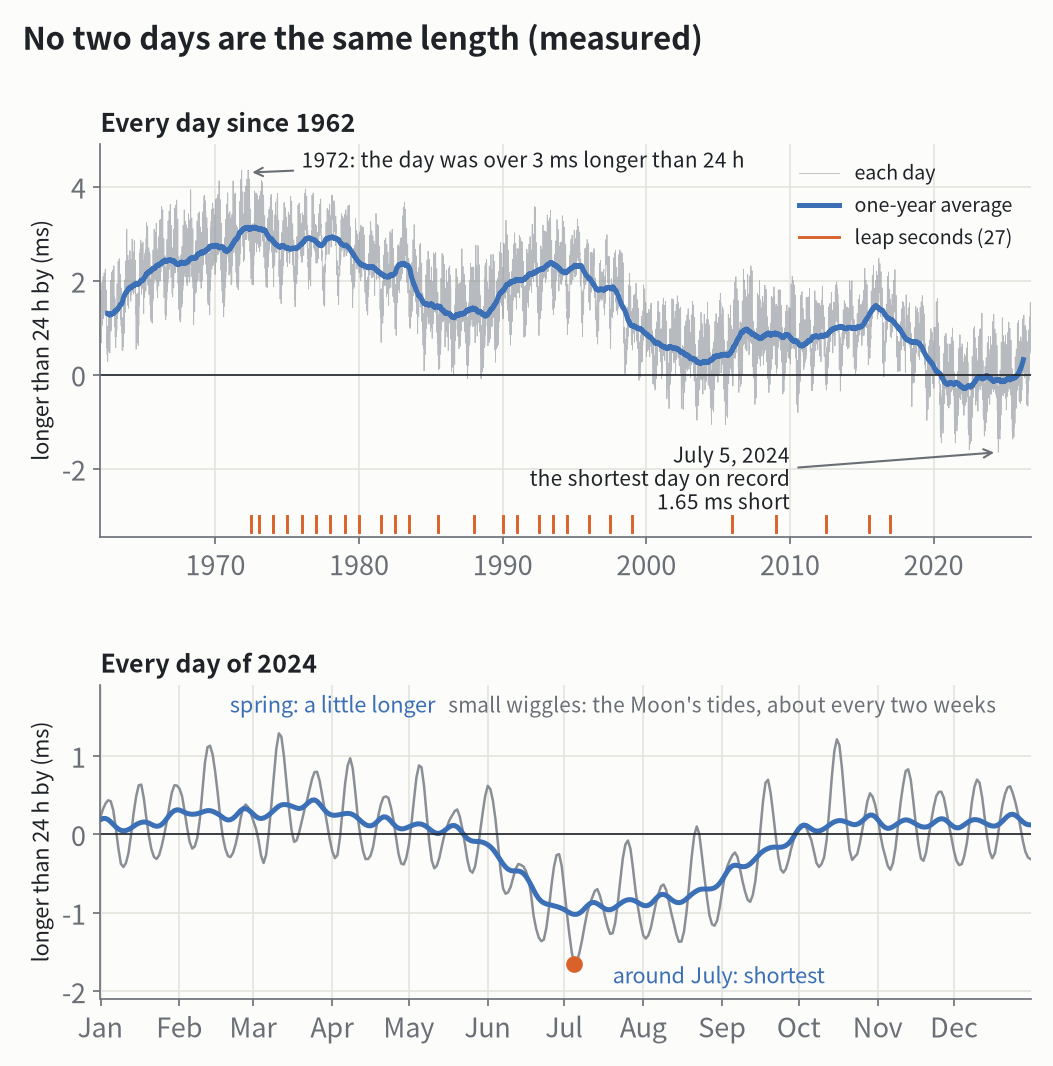
How are these numbers measured? Radio telescopes around the world watch quasars billions of light-years away together. Quasars are so far away that they can be treated as standing still, so the radio telescopes can record exactly what angle Earth has turned to at every moment, and atomic clocks give the exact time. Comparing the two tells how many seconds Earth takes to turn through one “day’s” angle. The figure shows how much longer or shorter that time is than 24 hours, or 86,400 seconds. The “day” here is the solar day averaged over a year, so the tens of seconds of change from the orbit in the last section have already been taken out; what is left is Earth itself spinning a little faster or a little slower.
A millisecond is a thousandth of a second. In the figure, no two days are the same length; they rise and fall within about 2 milliseconds. There are several reasons:
- Wind: Earth and its air spin together. In the northern winter and spring, the westerly winds blowing east high up are at their strongest; the air carries off a little more of the spin, the ground turns a little more slowly, and the day is a little longer. In summer the westerlies weaken, the spin is handed back to the ground, and the day gets shorter. So over a year the shortest days usually come around July, about 1 millisecond shorter than in spring. It is like a toy train on a big turntable that can spin: when the train runs forward in the direction the turntable turns, the turntable slows down a little.
- The Moon’s tides: the small wiggles about every two weeks in the lower panel come from the Moon’s gravity pulling on the oceans, and on the solid Earth too.
- Deep inside Earth: the big swings over decades come mainly from the core. The outer core is flowing liquid iron, and it tugs back and forth with the mantle outside it, trading spin. Around 1972, the day was more than 3 milliseconds longer than 24 hours; recent years have been the fastest-spinning on record: on July 5, 2024, the day was 1.65 milliseconds shorter than 24 hours, the shortest day on record.
- Earthquakes and ice: the great 2011 earthquake in Japan moved a little of Earth’s mass slightly inward; by calculation it shortened the day by about 1.8 microseconds, or 1.8 millionths of a second, too small to measure. Melting ice sends water toward the equator, which makes Earth spin a little more slowly.
Add these milliseconds up and they are no longer small. Atomic clocks tick off exactly 86,400 seconds every day, and since 1972 Earth has fallen 27 seconds behind them. To keep clock time from drifting away from the Sun, 27 “leap seconds” have been added to the clocks: on those days, the last minute had 61 seconds. The last one was the final second of 2016. After that Earth sped up, and none has been added since. Leap seconds cause a lot of trouble for computers and networks, and in 2022 the General Conference on Weights and Measures decided that by 2035 at the latest, the gap allowed between the clocks and Earth will be widened, which in practice means no more leap seconds.
So is Earth spinning faster or slower? It depends on how long you look. Within a year, it speeds up and slows down with the seasons; over decades, it spun faster and faster from 2016 to 2022, while in the first nine months of 2026 the average day was again about 0.5 milliseconds longer than in the same months of 2025. Over hundreds of millions of years, it has been slowing down all along.
The day is slowly getting longer
Besides these ups and downs, one force is at work all the time: the Moon.
The Moon’s gravity pulls the oceans into two bulges, one on each side. Earth spins faster than the Moon goes around it, so it drags these two “water bulges” ahead of the Moon, and the Moon pulls them back. That pull is like a very light touch on Earth’s brakes: today the day gets about 2 milliseconds longer every 100 years. The spin Earth loses goes to the Moon, which moves about 3.8 centimeters farther from Earth every year.
2 milliseconds doesn’t sound like much, but Earth’s age is counted in hundreds of millions of years. Fossils and ancient rocks have recorded how long the day used to be:
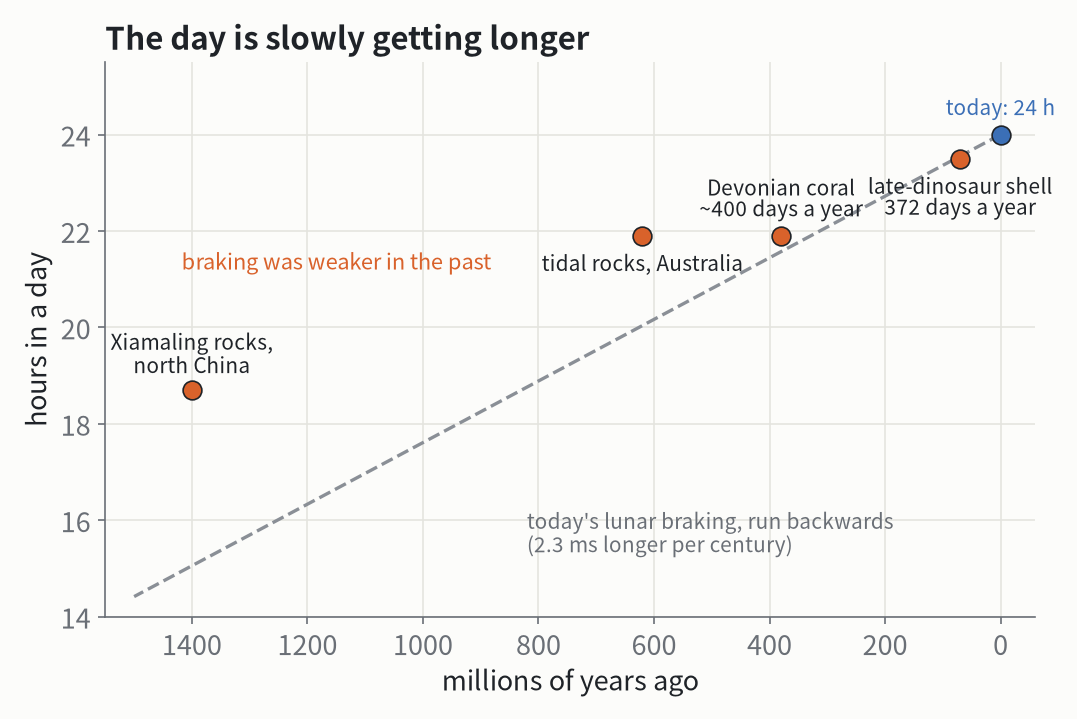
Corals and shells grow a thin layer every day and a thicker band every year; count the layers in a year, and you know how many days that year had. The length of the year has hardly changed, so the more days in a year, the shorter each day. 70 million years ago, near the end of the age of dinosaurs, a year had 372 days and a day was about 23 and a half hours; corals from 380 million years ago record about 400 days a year, a day of less than 22 hours. Further back we rely on the layers that tides left in rocks: 620 million years ago, a day was about 21.9 hours; 1.4 billion years ago, the Xiamaling rocks of north China recorded a day of only about 18.7 hours.
Interestingly, these points all lie above the dashed line: in the past, the day lengthened more slowly than it does today. Today’s oceans happen to have just the right shape to make the tides slosh especially hard, so the braking is especially strong.
The Moon itself was braked this way long ago. Earth’s tidal pull on the Moon is much stronger than the Moon’s on Earth, and early on it slowed the Moon’s spin until it matched the Moon’s trip around Earth: the Moon turns exactly once for each time it goes around Earth, so it always keeps the same face toward us. (The Moon’s orbit is a little elliptical and a little tilted, so seen from Earth it gently “rocks”; adding it all up, we can see about 59% of its surface.) Will Earth be braked that far too? Yes, but it would take far longer than the Sun has left to live.
In one sentence: Earth spins because it was born spinning and nothing in space makes it stop; one turn against the stars takes 23 hours 56 minutes, no two days are the same length to within a millisecond or two, and the Moon is making the day a little longer, bit by bit.
How do we know?
- Foucault’s pendulum: in 1851, the French physicist Léon Foucault hung a 67-meter pendulum under the dome of the Panthéon in Paris. The direction in which it swings slowly turns clockwise (seen from above, in the Northern Hemisphere). At the North Pole, the swing keeps the same direction in space and the ground turns beneath it, coming full circle in exactly one sidereal day, 23 hours 56 minutes. The farther from the pole, the less the ground turns beneath the pendulum and the longer it takes: about 37 hours in Beijing, and at the equator it doesn’t turn at all. It is a way to prove Earth is spinning without looking at the sky, from inside a building.
- Watching distant quasars: the radio telescopes described above can measure the length of the day to about a hundredth of a millisecond.
- Mirrors on the Moon: Apollo astronauts left reflectors on the Moon. Fire a laser from the ground and time its round trip, and you know how far away the Moon is, to better than a centimeter; that is also how we know the Moon moves 3.8 centimeters farther away each year.
- Ancient eclipse records: eclipses recorded more than two thousand years ago in China, Babylon and elsewhere should have been seen somewhere else if Earth had always turned at a steady rate. The difference in time adds up to several hours. This is evidence that the day is slowly getting longer.
What we still don’t know
How long the day was just after Earth formed and the collision that made the Moon, only a few hours or even shorter, is still unsettled. More than a billion years ago, the length of the day seems to have stayed at around 19 hours for a very long time, and why is still debated. How exactly the core makes the day longer and shorter over decades is not well understood either, so the length of the day is hard to forecast more than a few years ahead. Because Earth has been spinning fast in recent years, some worried that one day a second might have to be “taken out” of the clocks, which has never been done; later research found that melting ice is slowing Earth slightly, pushing that day back by a few years. Whether it will ever be needed is still uncertain.
For the curious: formulas, data and sources
Sidereal and solar days. One turn of Earth against the distant stars takes about 86,164.1 seconds, or 23 hours 56 minutes 4 seconds. In a year of 365.24 solar days, Earth turns 366.24 times against the stars, so each solar day it must turn an extra 360°/365.24 ≈ 0.986°, which takes about 3 minutes 56 seconds. In the diagram, the distance Earth moves along its orbit in a day is drawn about 40 times too large. The change in the solar day through the year uses the NOAA formulas for the Sun’s position from the last article: the interval between successive noons is shortest around September 16, about 24 hours minus 21.4 seconds, and longest around December 22, about 24 hours plus 29.8 seconds. These tens of seconds come from two things. One is the ellipse of the orbit: at perihelion (early January) Earth moves fast and the solar day is about 8 seconds longer; at aphelion (early July) it moves slowly and the day is about 8 seconds shorter. The other is the tilt of the axis: the Sun moves across the sky along the ecliptic, which is tilted against the equator. Around the equinoxes part of the Sun’s motion is north–south, so it moves less east–west, Earth needs to turn less extra, and the solar day is about 20 seconds shorter; around the solstices the Sun moves exactly east–west, and the solar day is about 20 seconds longer. Adding them: December has +8 and +20, the longest; June has −8 and +20, still about 13 seconds longer than 24 hours; mid-March has +3 and −20; mid-September has −2 and −20, so the shortest comes in September.
Conservation of angular momentum. The string pulls the ball only toward the hole, and such a force neither adds spin to the ball nor takes it away: the ball’s mass × the string length² × the rate of turning stays the same. Halve the string, and it turns 4 times as fast; quarter it, and 16 times as fast. In the simulation the table has no friction, the string is pulled at a steady speed from 100 cm to 25 cm in 5 seconds, each frame computes the ball’s position by this rule, and the animation plays at real speed: one turn goes from 6.4 seconds to 0.4 seconds. The ball’s speed along the circle is inversely proportional to the string length; with the string pulled at a steady speed, the pull equals exactly mass × speed² ÷ string length, so it is inversely proportional to the cube of the string length: a quarter of the string means 64 times the pull. The work done by the pull becomes the ball’s added kinetic energy.
How long a day is. The data are the IERS (International Earth Rotation and Reference Systems Service) EOP 20 C04 series, published by the Paris Observatory, one value for every day from 1962 to October 2026, combining measurements from radio telescopes (very long baseline interferometry, VLBI), satellite positioning and more. It first measures UT1, time kept by Earth’s rotation, and then how much UT1 gains or loses each day against atomic clocks: the “extra milliseconds” in the figure are the actual length of a mean solar day minus 86,400 SI seconds. The SI second was fixed in the 1960s to match the average day of around the 19th century, which is why for these decades the day has often been a millisecond or two longer than 86,400 seconds. The rule is that UT1 (time by Earth’s rotation) and UTC (clock time) may not differ by more than 0.9 seconds; when the gap gets close, a leap second is added. On January 1, 1972, UT1 was 10.05 seconds behind atomic time, TAI; by October 2026 it was 37.02 seconds behind, with 27 leap seconds added in between. The changes within a year come mainly from the seasonal change in the angular momentum of the atmosphere (the winds), plus a twice-yearly tide caused by the Sun; the wiggles of about two weeks and about a month come from the Moon’s tides (periods of 13.66 and 27.55 days).
The Moon’s braking. From lunar laser ranging, the tides lengthen the day by about 2.3 milliseconds per century; from ancient eclipse records, the day has lengthened on average by about 1.8 milliseconds per century over the past 2,700 years. The difference comes mainly from the crust slowly rebounding since the end of the last ice age, which makes Earth a little “rounder” and spin slightly faster (Stephenson, Morrison and Hohenkerk, 2016). The Moon moves away at about 3.8 centimeters a year.
The day in the past. 70 million years ago: a rudist shell fossil from Oman, 372 days a year, a day of about 23.5 hours (de Winter et al., 2020). About 380 million years ago: Devonian corals, about 400 days a year (Wells, 1963). 620 million years ago: tidal layers in the Elatina Formation, South Australia, a day of 21.9 ± 0.4 hours (Williams, 2000). 1.4 billion years ago: astronomical cycles in the Xiamaling Formation, a day of about 18.7 hours (Meyers and Malinverno, 2018). Each of these estimates is uncertain by about half an hour or more. The dashed line runs 2.3 milliseconds per century backwards: today’s tidal braking is stronger than its average in the past.
Foucault’s pendulum. Earth’s spin can be split into two parts: a turning about the local vertical, of size Earth’s rate of spin × sin(latitude), and a turning about a horizontal direction, which does not turn the pendulum’s swing. So the time for the plane of swing to turn once relative to the ground = sidereal day ÷ sin(latitude): 23.9 hours at the North Pole, about 33.4 hours in Harbin (45.8° N), about 35.9 hours in Chicago (41.9°), about 36.7 hours in New York (40.7°), about 37.3 hours in Beijing (39.9°), about 46 hours in Shanghai, about 61 hours in Guangzhou, about 42 days in Singapore, and never at the equator. The animation solves the equations of motion of the bob on the turning ground for small swings, including the Coriolis force: the pendulum is let go from the north side, and a 67-meter pendulum takes about 16.4 seconds to swing there and back; a real pendulum in Beijing needs more than 8,000 swings to turn once, so in the animation Earth’s turning is sped up about 230 times to make it turn once in 36 swings, and everything else is computed as is.