Turning the Clocks Back: Why Does It Get Dark So Early in Winter?
Our last article, Why Is the Sky Blue, and Why Are Sunsets Red?, said: “The lower the Sun, the more air its light must cross.” That article was about what color sunlight turns when the Sun is low. This one asks a different question: why is the winter Sun so low, and why does it set so early?
This Sunday, November 1, at 2 a.m., most of the United States and Canada will turn the clocks back to 1 a.m., and daylight saving time will end (Europe already did this on October 25). The hour from 1 to 2 a.m. will happen twice. On the first evening after the change, many people feel that it suddenly gets dark much earlier. For a long time I took early winter darkness for granted and never asked why.
Take a guess
Two things are often said: “Turning the clocks back takes an hour off the day,” and “The winter solstice is the shortest day, so it’s the day it gets dark earliest.”
The first is wrong: turning the clocks back doesn’t, by itself, take a single minute off the day. Once the clocks go back, an hour of daylight leaves the evening and turns up in the morning. The days do get shorter in autumn, but that’s the season, clocks or no clocks. The second is only half right: the solstice is indeed the shortest day, but the earliest sunset of the year comes about two weeks before it.
(The seasons in this article are those of the Northern Hemisphere. In the Southern Hemisphere it’s the other way round: November is spring there, and the days are getting longer.)
Turning the clocks changes only the clocks
Below are the times of sunrise and sunset for every day of the year in New York and Beijing, as read on local clocks. The two cities sit at almost the same latitude, about 40 degrees north. New York uses daylight saving time; Beijing doesn’t.
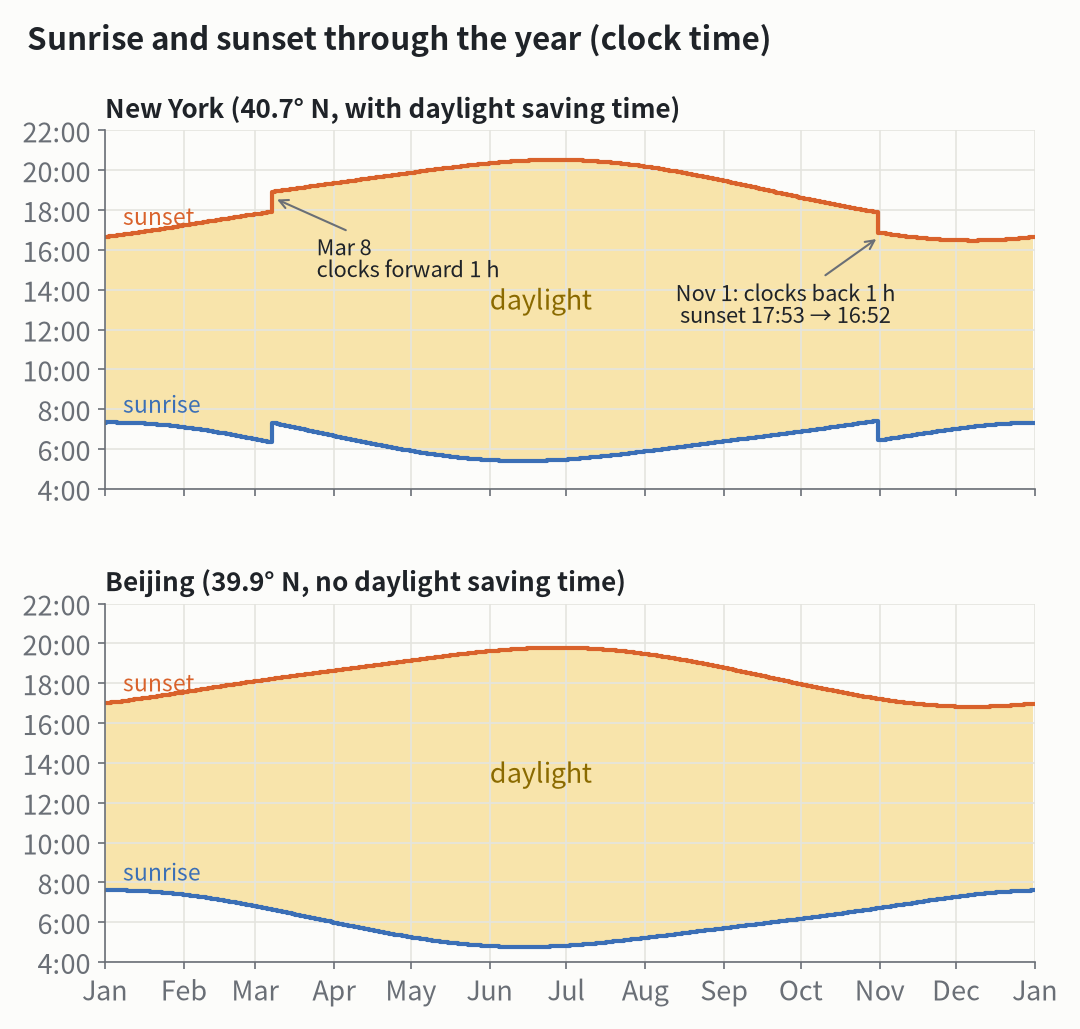
New York’s band breaks twice, in March and in November: when the clocks go forward or back, the clock times of sunrise and sunset jump by an hour. On October 31 the Sun sets in New York at 5:53 p.m.; on November 1 it sets at 4:52 p.m. But the width of the yellow band, the length of the day, doesn’t change at all where the band jumps: 10 hours 28 minutes on October 31 and 10 hours 26 minutes on November 1. The two-minute difference is just the season shortening the days, as it does every day in autumn.
Beijing’s band doesn’t break, yet it has almost the same shape as New York’s. So the early darkness comes from the season; turning the clocks only packs it into one evening, so that we notice it all at once.
Why are winter days short?
Earth’s axis is tilted, about 23.4 degrees from upright (from the line perpendicular to the plane of its orbit). More to the point, as Earth goes round the Sun, the axis doesn’t turn with it: all year it points the same way in space, with the North Pole aimed almost straight at the North Star. So on one side of the orbit the Northern Hemisphere leans toward the Sun, and on the other side it leans away.
In the simulation below, the top shows a year of Earth going round the Sun, with the axis always pointing the same way; the bottom left shows Earth close up, from the same viewpoint. The yellow and gray circle is the latitude 40 degrees north: as Earth turns once, people there travel once around this circle: on the yellow part they’re in daylight; on the gray part it’s night. At the equinoxes and solstices the animation pauses and Earth turns once, which is one day, carrying the red dot, someone living at 40 degrees north. The rest of the time Earth is spinning every day too, but the animation doesn’t show it: the real Earth turns more than 365 times for each trip round the Sun, which would only be a blur.
At the June solstice, the Northern Hemisphere leans toward the Sun, most of the circle is in daylight, and the day lasts about 15 hours. At the December solstice it leans away, only a smaller part of the circle is in daylight, and the day lasts only about 9 hours 20 minutes. At the equinoxes the circle is split in half, and day and night are nearly equal.
The slanting sunlight brings two more things. The Sun’s height is the angle between the Sun and the horizon: 0 degrees on the horizon, 90 degrees straight overhead. At noon on the December solstice, the Sun in New York is only 26 degrees up; at the June solstice it is 73 degrees. By the method of the last article, Why Is the Sky Blue, and Why Are Sunsets Red?, noon sunlight crosses more than twice as much air at the December solstice as at the June solstice, and the same patch of ground receives less than half as much sunlight. So winter is not only shorter in daylight, but colder too.
The farther from the equator, the bigger the difference between winter and summer:
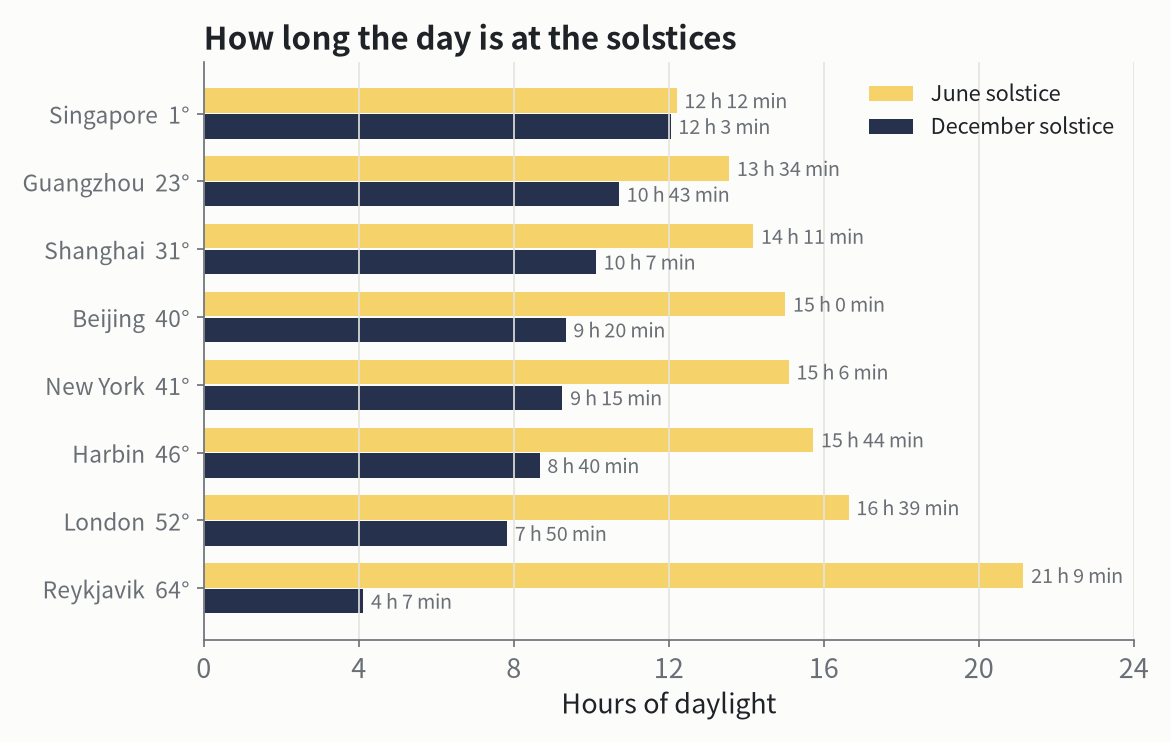
Singapore has about 12 hours all year round. Beijing has 9 hours 20 minutes at the December solstice. Reykjavik, in Iceland, has just over 4 hours of daylight at the December solstice, and more than 21 hours at the June solstice.
And what about how far Earth is from the Sun? This may come as a surprise: while the Northern Hemisphere has winter, Earth is at its closest to the Sun.
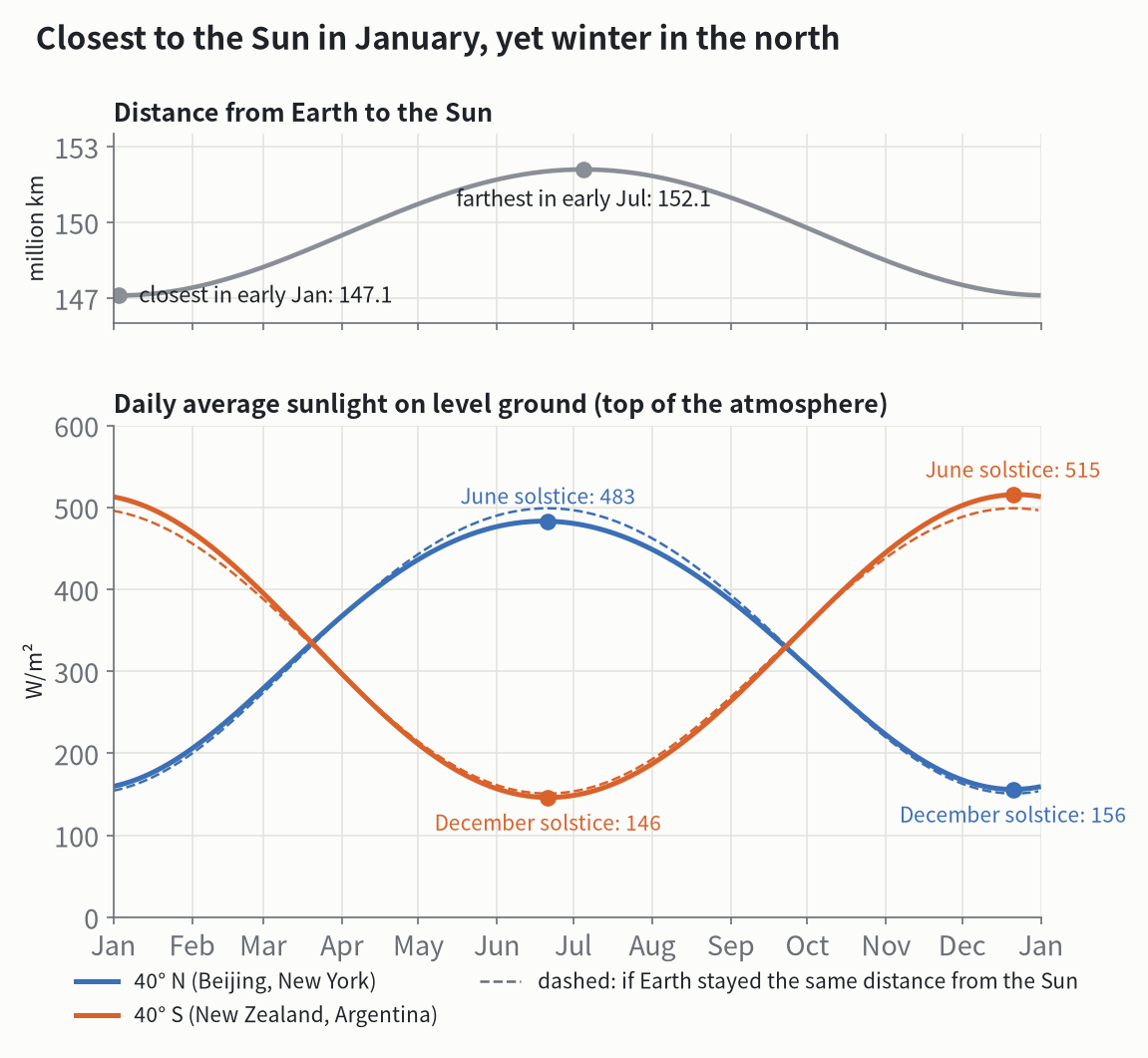
In early January, Earth is about 147.1 million kilometers from the Sun; in early July it is farthest, about 152.1 million kilometers. The distance differs by only 3%, and the strength of sunlight by about 7%. But low sunlight and short days together mean that at 40 degrees north, a day at the December solstice brings only a third as much sunlight as a day at the June solstice. Being 7% closer can’t make up for that: in the figure, the dashed and solid lines nearly coincide. The Southern Hemisphere’s summer comes when Earth is closest to the Sun, so its sunlight is about 7% stronger than in the northern summer. But the Southern Hemisphere is mostly ocean, and water warms slowly, so its summers are not hotter for it. In fact, the whole Earth’s average temperature is highest in July, when Earth is farthest from the Sun, because the Northern Hemisphere has more land, and land warms quickly.
The earliest sunset isn’t on the solstice
The solstice really is the shortest day of the year (though only by a second or two compared with the days on either side). So shouldn’t it also be the day it gets dark earliest? Work it out, and it isn’t:
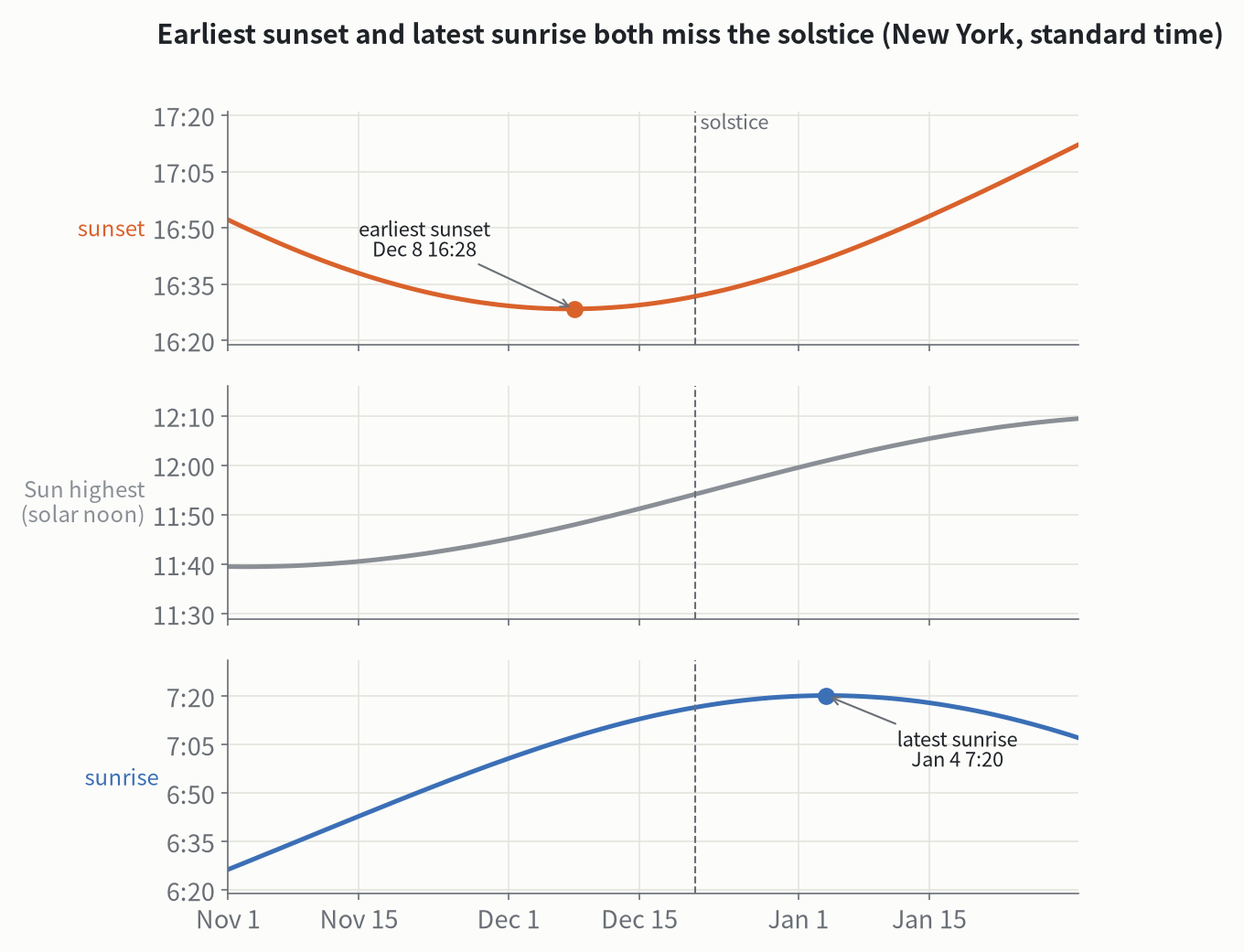
New York’s earliest sunset is 4:28 p.m., somewhere between December 3 and 12 (the time changes by less than half a minute over those days), while on the solstice itself the Sun sets at 4:32 p.m. The latest sunrise is 7:20 a.m., in early January. Beijing is the same: the earliest sunset is 4:49 p.m., in early December; the latest sunrise is 7:36 a.m., in early January.
The secret is in the middle line: the moment the Sun is highest, solar noon, isn’t always at 12 o’clock. In winter it moves later every day, by about 30 seconds a day around the solstice.
Why does it move? Earth spins and also travels around the Sun. After one full turn, Earth has moved a little farther along its orbit, so it must turn a little more to face the Sun again. In December, Earth is fairly close to the Sun and moves along its orbit fast, and at this time the Sun’s path across the sky also runs most nearly sideways. Together, these make that little extra turn larger: from one solar noon to the next takes about 24 hours and 30 seconds. But the clock counts only 24 hours a day, so solar noon slips later each day.
Sunset comes half a day’s daylight after solar noon. Before the solstice the days are still getting shorter, but more and more slowly as the solstice approaches. By early December, the 25 or so seconds by which solar noon moves later each day outweigh the amount by which the shrinking day pulls sunset earlier, so sunsets start getting later. Sunrise works the other way: as solar noon moves later, it pushes sunrise later too, all the way into early January.
In one sentence: turning the clocks changes only the clocks; winter days are short because Earth spins on a tilt; and the earliest sunset comes before the solstice because winter’s solar noon moves later every day.
Why change the clocks at all?
The first country to change its clocks nationwide was Germany, in 1916, during the First World War, to cut the use of lighting in the evening and save coal. Many countries followed at one time or another. China also used daylight saving time from 1986 to 1991, then dropped it. The current rule in the United States dates from 2007: clocks go forward on the second Sunday in March and back on the first Sunday in November. Today most countries in the world don’t change their clocks.
How do we know?
- Measure a shadow. Stand a stick 1 meter tall on the ground. Once a week, measure its shadow at the same clock time (say, 12 noon), or note the clock time when the shadow is shortest. By our calculation, in Beijing the noon shadow is about 2 meters long at the December solstice and only about 0.3 meters at the June solstice, and in winter the moment of the shortest shadow moves later day by day.
- Look up a sunrise and sunset table. The sunrise and sunset times in a phone’s weather app are also computed with astronomical formulas like the ones used here. Scroll to early December and early January, and find the earliest sunset and latest sunrise yourself.
- Earth really is tilted. More than two thousand years ago, people measured how much higher the noon Sun stands at the June solstice than at the December solstice, and from that worked out the tilt. Today’s measured value is 23.44 degrees, and it slowly changes over a cycle of tens of thousands of years.
What we still don’t know
Whether changing the clocks is a good idea is still unsettled. Some studies have found slightly more traffic accidents and heart attacks in the days after the clocks spring forward, but how large the effect is and what causes it are still debated. There are also different views on whether to keep daylight saving time all year or standard time all year: the American Academy of Sleep Medicine holds that year-round standard time fits the body’s internal clock better. The European Parliament voted in 2019 to end seasonal clock changes, but this has not yet been put into effect.
For the curious: the formulas, the data, and how accurate this is
The Sun’s position. Sunrise, sunset and solar noon are computed with the formulas of the solar calculator of the U.S. National Oceanic and Atmospheric Administration (NOAA), which come from Meeus’s Astronomical Algorithms. First come the Sun’s declination (the latitude where the Sun is overhead) and the “equation of time” (how far solar noon runs ahead of or behind 12 o’clock on the clock); then, for a given latitude, the moment the Sun reaches the horizon. Sunrise or sunset is taken as the moment the center of the Sun is 0.833 degrees below the horizon, which accounts for refraction by the air (which “lifts” the Sun by about 0.57 degrees) and for the Sun’s own radius. At mid-latitudes, times computed this way generally agree with observatory tables to within a minute.
Clock time. The clock times for New York and Beijing follow the rules in the IANA time zone database (Python’s zoneinfo), which also records Beijing’s daylight saving time from 1986 to 1991. New York is taken at 40.71° N, 74.01° W, and Beijing at 39.90° N, 116.41° E.
Earth in the animation. The view is from a fixed point in space, a little above the plane of Earth’s orbit. The Sun is in the middle, and Earth goes round it through its real position on each day (from the Sun’s ecliptic longitude and the Earth–Sun distance); the half facing the Sun is daytime. The axis is tilted by 23.44 degrees and keeps the same direction in space, so the direction in which it leans relative to the Sun changes through the year. The close-up of Earth uses the same viewpoint, so the axis stays still in the picture and it’s the direction of the sunlight that changes. The spin is shown only once at each equinox and solstice. The fraction of the circle that is yellow is the length of the day at 40 degrees north. This geometric fraction leaves out refraction and the size of the Sun, so it falls a few minutes short of the real day; the curve on the right uses the real sunrise and sunset. Strictly speaking, the axis does change direction, very slowly: it traces a circle about once every 26,000 years (precession), far too slowly to see in a year.
Which day is the solstice? In 2026 the December solstice falls at 4:50 a.m. on December 22, Beijing time, which is 3:50 p.m. on December 21 in New York. So in China the solstice is on December 22, and in the United States on December 21. The shortest day follows suit: December 22 in Beijing, December 21 in New York.
Why solar noon moves. The time from one solar noon to the next is a “solar day,” which averages exactly 24 hours over the year. Earth’s orbit is an ellipse; in early January Earth is closest to the Sun and moves fastest. And because of the tilt, the Sun moves across the sky along the ecliptic, which near the solstices runs parallel to the equator, so the Sun moves farthest in the east–west direction. In December the two effects add up, and the solar day is at its longest, about 24 hours 0 minutes 30 seconds. The extra seconds, added up day after day, make up the change in the time of solar noon.
How strong winter sunlight is. The height of the noon Sun is 90 degrees minus the latitude plus the Sun’s declination, which is about −23.44 degrees at the December solstice and +23.44 degrees at the June solstice. New York is at 40.71 degrees north, so the noon Sun is about 25.8 degrees up at the December solstice and about 72.7 degrees at the June solstice. By the Kasten and Young (1989) formula from the last article, Why Is the Sky Blue, and Why Are Sunsets Red?, sunlight crosses about 2.3 and 1.05 units of air. The sunlight falling on a patch of level ground is proportional to the sine of the Sun’s height, so at the December solstice it is only 46% of that at the June solstice (before the air weakens it). The length of a shadow is the stick’s length divided by the tangent of the Sun’s height.
How far Earth is from the Sun. The Earth–Sun distance follows Meeus’s formulas (orbital eccentricity about 0.0167): about 147.1 million kilometers in early January and about 152.1 million in early July. Sunlight weakens with the square of the distance, so it is about 7% stronger in January than in July. The sunlight falling on a level patch at the top of the atmosphere over a day is the solar constant, 1361 W/m² (Kopp and Lean, 2011), corrected for distance and averaged over 24 hours as the Sun’s height changes: at 40 degrees north, about 156 W/m² at the December solstice and about 483 at the June solstice; with a circular orbit they would be 151 and 499.