Why Is the Sky Blue, and Why Are Sunsets Red?
Our last article, What Color Is Sunlight?, contains this passage: “The lower the Sun sits, the more air its light crosses, the more blue gets bounced away, and the more yellow and red the Sun looks. The blue light that gets bounced away is spread across the whole sky.”
That article was about the Sun itself. This one picks up from that passage: why does the air bounce away blue light in particular? And how does the bounced light become a whole blue sky?
Take a guess
There are a few common answers. Some say the sky reflects the color of the ocean. Others say air itself is blue, like blue glass.
In fact, the first gets it backward: the sea looks blue partly because it reflects the sky. The second isn’t right either: air is almost transparent, and it doesn’t “eat” any particular color. The blue of the sky comes from something else: air bounces light around, and it is much better at bouncing some colors than others.
Air bounces blue light the most
Light is a wave. Air molecules are tiny, more than a thousand times smaller than the wavelength of visible light. When light meets something that small, some of it is bounced off in every direction; this is called scattering. In 1871 the British physicist Lord Rayleigh worked out that the shorter the wavelength, the more strongly light is scattered, in inverse proportion to the fourth power of the wavelength.
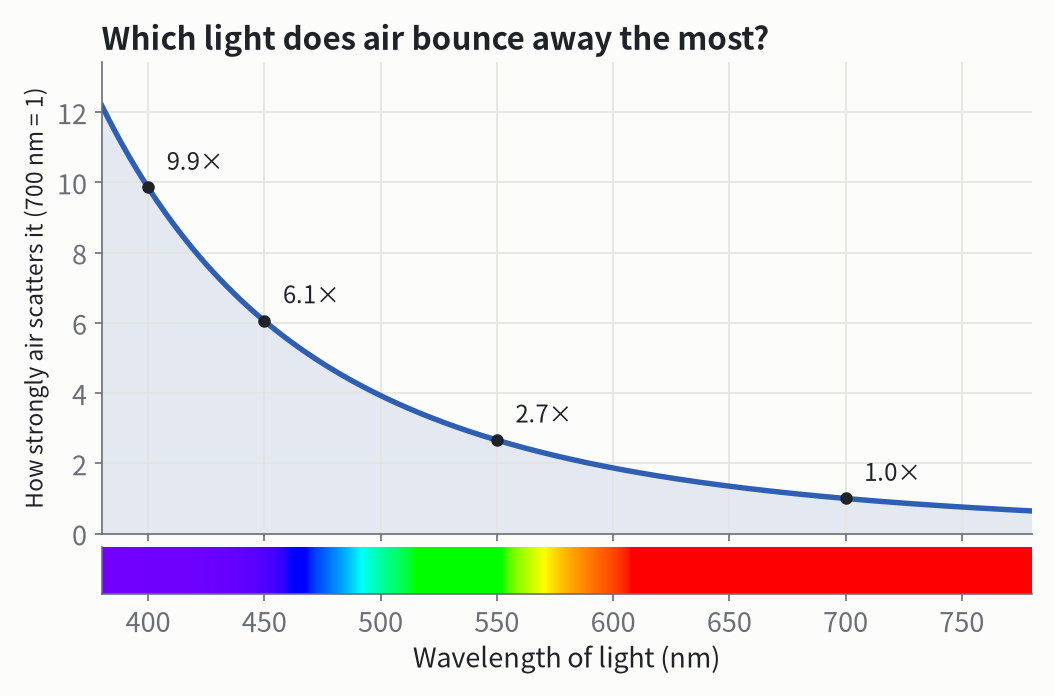
Compared with red light at 700 nm, blue light at 450 nm is scattered about 6 times as strongly, and violet light at 400 nm nearly 10 times.
A beam of sunlight crosses the air
Think of sunlight as a stream of tiny photons, and watch what happens as they cross the air. In the simulation below, 40 photons of each color set out, using the real strength with which air scatters each of these three colors:
Count the air that light crosses with the Sun overhead as 1 unit. At noon, with the Sun 60 degrees up, sunlight crosses the atmosphere at a slant and passes through 1.2 units. About a quarter of the blue light is bounced away, but only about 6% of the red. The direct sunlight loses a little blue, so the Sun looks white with a faint warm tint. The light that gets bounced away is mostly blue, and it reaches us from every direction: that is the blue sky.
Why isn’t the sky violet?
If violet light is scattered even more easily than blue, why isn’t the sky violet? Using the method from the earlier articles, we can simply compute the light from the sky overhead and the three numbers the eye receives:
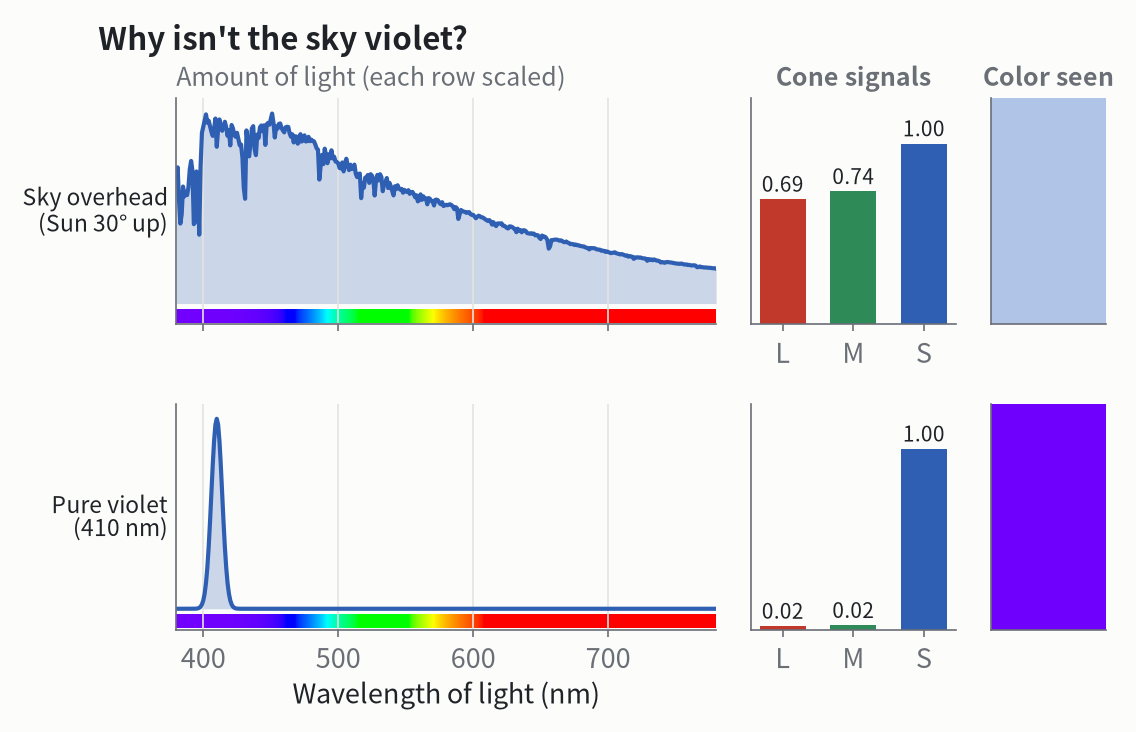
Two things stand out.
First, sunlight has less violet than blue to begin with (see the solar spectrum in the last article). Violet is scattered more easily, but there’s less of it to start with. The two effects roughly cancel: in the light scattered down from the sky, there is about as much violet as blue, so violet doesn’t win. On top of that, the eye is not very sensitive to violet. The S cones, which handle blue, are only about a quarter as sensitive to violet at 410 nm as to blue at 450 nm. Adding it up, about 80% of the S-cone signal comes from blue light and only about 20% from violet.
Second, sky light isn’t only blue. Its spectrum is broad: green, yellow and red light are scattered too, just less than blue. The three cone signals are 0.69 : 0.74 : 1. The S cones are the most excited, but the other two aren’t weak, so the sky is a whitish pale blue rather than a pure deep blue or violet. Pure violet light excites almost only the S cones, with hardly any response from the other two, and that is a completely different color.
The blue of the sky isn’t the same everywhere, either. The cleaner the air and the farther you look from the Sun, the deeper the blue; the more haze, the whiter the sky.
Why are sunsets red?
The lower the Sun, the more air its light must cross: 1 unit with the Sun overhead, 2 at 30 degrees, about 5.6 at 10 degrees, about 10 at 5 degrees, and nearly 38 right at the horizon.
At 5 degrees, only about a tenth of the blue light still comes straight through, while six-tenths of the red does, so the Sun turns yellow-orange. A little lower, nearly all the blue is gone, and the Sun turns red.
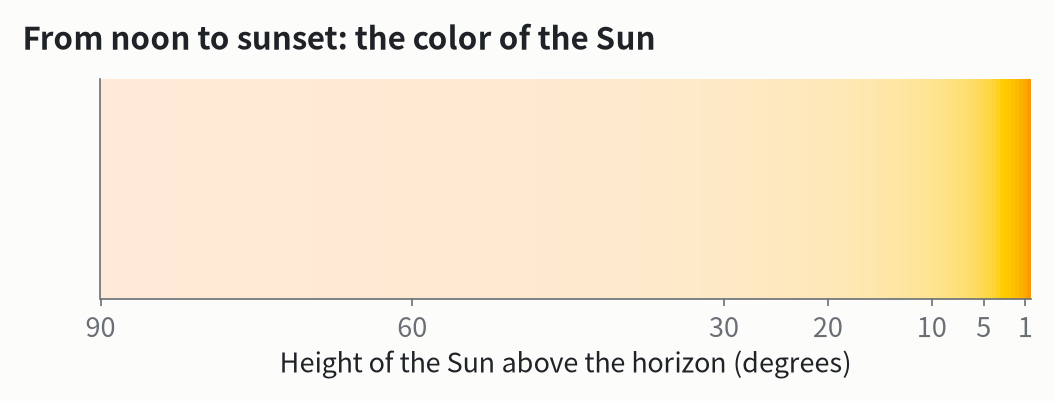
When the air quality is poor and the air carries more small particles, such as smoke and haze, even more blue light is blocked. During wildfires, when the smoke is heavy, the Sun can look orange-red even in the middle of the day, for the same reason.
The same idea explains another familiar sight: the sky gets whiter toward the horizon. Looking out along the horizon, your line of sight passes through a great deal of air. Light of every color gets bounced into it, while blue light is also bounced away along the way, and the mixture comes out close to white.
In one sentence: the blue of the sky is sunlight bounced off by the air; the red of a sunset is the sunlight left after the blue has been bounced away.
How do we know?
- Make a little sky at home. Stir a few drops of milk into a glass of clear water. In a dark room, shine a flashlight into the side of the glass. From the side, the glass looks faintly blue; looking through the glass toward the flashlight, the light turns orange-yellow. The particles in milk are bigger than air molecules, so the effect isn’t as pure as the sky’s, but the idea is the same.
- Look at the sky through polarized sunglasses. Look at the part of the sky roughly at right angles to the Sun and turn the glasses: the sky gets noticeably brighter and darker. Sunlight itself is not polarized, but once air scatters it, the light becomes polarized, most strongly at right angles to the Sun, just as the theory of scattering predicts.
- From experiment to theory. In 1869 John Tyndall sent light through a gas carrying fine particles in his laboratory and saw blue light coming out the side; two years later, Rayleigh worked out the theory of the scattering. Later, Einstein and others completed the explanation in terms of air molecules constantly moving and the air’s density flickering from place to place.
- Sunsets on Mars. NASA’s Curiosity rover has photographed sunsets on Mars with blue around the Sun. Mars has thin air full of dust, and the dust grains are about as big as the wavelength of light, so they scatter light by different rules than the air on Earth.
What we still don’t know
Why the sky is blue is well understood. But how much the tiny particles in the air, the smoke, dust and haze that make sunsets redder, affect Earth’s climate is still one of the most uncertain questions in climate research. They reflect some sunlight back to space and cool the ground, while also changing how clouds form, and the effects are tangled together.
With this, the articles that started with an autumn leaf have followed color to its sources: a leaf absorbs part of the light, the eye counts a spectrum down to three numbers, the Sun’s temperature sets the color of sunlight, and the air bounces sunlight in every direction. Next time you look up, the blue you see is sunlight that has been bounced your way.
For the curious: the formulas, the simulation, and what this model leaves out
Why the fourth power of the wavelength. The electric field of light makes the charges in an air molecule oscillate, and the oscillating charges send out light in every direction. The power a tiny oscillating “antenna” radiates grows as the fourth power of its frequency; frequency is inversely proportional to wavelength, so scattering goes as one over the wavelength to the fourth power. This holds only for particles much smaller than the wavelength, such as air molecules; larger particles such as smoke, dust and water droplets follow other rules.
How strongly air scatters. The vertical Rayleigh optical depth of the whole atmosphere is computed with the formula of Hansen and Travis (1974): about 0.097 at 550 nm and about 0.22 at 450 nm. Light crossing the atmosphere at a slant passes through more air, given by the “air mass,” which grows as the Sun gets lower; it is computed with the formula of Kasten and Young (1989), which also works near the horizon. The fraction of direct light that gets through is e raised to minus (optical depth × air mass).
The photon animation. Where each photon gets scattered is drawn at random from an exponential distribution whose mean free path is set by that color’s optical depth and the air mass. The animation includes only air molecules, no haze; blue, green and red are taken at 450, 550 and 650 nm. The random numbers are stratified so that the number of photons reaching the eye matches the computed fraction. The directions after scattering are only illustrative.
The sky’s spectrum (third chart). It uses the single-scattering approximation: sunlight is assumed to be scattered just once before reaching the eye, the atmosphere is treated as a flat layer, air molecules scatter with Rayleigh’s angular pattern, and haze has an optical depth of 0.1 at 550 nm, varying with wavelength by the Ångström law. The chart shows the sky overhead with the Sun 30 degrees up. The swatch shows hue only, at a chosen brightness: the real sky is much darker than white paper in sunlight.
What’s left out. Light scattered more than once (multiple scattering) and the absorption of orange and red light by ozone are not included. So this simple model is not suited to the twilight sky: after the Sun sets, the sky overhead stays deep blue mainly because ozone absorbs some of the orange and red light. The Sun’s color in the fourth chart uses only direct light, so multiple scattering doesn’t matter; but when the Sun is very close to the horizon, absorption by ozone and water vapor also changes its color somewhat, so the right end of that chart is only approximate.
Polarization. Sunlight is unpolarized. By Rayleigh scattering, light scattered at 90 degrees from the Sun is almost completely polarized; in the real sky, multiple scattering, haze and light reflected from the ground bring the maximum down to typically 60 to 80%.
Data. Solar spectrum: ASTM G173-03 above the atmosphere (U.S. National Renewable Energy Laboratory). Cone signals: Stockman & Sharpe (2000). Colors are computed the same way as in the earlier articles.