Can Time Really Slow Down?
Our last article, What Else Does the Sun Send Us Besides Light?, described three kinds of neutrino, “named after the three charged particles they pair with: the electron, and its heavier cousins, the muon and the tau.” The muon is not far away at all: right now, about once a second, a muon comes down from the sky and passes through your palm. It can get here thanks to something that sounds like a myth: time slows down.
Take a guess
In the Chinese classic Journey to the West, the Monkey King takes a job in the palace of heaven. He thinks he has been away “only half a month or so”, but when he returns home, his monkeys say he has been gone more than ten years: “One day in heaven is a year down below.”
That is a myth. But two things people often say, “Time is the same for everyone; a second is a second,” and “Relativity only matters for spaceships and science-fiction films,” are not right either. The faster something moves, the slower its time runs. This happens over your head every day, and the satellite positioning in your phone depends on it.
Muons falling from the sky
Space is full of particles with enormous energies, mostly protons, called cosmic rays. When one plunges into Earth’s atmosphere, it smashes into the nucleus of an atom of air ten-odd kilometers up; the pieces hit more nuclei and break up again, making an invisible “shower” of particles. Of everything in this shower, the particles that are most plentiful by the time it reaches the ground are muons.
A muon is a lot like an electron, with the same charge, but about 207 times heavier. It is unstable: on average it lives 2.2 microseconds, then decays into an electron and two neutrinos. A microsecond is a millionth of a second, 10−6 s. At sea level, about one muon comes down through each square centimeter every minute; a palm is about 80 square centimeters, so that is roughly one a second. They pass through you and through roofs, and many reach mines hundreds of meters underground.
Here is the puzzle. Light travels about 300,000 kilometers a second; in 2.2 microseconds, even at the speed of light, a muon can go only about 660 meters. Fifteen kilometers is about 23 times that. Muon decay is like a lottery: every 2.2 microseconds, on average only about 37% (one over e) are left. After 23 rounds, only e−23 is left, about 1.3 × 10⁻¹⁰: roughly one muon in 8 billion would reach the ground. And that assumes they fly at the speed of light; muons are a little slower, so it would be even fewer. Yet there are plenty of muons at ground level.
The faster you go, the slower time runs
In 1905, Einstein proposed that no matter how fast you are moving yourself, you always measure the same speed of light, about 300,000 kilometers a second. From that one rule follows something strange: moving clocks run slow.
Picture a “light clock”: two mirrors facing each other, one above the other and fixed together, with a pulse of light bouncing between them. Up and down counts as one “tick.”
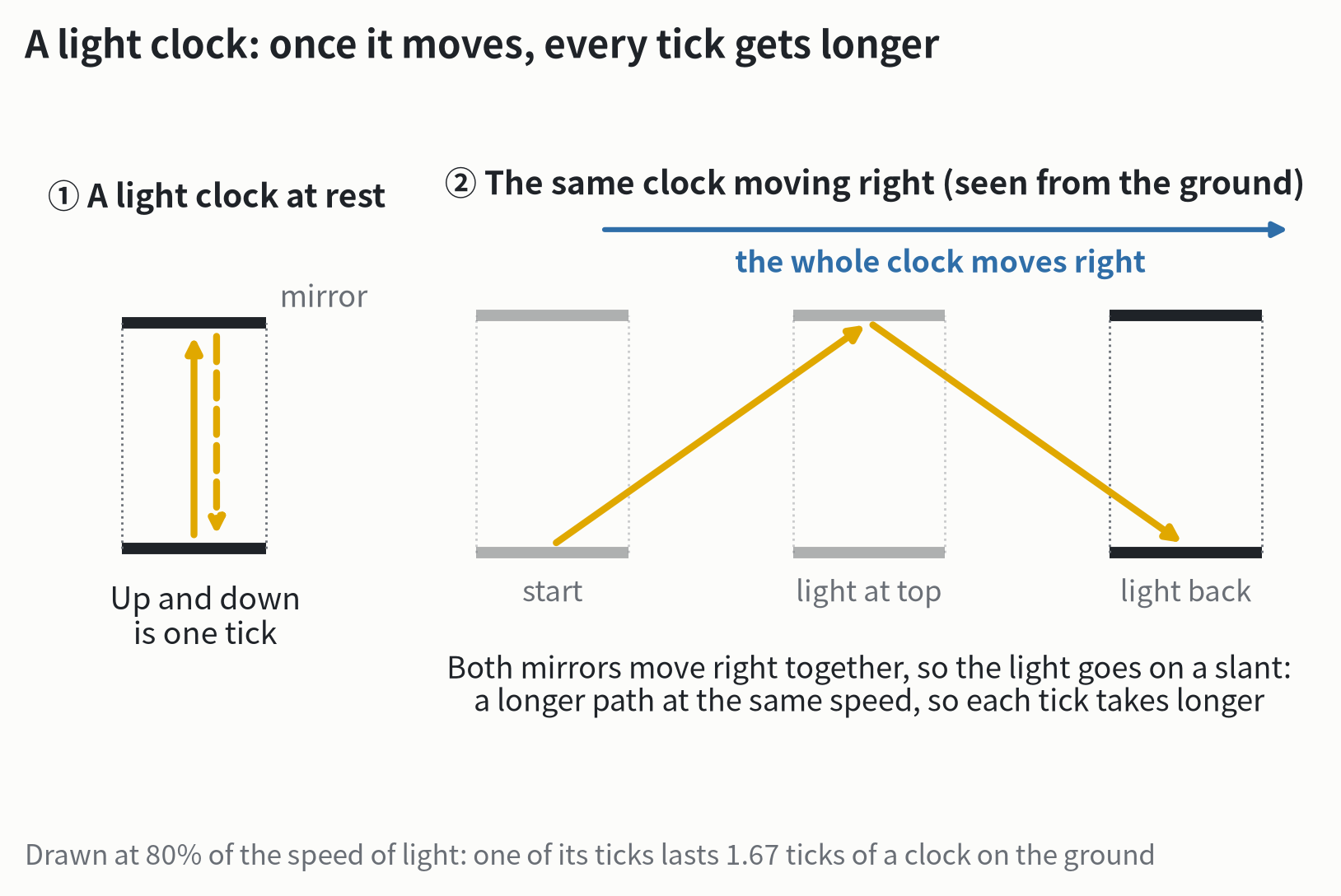
When the light clock is at rest, the light goes straight up. Now let the whole clock, both mirrors together, rush to the right. Seen from the ground, by the time the light reaches the top mirror, that mirror has moved to the right; the light has to go on a slant, a longer path. Light doesn’t speed up, so the longer path takes longer: every tick is stretched. Everything moving along with the clock, a heartbeat, the vibration of an atom, a muon’s decay, slows down in the same way, and none of it notices.
At everyday speeds the effect is far too small to notice; close to the speed of light it becomes large. The muons that reach the ground have an average energy of about 4 GeV (4 billion electron volts) and move at more than 99.96% of the speed of light, so their “clocks” run about 38 times slower than ours: we see them live 2.2 × 38 ≈ 83 microseconds on average, long enough to fly about 25 kilometers. Starting from 15 kilometers up, about half reach the ground. For “one day in heaven, a year down below,” a clock would have to run 365 times slower, which takes 99.9996% of the speed of light.
1963: counting muons on a mountain and by the sea
This is not just a calculation. In 1962, David Frisch and James Smith of the Massachusetts Institute of Technology took a muon detector up Mount Washington. The mountain is in New Hampshire, in the northeastern United States; at 1,917 meters it is the highest peak in the Northeast, and it is famous for terrible weather: in 1934 a gust of 372 kilometers an hour was measured on the summit, a world record that stood for more than 60 years.
They counted only muons moving at about 99.5% of the speed of light: on the summit, about 563 an hour. The trip from the summit down to sea level takes these muons about 6.4 microseconds, about three lifetimes. If time did not slow down, only about 27 an hour would be left at sea level. They took the detector back to Cambridge, Massachusetts, home of MIT, and counted about 412 an hour. This Cambridge (not the one in England, though it was named after it in the 1600s) sits right next to Boston on the coast, almost at sea level, a little over 200 kilometers from Mount Washington.
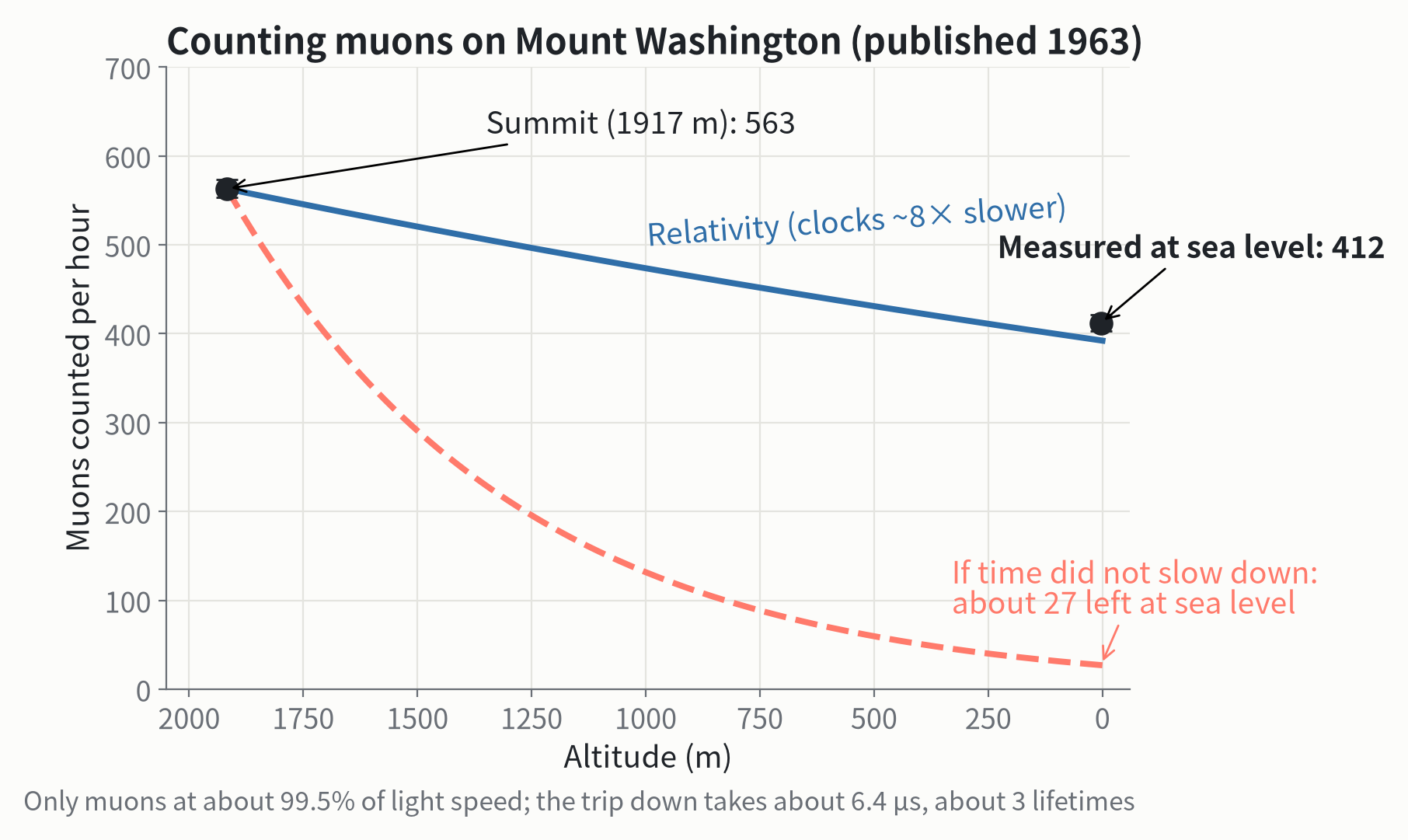
412, not 27. From their data, these muons’ clocks ran about 8.8 times slower than ours, as relativity predicts. They also made a teaching film of the whole experiment, which has been shown in many physics classes.
Riding on a muon
If you were riding on a muon, your watch would run normally, and the muon would still decay after 2.2 microseconds on average. So how does it reach the ground?
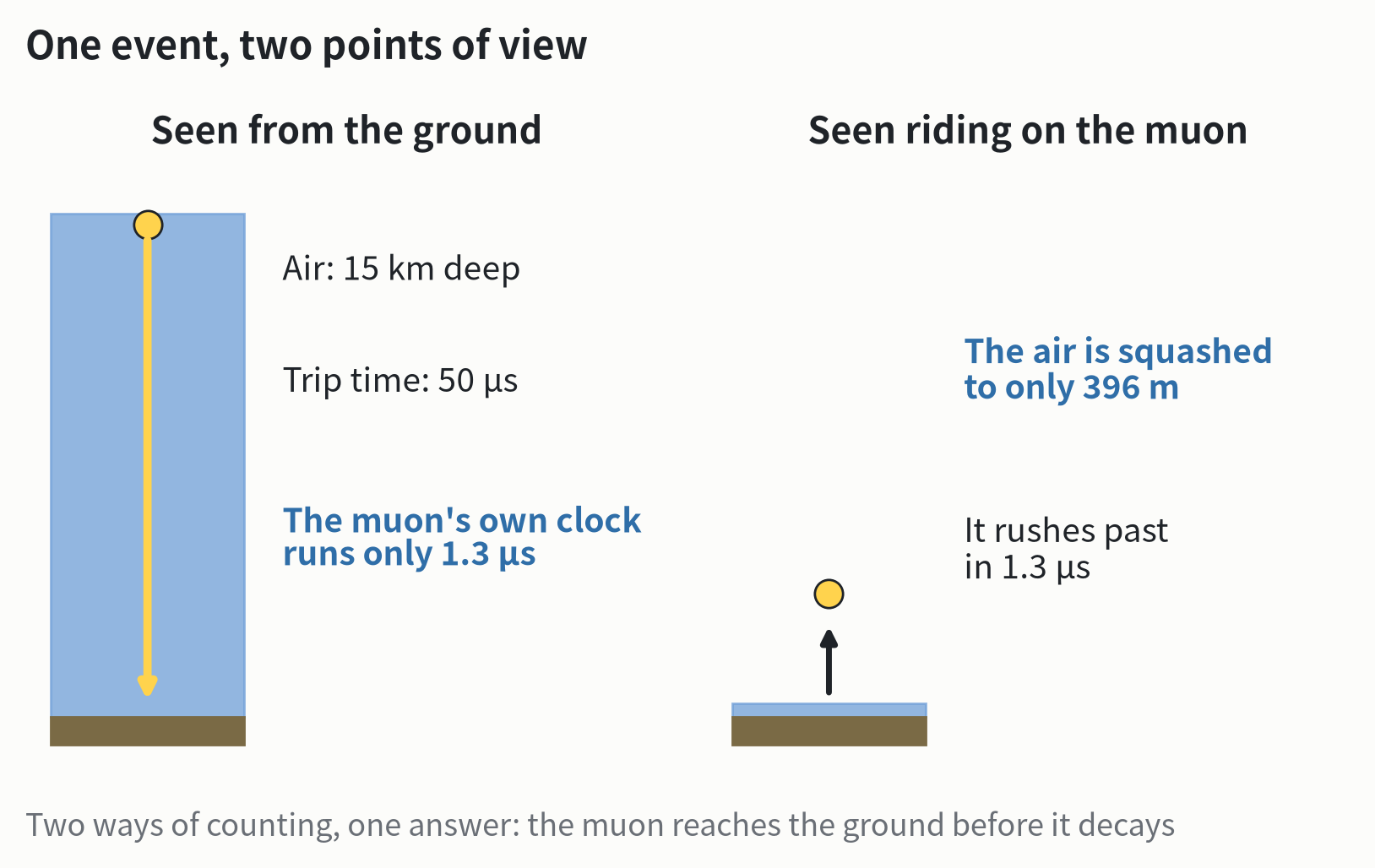
The answer: to the muon, the whole atmosphere rushing toward it is “squashed.” Fifteen kilometers of air become only about 400 meters, gone in 1.3 microseconds. Seen from the ground, the muon’s clock runs slow; seen from the muon, the distance it has to cover is shorter. The two explanations give exactly the same answer: the muon reaches the ground before it decays.
Behind this is a deeper idea of special relativity: time and space are not separate, but joined into one whole, “spacetime.” Look from a moving point of view, and a bit of “time” turns into “space” and a bit of “space” into “time”; the rule for converting between them is called the Lorentz transformation. It is a little like looking at a stick from different directions: its shadow may be long or short, but the stick itself keeps its length. In spacetime there is also a “length” that everyone measures the same, called the spacetime interval. The person on the ground and the muon each use their own times and distances, and they get exactly the same interval (the arithmetic is in “For the curious” at the end).
Clocks on planes run a little slow too
It isn’t only muons. Any moving clock runs slow; at everyday speeds, just by very little.
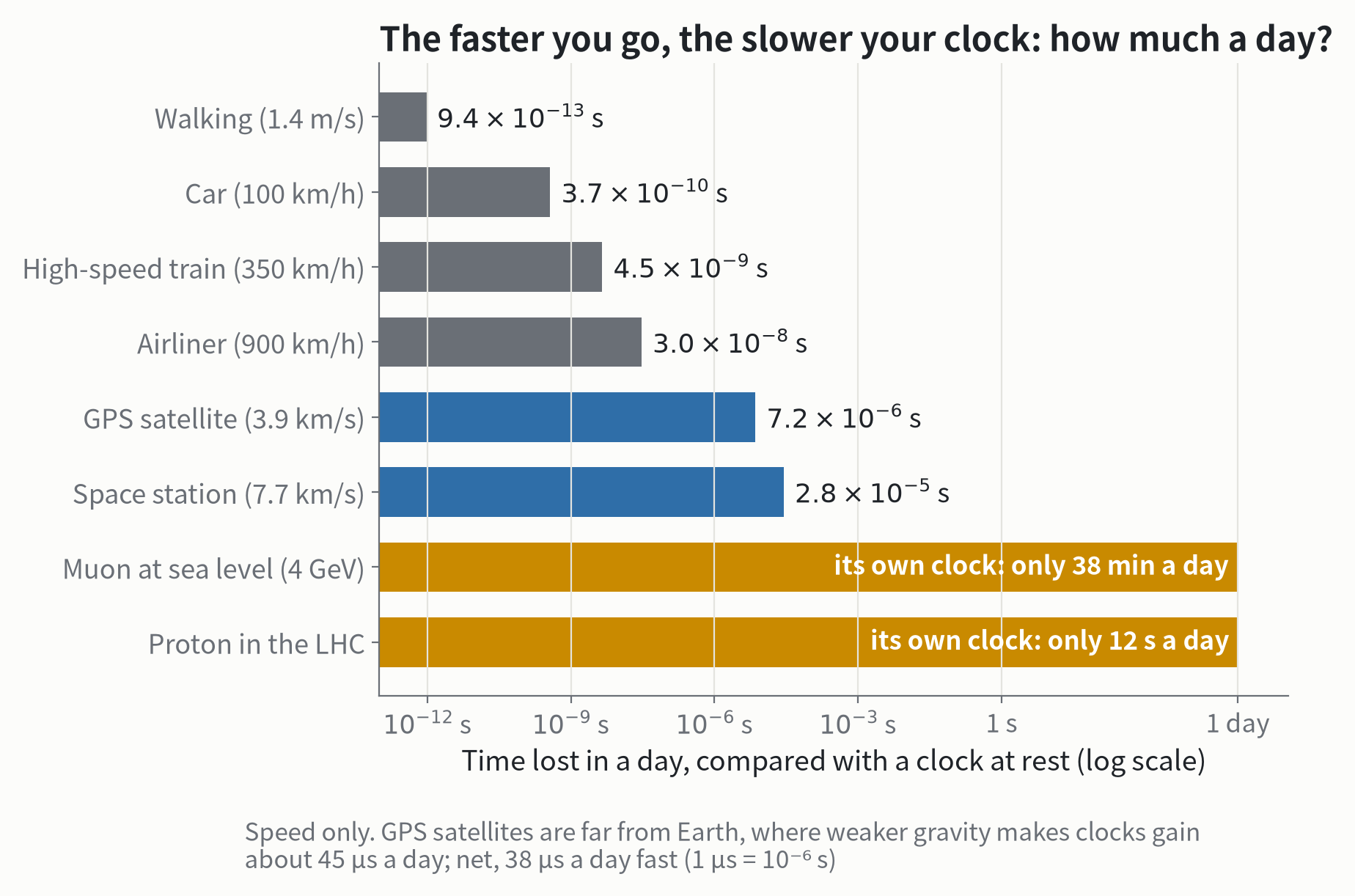
Fly in an airliner for a day, and your clock falls about 3 × 10⁻⁸ seconds behind one on the ground: 30 nanoseconds (a nanosecond is a billionth of a second, 10−9 s). In 1971, Joseph Hafele and Richard Keating actually took four atomic clocks around the world twice on commercial flights: going east, the clocks lost about 59 nanoseconds; going west, they gained about 273 nanoseconds, both as relativity predicts. Why did they gain going west? Earth itself turns eastward, so a plane flying west is actually moving more slowly around Earth’s center; and higher up, clocks run a bit faster anyway, which we come to with GPS below.
So “exercise keeps you young” is true in relativity too, just barely: run for an hour every day for 60 years, and you will be about 4 nanoseconds (4 × 10⁻⁹ s) “younger” than someone who sat still. The real benefits of running are for your body.
GPS satellites: clocks up high run fast
GPS satellites move at 3.9 kilometers a second, so their speed makes their clocks lose about 7 microseconds a day. But they are 20,000 kilometers up, and there Einstein’s other theory, general relativity, comes in: where gravity is stronger, time runs slower.
Why would gravity slow time down? One way to picture it: light going up from the ground has to “climb a hill” out of Earth’s gravity. It loses a little energy, so it becomes slightly redder, vibrating slightly slower. Someone high up, watching the light from a clock on the ground, sees each vibration arriving slower than their own clock’s, and concludes that the ground clock runs slow. In 1959, Robert Pound and Glen Rebka at Harvard sent gamma rays up and down a 22.5-meter tower and measured this tiny change.
GPS satellites are far from Earth, where gravity is weaker, so their clocks gain about 45 microseconds a day; minus the 7 lost to speed, a net gain of about 38 microseconds a day. In 38 microseconds light travels more than 11 kilometers: if relativity were left out, satellite positions would drift by about 10 kilometers a day.
Back to Journey to the West: by general relativity, clocks “in heaven” actually run fast, not slow. If there were a palace up in the sky, the immortals living there would age a tiny bit faster than us.
Muons circling in a ring
Shut muons in a ring and let them go round and round, and time dilation shows up even more clearly. In 1977, in a storage ring at CERN, the European particle physics laboratory, muons circled at 99.94% of the speed of light and lived about 64 microseconds on average, 29 times longer than at rest, matching relativity to within two parts in a thousand.
The ring was built for something else: measuring the muon’s tiny “compass needle.” A muon is itself like a minute magnet. In a magnetic field, it turns slowly like a spinning top. In the simplest theory, a number describing how fast it turns, called g, is exactly 2. But empty space is not really empty: “virtual particles” keep popping in and out of existence, and they push g a little above 2, to about 2.0023. Add up the effects of all the known particles, and you can predict how much g exceeds 2; if the measurement disagrees, some unknown particle must be meddling. This experiment is called “muon g−2.”
How do you measure it? Let the muons circle in a magnetic field: as each goes round, its needle turns too, just slightly faster than it circles. When a muon decays, the positron it gives off (the electron’s antiparticle) tends to fly in the direction the needle points, so counting positrons tells you where the needles have turned to. Relativity helps here again: at rest a muon lives only 2.2 microseconds, but in the ring it lives more than 60, enough for hundreds of laps and a long measurement.
The experiment ran in three generations: at CERN in the 1970s, at Brookhaven National Laboratory in the United States around 2000, and finally at Fermilab. Fermilab’s storage ring is a superconducting magnet about 15 meters across, moved from Brookhaven in 2013 by barge and truck, a journey of about 5,000 kilometers. In June 2025, Fermilab announced its final result, with an uncertainty of about 1.27 parts in ten million: like measuring the length of a football field to a dozen micrometers, finer than a human hair. In April 2026, the three generations of g−2 collaborations shared the Breakthrough Prize in Fundamental Physics.
And the answer? In 2021, the experiment seemed to disagree with the theory of the time, and many people guessed there was a new particle. Then theorists used supercomputers to redo the hardest part of the calculation, and the new prediction agrees well with the experiment. But two ways of doing that calculation still haven’t been fully reconciled; the story isn’t over.
X-raying a pyramid with muons
Muons are very penetrating: they can pass through tens or even hundreds of meters of stone, but the thicker the stone, the fewer get through. To cross 100 meters of stone, a muon needs tens of GeV, and only a small share of the muons from the sky have that much. So put a detector under a mountain or an ancient building and count the muons arriving from each direction: where more arrive than the known structure predicts, there is less stone than expected, perhaps a hollow. It works like an X-ray at the hospital, except that the “light source” is the muons falling free from the sky.
The idea is old. In the late 1960s, the American physicist Luis Alvarez (Nobel Prize in Physics, 1968) put detectors in the chamber under the Pyramid of Khafre, next to the Great Pyramid, and counted muons for more than a year in 1968 and 1969. The detector clearly “saw” the pyramid’s four edges, so the method worked, but it found no hidden chamber (published 1970).
The Great Pyramid of Khufu was built about 4,500 years ago. It was about 146 meters tall (139 today), with a base about 230 meters on a side, built of roughly 2.3 million blocks. Inside, the King’s Chamber, the Queen’s Chamber and the “Grand Gallery,” 8.6 meters high and about 47 meters long, were already known. From 2015, teams from Egypt, Japan, France and elsewhere ran the ScanPyramids mission with three different kinds of muon detector:
- Nuclear emulsion films from Nagoya University, a special kind of photographic film, left in the Queen’s Chamber for months; every muon passing through leaves a fine track, counted one by one under a microscope after the film is developed.
- Scintillator detectors from KEK, Japan’s High Energy Accelerator Research Organization, also in the Queen’s Chamber, which give a faint flash of light whenever a muon passes.
- Gas detectors from CEA, the French Alternative Energies and Atomic Energy Commission, placed outside the pyramid to look from another angle.
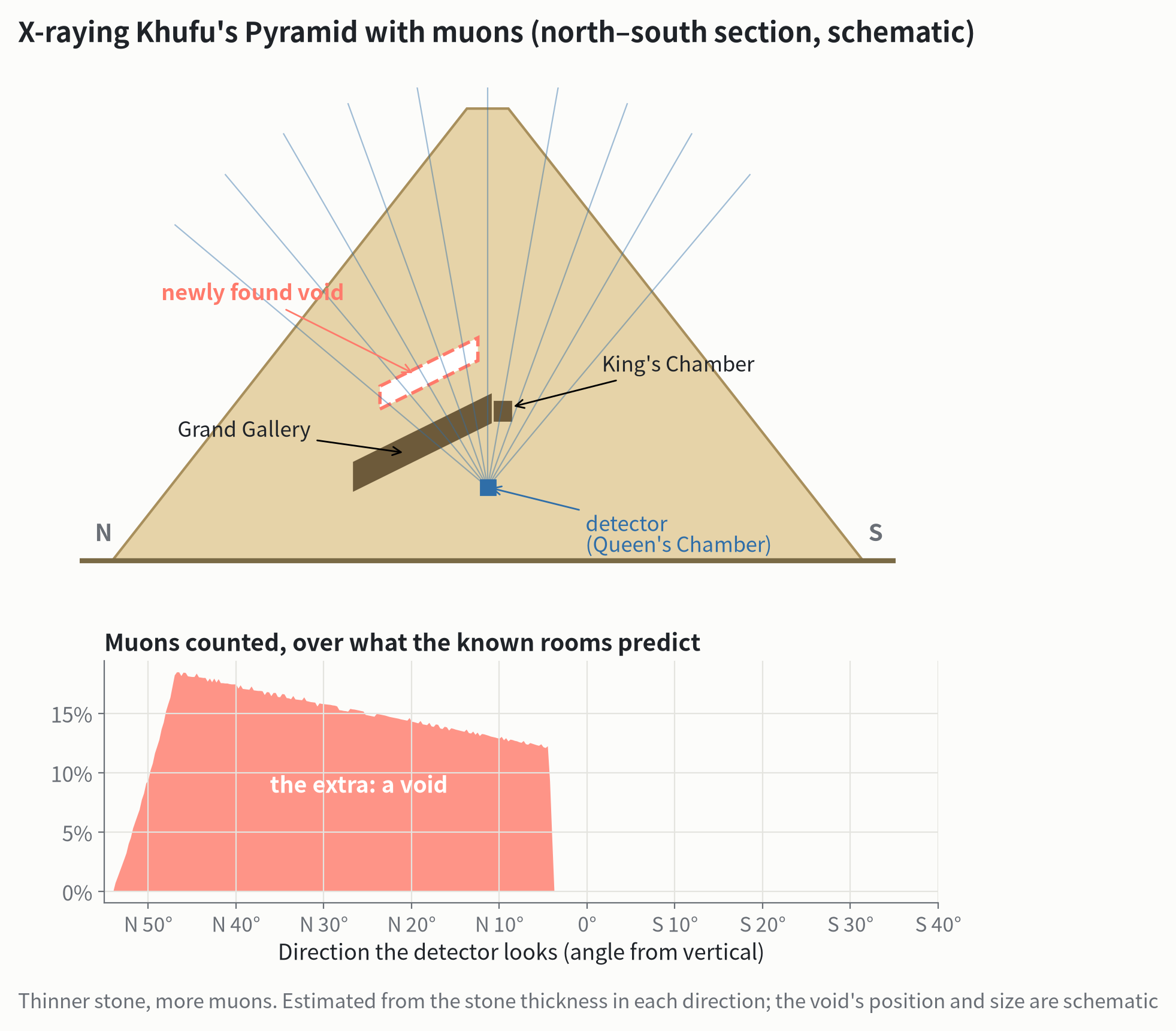
All three, from different places and by different methods, saw extra muons from the same spot above the Grand Gallery: a big void at least 30 meters long, with a cross-section similar to the Grand Gallery’s, far too strong a signal to be a chance fluctuation. The result was published in Nature in 2017. It was the first time in 4,500 years that anyone knew there was such a large space inside the pyramid; what it was for, nobody knows.
They also saw a corridor about 9 meters long, with a cross-section of about 2 by 2 meters, behind a set of chevron-shaped blocks above the pyramid’s north entrance. In March 2023, the team pushed a thin endoscope through a gap between stones and saw the corridor itself; the result was published in Nature Communications. Today the same method is used to X-ray volcanoes, to see where the magma is, and to look at the melted fuel inside the reactors at Fukushima.
Does a plane shield you from cosmic rays?
The higher you go, the less air there is overhead to block cosmic rays: at cruising altitude, radiation from cosmic rays is dozens to a hundred times stronger than on the ground (mostly from neutrons and other particles, not just muons). A flight from New York to London gives a dose of a few tens of microsieverts, about the same as one chest X-ray: nothing to worry about for an occasional traveler.
Doesn’t the plane’s metal skin help? The skin is indeed a “Faraday cage”: when lightning strikes a plane, the current flows around the outside and the people inside are safe. But it doesn’t stop cosmic rays. A Faraday cage blocks electric fields; cosmic rays are particles flying extremely fast, often with billions of electron volts, and an aluminum skin a millimeter or two thick is like a sheet of paper to them. What really shields us is the air overhead: the whole atmosphere is equivalent to 10 meters of water. At cruising altitude, less than a quarter of it is left above you, and the plane’s skin adds only about one four-hundredth as much shielding as that remaining air.
In one sentence: the faster something moves, the slower its time runs; muons from high up have their time slowed dozens of times, so they reach the ground before they decay. This isn’t a myth: it happens in your hand every second.
How do we know?
- See muons for yourself. With a clear plastic box, a slab of dry ice and high-strength isopropyl (rubbing) alcohol, you can make a “cloud chamber”: the supersaturated alcohol vapor in the box condenses into thin trails of mist wherever a charged particle passes. Sit in the dark, shine a flashlight in from the side, and within a few minutes you will see thin, straight white lines, many of them left by muons. Dry ice is very cold: wear gloves, and have an adult handle it.
- Atomic clocks. Today’s best atomic clocks can tell when they have been lifted by 30 centimeters (where gravity is a tiny bit weaker), or moved at a few meters per second.
- GPS. Satellite positioning around the world corrects the satellites’ clocks for relativity every day; if relativity were wrong, navigation would have stopped working long ago.
What we still don’t know
Where do the highest-energy cosmic rays come from? In May 2021, the Telescope Array in Utah detected a single cosmic-ray particle with an energy of about 2.4 × 10²⁰ electron volts, about as much energy as a fast-flying tennis ball packed into one particle. It was named “Amaterasu,” after the sun goddess of Japanese mythology. But it came from the direction of the “Local Void,” a nearly empty region next to our galaxy, where there is no known object able to accelerate a particle to such an energy.
One reason: cosmic rays are charged, so magnetic fields in our galaxy and between galaxies bend their paths, and the direction they arrive from need not point back to where they started. If the particle was a heavier nucleus with more charge, it would bend even more. Tracing it back through various models of those fields still hasn’t found a convincing source. That is why scientists also hunt with uncharged “messengers”: neutrinos carry no charge and don’t bend, so wherever they point is where they came from. In 2018, the IceCube detector at the South Pole caught a high-energy neutrino pointing to a blazar (a galaxy with a supermassive black hole whose jet points at us) about 4 billion light-years away: the first time a neutrino pointed to a likely source of high-energy cosmic rays. Where the universe’s most powerful “particle accelerators” are is still a mystery.
For the curious: the formulas, the simulation and the data
How slow. A clock moving at speed , seen by someone at rest, has each tick stretched by a factor
where is the speed of light. The light-clock derivation: with mirrors a distance apart, one way takes at rest; moving, the light goes along a slant, and by Pythagoras , so . At low speeds, : for an airliner at 250 meters a second, , about s a day. is also a particle’s total energy divided by its rest energy: the muon’s rest energy is 105.66 MeV, so a 4 GeV muon has . “One day in heaven, a year below” needs , so . Running at 3 m/s: ; an hour a day for 60 years is about s, so about s in all.
Spacetime: the Lorentz transformation and the interval. For two frames moving at speed relative to each other along , the time and position of the same event convert as
Time and space mix. What stays the same is the spacetime interval:
where is the Minkowski metric. Unlike an ordinary rotation (which keeps ), the time term has a plus sign and the space terms minus. For the muon: from the ground, km and μs, so m and m. For the muon itself, it stays put, , so and its own clock runs μs. Both get the same .
Muons. Mean lifetime 2.1970 microseconds (Particle Data Group); m. Decay: . Muons come mainly from the decay of pions made by cosmic rays high up, mostly around 15 kilometers, and lose about 2 GeV of energy in collisions with the air on the way down. At sea level, a horizontal detector counts about 1 muon per square centimeter per minute, with an average energy of about 4 GeV; more come from near the vertical.
The animation. 160 muons start between 13.5 and 16.5 kilometers up; each muon’s “own lifetime” is drawn at random from an exponential distribution with a mean of 2.197 microseconds. To keep it simple, every muon has 4 GeV, flies straight down, and loses no energy on the way. On the left they live their own lifetimes; on the right, lifetimes 38 times longer. From 15 km, the fraction reaching the ground is about on the right (24.9 km is ) and on the left.
Mount Washington. Frisch and Smith, American Journal of Physics 31, 342 (1963). Summit 1,917 m, 563 ± 10 an hour; Cambridge, Massachusetts, at sea level, 412 ± 9 an hour; about 27 expected without time dilation. They counted muons that stopped in the detector, moving at about 99.5% of the speed of light at the summit; since muons lose some energy in 1,900-odd meters of air, they corrected for it with absorbing material so that the summit and the seaside counts were of the same muons. The measured time dilation factor was 8.8 ± 0.8; relativity gives about 10 at the summit, falling to about 7 by sea level as the muons slow down. The blue line uses an average of about 8.4.
Time lost per day. s. GPS satellites orbit at a radius of about 26,560 km and about 3.87 km/s: the speed effect is about s a day; the gravity effect, s; a total of about s. A 6.8 TeV proton in the Large Hadron Collider has , so its own clock runs only about 12 seconds a day. Pound–Rebka: over 22.5 m, the fractional frequency shift is .
Hafele–Keating. October 1971, cesium clocks on commercial flights eastward and westward around the world (Science, 1972). Eastward: predicted −40 ± 23 ns, measured −59 ± 10 ns. Westward: predicted +275 ± 21 ns, measured +273 ± 7 ns. The predictions include both the speed and the gravity effects.
g−2. CERN storage ring: Bailey and others, Nature, 1977: muons with lived 64.4 microseconds, matching relativity to within two parts in a thousand (95% confidence). What “g−2” measures is . Fermilab’s final result (Physical Review Letters, 2025): , to 127 parts per billion (). The muons have a momentum of 3.094 GeV/c (the “magic momentum,” at which the focusing electric fields don’t affect how the needle turns), so , the same as at CERN in 1977; the ring is about 45 m around, and one lap takes about 0.15 μs. Theory: the 2025 White Paper of the Muon g−2 Theory Initiative, which uses lattice QCD for the hadronic vacuum polarization, agrees with the experiment.
The pyramid. Morishima and others, Nature, 2017 (the big void, seen by all three kinds of detector, with significances from 5.8σ to more than 10σ); Procureur and others, Nature Communications, 2023 (the north face corridor); Alvarez and others, Science, 1970 (Khafre). Figure 6: stone density 2.4 g/cm³; the minimum energy to cross a thickness (meters of water equivalent) is with GeV per m.w.e. and per m.w.e.; the number of sea-level muons above energy goes roughly as . Only a two-dimensional section; the void’s position and size are schematic, not measured.
Flight radiation. At cruising altitude and high latitude, the dose rate is about 6 microsieverts an hour, compared with about 0.06 microsieverts an hour from cosmic rays at sea level; New York to London is about 30 to 40 microsieverts, and one front chest X-ray about 20. The numbers vary with route, altitude and solar activity. The whole atmosphere is about 1,030 g/cm²; above 11 km, about 230 g/cm² remains; 2 mm of aluminum is about 0.54 g/cm².
The Amaterasu particle. Telescope Array Collaboration, Science, 2023: May 27, 2021, about 244 EeV ( eV). The IceCube neutrino IceCube-170922A and the blazar TXS 0506+056: Science, 2018.