What Else Does the Sun Send Us Besides Light?
What Color Is Sunlight? said that sunlight leaves the Sun’s surface and reaches Earth in about 8 minutes 20 seconds. But light is not all the Sun sends. Every second, several hundred trillion particles from the center of the Sun pass through your body; and an invisible “wind” blows all the way from the Sun to Earth. In May 2024 that wind gusted hard, and many people in Chicago, New York and all the way to the American South saw aurorae from their own backyards.
Take a guess
Things you often hear: “What the Sun gives Earth is light and heat”; “aurorae are sunlight reflected off the snow, ice or clouds near the poles.”
Neither is right. Besides light, the Sun sends two other things. One is neutrinos, which hardly interact with anything: they pass through us, and through the whole Earth, as if nothing were there. The other is the solar wind, a stream of charged particles; aurorae are made by it together with Earth’s magnetic field and air, and have nothing to do with reflected sunlight.
What happens at the center of the Sun
The Sun’s energy comes from nuclear fusion at its center: at 15 million degrees, hydrogen nuclei (that is, protons) are built, step by step, into helium nuclei, releasing energy.
The main route is called the “proton–proton chain”: two protons collide, one of them turns into a neutron, and together they make deuterium (heavy hydrogen), giving off a positron and a neutrino; the deuterium grabs another proton and becomes helium-3; two helium-3 nuclei collide and become one helium-4, releasing two protons. Adding it up: four protons become one helium nucleus, giving off two neutrinos. The chain has a few side branches, where nuclei of lithium, beryllium and boron are made and soon turned into helium, giving off neutrinos of higher energy. About 99% of the Sun’s energy comes from the proton–proton chain; the other 1% or so comes from the “CNO cycle”, in which nuclei of carbon, nitrogen and oxygen act like a catalyst, helping to turn hydrogen into helium without being used up. In 2020, the Borexino experiment in Italy detected the neutrinos from this cycle for the first time.
The helium made stays at the center of the Sun and keeps piling up, like ash in a furnace. 15 million degrees is not hot enough to burn helium: helium nuclei need about 100 million degrees to fuse into carbon. In about 5 billion years, when the hydrogen at the center runs out, the Sun will swell into a red giant, and only then will its center be hot enough to burn helium.
Light and neutrinos are born in the same place, but they take completely different paths out of the Sun.
Can light be absorbed inside the Sun? Yes, and it is absorbed again and again all the way out. The inside of the Sun is very dense; the light at the center is X-rays, and it can’t go far before it is scattered by electrons or absorbed by nuclei and electrons, then sent out again in some random direction. The energy isn’t lost, just handed on over and over; strictly speaking, what is sent out each time is new light. The farther out, the cooler it is, and the lower the energy of the light handed on, until at the surface it becomes the visible light we see.
Walking one step this way, one step that, is called a “random walk”. The simulation above counts it: when the radius is 32 times the step, it takes a little over 1,000 steps on average to get out, which is just 32 × 32. Walking in a plane or in a three-dimensional ball gives the same result. The rule: the number of steps = (radius ÷ step)².
The Sun’s radius is 700,000 kilometers. If each step were 1 millimeter, the number of steps would be (700 billion millimeters)², about 5 × 10²³ steps, and even at the speed of light for every step, it would take 50,000 years. Detailed models of the Sun estimate that energy takes about 170,000 years to work its way from the center to the outer layers. When the energy in the sunlight on your face today was born at the center of the Sun, our modern human ancestors were still living in Africa.
Neutrinos don’t have to take this long detour. They hardly interact with anything, flying straight out from the center of the Sun at nearly the speed of light, reaching the surface in about 2.3 seconds and Earth in about 8 minutes 19 seconds.
65 billion neutrinos a second through your fingernail
How many neutrinos are there? You can work it out from how bright the Sun is. How much energy the Sun gives off as light each second can be measured; how much energy is released in making one helium nucleus is known too, and the two neutrinos carry off only a small part of it, while the rest ends up as light. Divide the total energy of the light by that, and you know how many helium nuclei the Sun makes each second, with two neutrinos for each: about 1.8 × 10³⁸ neutrinos a second.
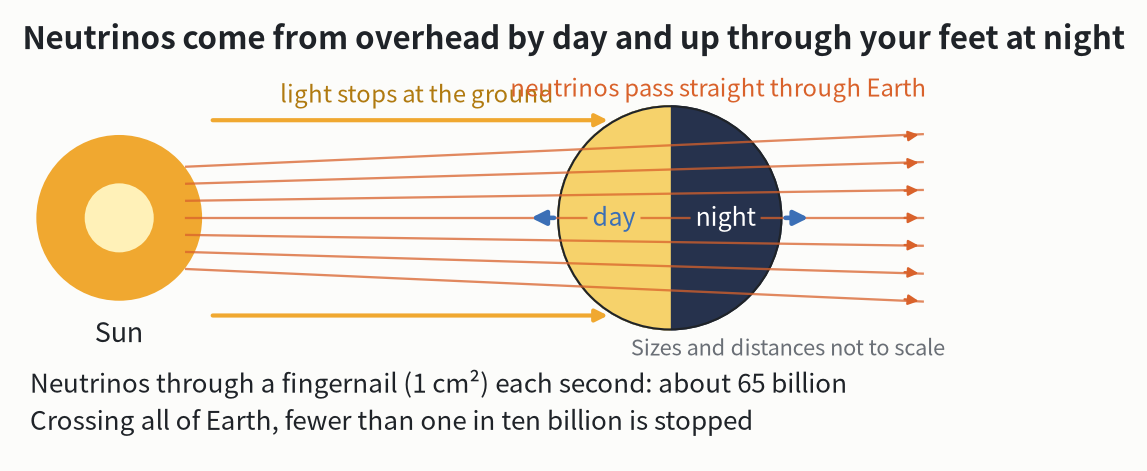
These neutrinos fly off in every direction. By the time they reach Earth’s distance, 150 million kilometers away, they are spread over a huge sphere centered on the Sun with a radius of 150 million kilometers; averaged over that sphere, about 65 billion pass through each square centimeter every second, about the size of one of your fingernails. Through the side of your body facing the Sun, taken as half a square meter, more than 300 trillion neutrinos pass every second.
And they never stop, day or night: by day they come from overhead; at night they first cross the whole Earth and then come up through your feet. Neutrinos interact with matter so rarely that, crossing all of Earth, fewer than one in ten billion is stopped. They carry off about 2% of the Sun’s energy and simply fly on into space.
Two-thirds of the neutrinos were missing
How do we know something so hard to catch is really there? In the 1960s, the American physicist Ray Davis put a huge tank of more than 600 tonnes of dry-cleaning fluid 1,500 meters underground, in a gold mine in South Dakota. Now and then a neutrino would turn a chlorine atom in the fluid into an argon atom. Every month or two, he found and counted the few dozen argon atoms in that enormous tank.
What he counted was only about a third of what theory predicted. Was the model of the Sun wrong, or the experiment? This puzzle, called the “solar neutrino problem”, troubled physicists for 30 years.
The answer lay with the neutrinos themselves. As far as we know today, there are three kinds of neutrino: the electron neutrino, the muon neutrino and the tau neutrino, named after the three charged particles they pair with: the electron, and its heavier cousins, the muon and the tau. Fusion in the Sun makes only electron neutrinos, and Davis’s experiment could catch only that kind. In 2001, the Sudbury Neutrino Observatory in Canada used a thousand tonnes of heavy water to count all three kinds together: the total matched the prediction of the solar model exactly. On their way from the Sun to Earth, the neutrinos had been turning into the other two kinds, which is called “neutrino oscillation”. That neutrinos can “change” means they have mass, while in the original Standard Model of particle physics, neutrinos had none.
This story won the Nobel Prize in Physics twice. In 2002, Davis and Masatoshi Koshiba of Japan won it for pioneering the detection of neutrinos from space: Davis caught neutrinos from the Sun, and Koshiba’s Kamiokande detector caught neutrinos from an exploding star, a supernova, in 1987. In 2015, Takaaki Kajita of Japan and Arthur McDonald of Canada won it for discovering neutrino oscillation, which shows that neutrinos have mass.
The solar wind: 1.5 million tonnes a second
The Sun’s outermost atmosphere, the corona, is at one or two million degrees, hundreds of times hotter than the Sun’s surface. Gas this hot cannot be held by the Sun’s gravity, and it keeps blowing outward as the solar wind. It is mostly protons and electrons, and it carries the Sun’s magnetic field with it.
Near Earth, the solar wind has only a few particles per cubic centimeter, thinner than the best vacuum in a laboratory; but it is fast, usually around 400 kilometers per second, and 700 or 800 kilometers per second at its fastest. From a whole year of measurements in 2024, the solar wind carried away about 1.57 million tonnes of matter every second. And by shining, according to Einstein’s E = mc², the Sun gets about 4.26 million tonnes “lighter” every second. That sounds like a lot, but at today’s rates, 4.6 billion years of it adds up to only about four ten-thousandths of the Sun’s mass.
Earth’s magnetic field steers particles toward the poles
When the solar wind reaches Earth, it runs head-on into Earth’s magnetic field. Charged particles can’t simply cross magnetic field lines; they can only circle around them and slide along them. Earth’s field is much like that of a bar magnet: its field lines come out near the South Pole, loop around in a big arc and go back in near the North Pole, so the particles are steered toward the poles.
First, a term: magnetic latitude. Earth’s magnetic field has its own north and south poles, which are not at the geographic poles; the northern one is over northern Canada. Latitude measured from this “magnetic axis”, the same way geographic latitude is measured, is called magnetic latitude: 0 degrees at the magnetic equator and 90 degrees at the magnetic pole. Particles follow the magnetic field, so for aurorae it is magnetic latitude that counts.
MeV means “million electron volts”. The electron volt is a unit of energy used for tiny things: the energy an electron gains when pushed by 1 volt is 1 electron volt; one particle of visible light carries only about 2 electron volts. A proton with an energy of 1 MeV travels about 14,000 kilometers every second, 4.6% of the speed of light.
The two protons in the simulation have the same energy, only different directions.
The blue one starts at the magnetic equator, about 32,000 kilometers above the ground. At the magnetic equator, field lines point from south to north; its velocity is at a slant of 35 degrees to the field line, so it circles the field line while moving north (up in the picture). That high up, Earth’s field is already very weak, about 200 times weaker than on the ground; but a proton is very light, and this small magnetic force is enough to make it circle: once every 0.45 seconds, in a circle about 600 kilometers in radius.
The farther north, the more the field lines crowd together and the stronger the field. The proton’s circles get tighter and faster; its total speed doesn’t change, so the more of it goes into circling, the less is left for moving along the field line, until at about 28 degrees magnetic latitude that drops to zero and the proton is pushed back, like a ball rolling into a narrowing funnel and being turned back. This is called a “magnetic mirror”. In the south the same thing happens again. So it keeps bouncing north and south, always 24,000 to 33,000 kilometers above the ground, never touching the air. The proton is so fast that, counting its circling, it covers well over 100,000 kilometers on each round trip, yet takes only about 10 seconds.
In the animation, the blue path drifts slowly to one side as it bounces: that is the proton drifting west around Earth, once around in about 8 minutes, moving about 30 degrees in 40 seconds. Earth is not spinning in the simulation, because a field like this is symmetric about its magnetic axis, so whether Earth turns makes no difference to it. Earth is surrounded by huge numbers of charged particles bouncing and drifting like this: the more energetic ones form the Van Allen radiation belts, discovered in 1958 by the first American satellite; among the somewhat less energetic ones, protons drift west and electrons east, which together make a current flowing around Earth, called the ring current.
The red one starts at 30 degrees magnetic latitude and moves almost straight along the field line: so little of its speed goes into circling that it reaches the air before it can be bounced back. In 2 seconds it slides down to 66 degrees magnetic latitude and into the air 100 kilometers up (the green star in the animation).
Why 66 degrees? This field line is 6 Earth radii from Earth’s center at the magnetic equator, and following it down to the ground brings you to 66 degrees magnetic latitude. Field lines farther out connect to the outer part of Earth’s field, which the solar wind squashes and stretches, and mostly come down at 65 to 70 degrees magnetic latitude. Particles that “leak” in from the solar wind, mostly electrons, come down along these field lines, and where they land forms a ring around the magnetic pole, the auroral oval. 66 degrees is just where this particular field line lands; its closeness to the Arctic Circle (66.6 degrees) is a coincidence.
Aurorae are made mainly by electrons. Protons come down too, making a faint, diffuse “proton aurora” that is usually invisible to the eye. Why simulate protons, then? A proton is 1,836 times heavier than an electron. At the same energy, the radius of a particle’s circle around the field line is proportional to the square root of its mass times its energy: a 1 MeV proton circles out there in a radius of about 600 kilometers, big enough to see in the picture; the electrons that make aurorae usually have a few thousand electron volts, and in the same place they circle in a radius of only a kilometer or two, which would look like a single line. But they follow the same field lines.
The auroral oval is at 65 to 70 degrees magnetic latitude, which is why aurorae are seen most often in Alaska, northern Canada and northern Norway. Chicago and Beijing are at about the same geographic latitude, but Chicago is much closer to the northern magnetic pole: its magnetic latitude is about 51 degrees, Beijing’s only about 31. In the same storm, Chicago has a much better chance of seeing aurorae than Beijing.
The Sun has “weather” too
The solar wind isn’t always calm. Sunspots on the Sun’s surface are places where the magnetic field is especially strong; in years with many sunspots, the Sun “erupts” more easily, suddenly throwing out billions of tonnes of magnetized gas, a coronal mass ejection. If one is headed straight for Earth, it arrives in a day or two.
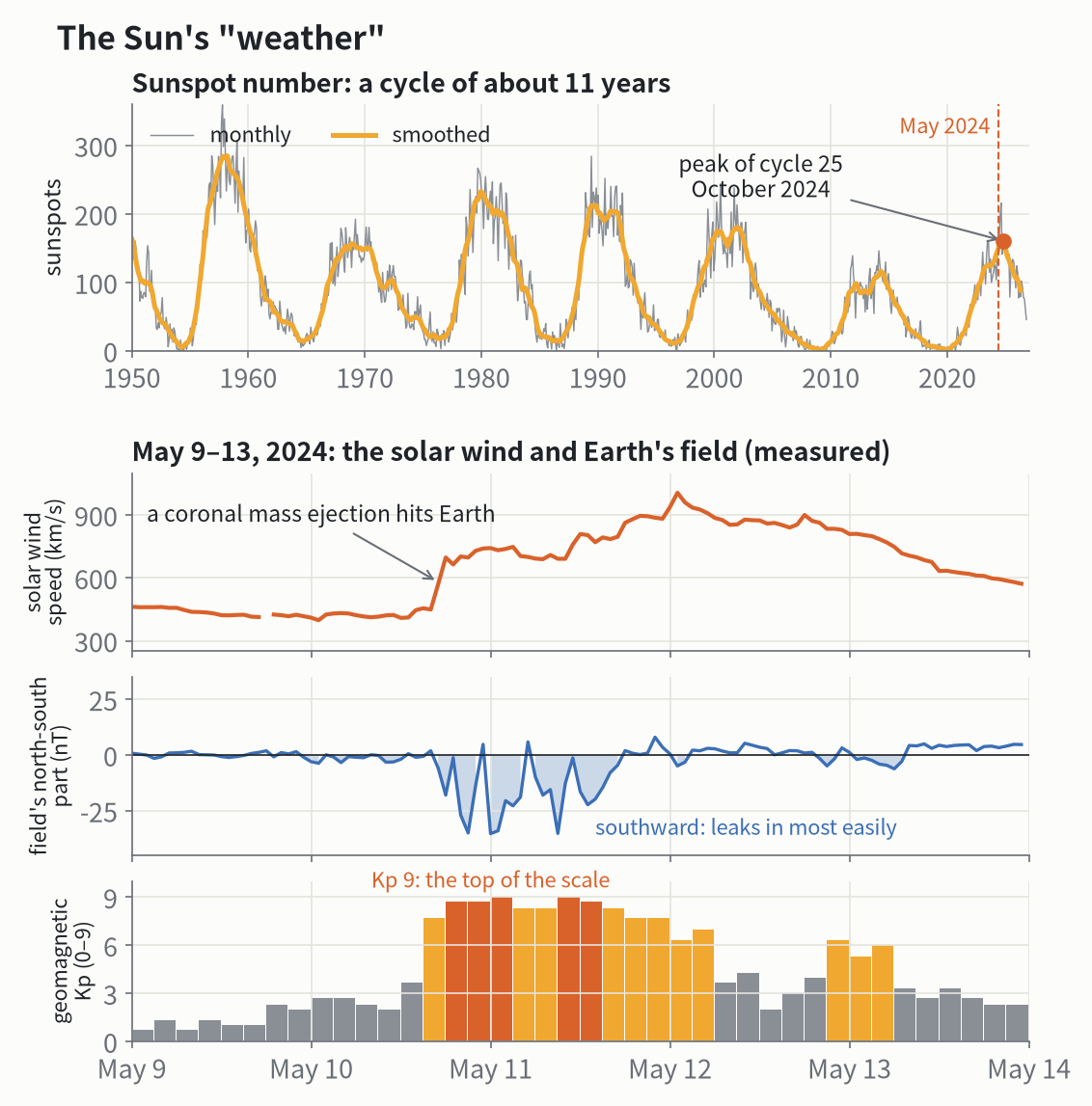
First, two units in the figure. The nanotesla (nT) is a unit of magnetic field, a billionth of a tesla: on the ground, Earth’s field is about 30,000 to 60,000 nanotesla; a fridge magnet’s field is several million; the field carried by the solar wind is usually only a few nanotesla. The Kp index measures how hard Earth’s magnetic field is being shaken: a dozen or so magnetic observatories around the world measure, every 3 hours, how much the direction and strength of the field on the ground has wobbled; this is converted with a table into a scale of 0 to 9 and combined into one number. 0 is very quiet, 5 and above counts as a geomagnetic storm, and 9 is the top of the scale; each step up means a wobble roughly twice as large.
The sunspot number goes through a cycle of about 11 years; the peak of this cycle (cycle 25), by the smoothed sunspot number, came in October 2024. In May of that year, a big group of sunspots threw out several coronal mass ejections one after another. They hit Earth on the afternoon of May 10 (UTC): the solar wind speed jumped from a little over 400 to 700 kilometers per second, and later reached 1,000; the magnetic field it carried turned south, reaching 35 nanotesla at its strongest.
Why does a southward field matter? On the side facing the Sun, Earth’s field points north; when the solar wind’s field points south, the field lines on both sides “connect”, and the solar wind’s energy and particles pour into Earth’s magnetic field, like two magnets snapping together. That night, the global geomagnetic Kp index reached 9, the top of the scale, the strongest geomagnetic storm since 2003, and the auroral oval, usually near the Arctic Circle, spread far to the south.
Why aurorae are green and red
The electrons coming down crash into oxygen atoms and nitrogen molecules high in the air and “excite” them, that is, hand them energy and leave them in a higher-energy, unsteady state. When they return to their original state, they turn that energy into light of a particular color, like a neon sign. The color of an aurora depends on which atoms are hit and how high up, not much on whether electrons or protons came down.
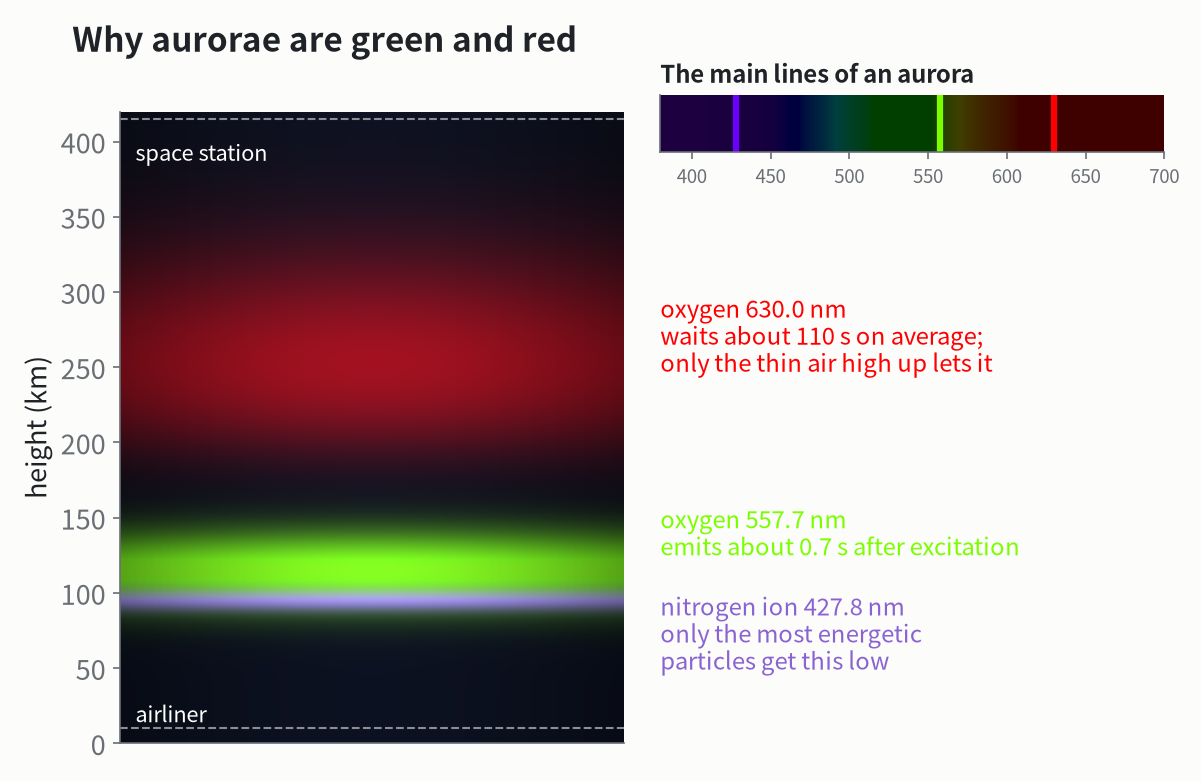
An excited atom doesn’t give off its light right away; it waits a while. How long it waits on average is called the “lifetime” of that excited state. It is the same kind of idea as the half-life of a radioactive element: each atom waits a different time, and the lifetime is the average.
The most common color, green, is light of 557.7 nanometers from oxygen atoms, mostly 100 to 150 kilometers up. This excited state has a lifetime of about 0.7 seconds, a short wait, so the light comes out quickly. Red also comes from oxygen atoms, at 630.0 nanometers, but its lifetime is about 110 seconds, a long wait. Below 150 kilometers the air is dense enough that in that long a time, the atom has been bumped by other molecules countless times, its energy carried off in the collisions, and the light never comes out. Only in the thin air above 200 kilometers can it wait long enough to shine. So red is on top and green below. Sometimes especially energetic particles reach down to about 100 kilometers, where nitrogen molecular ions give off blue-violet light, and the lower edge of the auroral curtain takes on a purplish-red tint.
On that night in May 2024, many people found that aurorae photographed with their phones looked much redder and more vivid than what they saw with their eyes. At night the light is too dim, and the eye sees mainly with its rod cells, which can’t tell colors apart; the cone cells the eye uses to tell colors (see Your Eyes Only Count to Three: How Do We See Color?) hardly work in the dark. A phone camera exposes for a second or two and brightens the picture, and all the colors come out.
In one sentence: the Sun sends us more than light; there are neutrinos, hundreds of trillions of them passing through us every second, coming up through our feet at night; and there is the solar wind, steered by Earth’s magnetic field toward the poles, where it hits the oxygen and nitrogen high in the air and makes aurorae.
How do we know?
- Photographing the Sun with neutrinos: Japan’s Super-Kamiokande detector holds 50,000 tonnes of pure water in a mine 1,000 meters underground. Now and then a neutrino hits an electron in the water, and the direction the electron is knocked in points roughly at the Sun. Record those directions, and you get a picture of “the Sun as seen by neutrinos”, and it works just as well at night, when the neutrinos come through from the other side of Earth.
- “Weather stations” in space: between the Sun and Earth, about 1.5 million kilometers from Earth, several satellites keep measuring the solar wind’s speed and magnetic field; the data above came from them. From there the solar wind normally takes about an hour to reach Earth, and even at 1,000 kilometers per second it takes 25 minutes. That is how much warning we get of a geomagnetic storm.
- Compass needles on the ground: magnetic observatories around the world keep recording how the field on the ground wobbles, and the Kp index is worked out from these records.
- Counting sunspots: people have been counting sunspots since Galileo’s generation first turned telescopes on the Sun in 1610; the Royal Observatory of Belgium has collected the sunspot number for every month from 1749 to today.
What we still don’t know
Why the corona is hundreds of times hotter than the Sun’s surface is still not fully understood; it is called the “coronal heating problem”. How the solar wind is sped up to hundreds of kilometers per second is still being studied, and NASA’s Parker Solar Probe keeps diving through the corona to measure it. How strong the next solar cycle will be is still hard to forecast years ahead. Neutrinos have mass, but exactly how much, and which of the three kinds is heaviest, are still unknown; these are among the questions particle physics most wants to answer today.
For the curious: formulas, data and sources
Light’s random walk. With each step in a random direction and of length l, the average squared distance from the start after N steps is N l²; to get beyond radius R takes (R/l)² steps on average, both in a plane and in three dimensions. The simulation averages 400 walks for each radius: for R/l = 4, 8, 16 and 32, the walks in a plane averaged 19, 70, 266 and 1,007 steps, and in 3D 19, 69, 270 and 1,047, close to (R/l)² = 16, 64, 256 and 1,024 (with few steps, the last step “overshoots” the edge a little, so a few more). The walk drawn in the animation took 478 steps, against an average of (1/0.045)² ≈ 494. In the real Sun, the deeper you go the denser it is, and the length of one step of light ranges from much less than a millimeter to about a centimeter, so the answer has to come from a model of the Sun: Mitalas and Sills (1992) found that energy takes about 170,000 years to travel from the center to the outer layers; different estimates range from ten thousand to over a hundred thousand years. In the outer 30% or so of the radius, convection carries the energy up instead, taking only a few months.
Nuclear reactions in the Sun. The main line of the proton–proton chain is: p + p → ²H + e⁺ + νₑ; ²H + p → ³He + γ; ³He + ³He → ⁴He + 2p. The side branches go through ⁷Be and ⁸B and give off higher-energy neutrinos (⁷Be neutrinos 0.86 MeV, ⁸B neutrinos up to about 15 MeV, while the main line’s pp neutrinos have at most 0.42 MeV). In the standard solar model, the proton–proton chain provides about 99% of the energy and the CNO cycle about 1%; Borexino detected CNO neutrinos in 2020. Fusing helium into carbon (three ⁴He → ¹²C) needs about 100 million degrees.
How many neutrinos. Making one helium nucleus from four protons releases 26.73 MeV, of which the two neutrinos carry off about 0.59 MeV on average; the remaining 26.14 MeV ends up as light leaving the surface. The Sun’s luminosity, the total energy it gives off as light each second, is 3.828 × 10²⁶ watts (IAU 2015 nominal value), and it does not include the energy carried off by neutrinos. So the Sun makes 3.828 × 10²⁶ joules ÷ 26.14 MeV ≈ 9.1 × 10³⁷ helium nuclei per second, giving off about 1.8 × 10³⁸ neutrinos. They fly out evenly in every direction and, when they reach Earth, are spread over a sphere 1 astronomical unit in radius; 1 astronomical unit is the average distance from Earth to the Sun, 149.6 million kilometers. The sphere’s area is 4π × (1.496 × 10¹³ cm)² ≈ 2.8 × 10²⁷ square centimeters, and dividing gives 6.5 × 10¹⁰ per square centimeter per second, in agreement with the standard solar model. Taking the side of a body facing the Sun as 0.5 square meters (5,000 square centimeters) gives about 3 × 10¹⁴ per second. The cross-section for a solar neutrino to scatter off an electron is about 10⁻⁴⁵ to 10⁻⁴⁴ square centimeters (rising with energy); along Earth’s diameter there are about 2 × 10³³ electrons behind each square centimeter, so the chance of being scattered while crossing Earth is only about 10⁻¹² to 10⁻¹¹. Light takes 2.32 seconds to cross the Sun’s radius (695,700 km) and 499 seconds to cross 1 astronomical unit.
The neutrino experiments. Davis’s Homestake experiment (starting in 1968) used 615 tonnes of perchloroethylene and measured about a third of the predicted rate. Results from the Sudbury Neutrino Observatory (SNO) in 2001 and 2002 showed that the total of all three kinds of neutrino agrees with the solar model. The 2002 Nobel Prize in Physics went to Davis and Koshiba “for pioneering contributions to astrophysics, in particular for the detection of cosmic neutrinos” (the other half went to Riccardo Giacconi for X-ray astronomy); the 2015 prize went to Kajita and McDonald “for the discovery of neutrino oscillations, which shows that neutrinos have mass”.
The solar wind and mass. The data are NASA Goddard’s OMNI 2 data set, one value per hour for 2024, combining measurements between the Sun and Earth by ACE, Wind, DSCOVR and other spacecraft, shifted to Earth’s position. In 2024 the average was 7.2 protons per cubic centimeter and the median speed 385 kilometers per second; proton number density × speed × proton mass (plus the measured helium), times the area of a sphere at 1 astronomical unit, gives about 1.57 × 10⁹ kilograms per second carried off by the solar wind. The mass the Sun loses each second by shining is its luminosity ÷ the speed of light², about 4.26 × 10⁹ kilograms. Together, at today’s rates over 4.6 billion years, that is about 0.04% of the Sun’s mass (1.989 × 10³⁰ kg).
Particles in a magnetic field. The simulation uses the relativistic Boris algorithm to solve, step by step, a proton’s equations of motion in a dipole field (the Lorentz force: force = charge × velocity × field, at right angles to both the velocity and the field), with a field of 3.12 × 10⁻⁵ tesla on the ground at the magnetic equator and at least 40 steps per turn around the field line. Both protons are on the L = 6 field line: it is 6 Earth radii from Earth’s center at the magnetic equator, where the field is 3.12 × 10⁻⁵ ÷ 6³ ≈ 144 nanotesla, and it reaches the ground at 65.9° magnetic latitude. The blue proton starts at the magnetic equator with its velocity at 35° to the field (the “pitch angle”): it bounces between about ±28° magnetic latitude, about 10.4 seconds for a round trip, circles the field line once in 0.45 seconds at the equator, and drifts west around Earth once in about 8.2 minutes. The mirror works because the particle’s “magnetic moment” (kinetic energy across the field ÷ field strength) stays the same, so where the field has grown 1/sin²(35°) ≈ 3 times, the speed along the field line falls to zero. The red proton starts at 30° magnetic latitude with a pitch angle of only 3°: on this field line, particles whose pitch angle at the equator is less than 2.9° (the “loss cone”) reach the air at 100 km before they can be bounced back; it hits the air at 65.7° magnetic latitude after 1.9 seconds. The radius of the circle is r = p⊥ / (qB), where p⊥ is the momentum across the field, q the charge and B the field; at the same kinetic energy E, p = √(2mE), so r is proportional to √(mE). A 1 MeV proton at the equator (144 nanotesla) circles with a radius of about 570 km; a 5 keV (5,000 electron volt) electron in the same place, about 1.7 km, and near the ground only a few meters. Earth’s real field is squashed and stretched by the solar wind and is not exactly a dipole; its magnetic axis is also tilted from the spin axis, so the field wobbles as Earth turns. The simulation leaves all this out.
Magnetic latitude. Taking the geomagnetic (dipole) north pole at 80.8° N, 72.7° W: Chicago (41.9° N) is at about 50.7° magnetic latitude and Beijing (39.9° N) at about 30.8°.
The Kp and Dst indices. Kp is published by the GFZ German Research Centre for Geosciences: from 13 mid-latitude magnetic observatories, the largest change of the horizontal field within each 3 hours is converted with a quasi-logarithmic table into a scale of 0 to 9 (in 28 steps: 0, 0+, 1−, 1, …, 9−, 9) and averaged. Dst is published by Kyoto University: from 4 observatories near the equator, the hourly change of the horizontal field measures how much the ring current has pushed down the field on the ground; it goes negative in a storm, and the more negative, the stronger.
The May 2024 storm. In the OMNI data, the solar wind speed jumped from about 450 to about 700 kilometers per second around 17:00 UTC on May 10, peaking at about 1,006; the north-south part of the field (GSM coordinates) reached a minimum of −35.3 nanotesla; Kp reached 9 at 00:00 on May 11; the Dst index fell to about −406 nanotesla (02:00 on May 11, provisional). It was the first storm to reach Kp 9 since October 2003. The sunspot numbers come from the World Data Center SILSO at the Royal Observatory of Belgium (version 2.0): the smoothed peak of cycle 25 was 160.9 in October 2024, higher than cycle 24’s 116.4 (April 2014).
Auroral lines. Oxygen’s green line at 557.7 nm comes from the ¹S excited state, with a lifetime of about 0.7 seconds; the red line at 630.0 nm comes from the ¹D excited state, with a lifetime of about 110 seconds, and is “quenched” by collisions at lower heights (a collision carries the energy away, with no light). The blue-violet line of molecular nitrogen ions at 427.8 nm is mostly at the lower edge of the aurora, around 100 km. Proton aurorae give off mainly the lines of hydrogen atoms (a red line at 656.3 nm and a blue-green line at 486.1 nm), and are faint. The colors of the lines in the figure are worked out with the CIE 1931 color-matching functions; the height profiles are sketched typical values, and real aurorae vary a lot with the particles’ energy.