Tides: Why Does the Sea Rise Twice a Day?
Our last article, Why Can We See the Moon in the Daytime?, said the Moon “rises about 50 minutes later each day than the day before.” People who live by the sea know that number well: high tide also comes about 50 minutes later each day. The article before that, Does Earth Really Take 24 Hours to Turn Once?, said: “The Moon’s gravity pulls the oceans into two bulges, one on each side.” This article explains that sentence: why two bulges, and why on both sides?
Take a guess
Two things are often said: “The Moon pulls the sea toward itself, so the tide is high on the side facing the Moon,” and “The tide comes in once a day.”
Neither is quite right. The tide is high on the side facing the Moon, and also on the side facing away. So most coasts get two high tides and two low tides a day.
What is a tide?
The regular rise and fall of the sea is the tide. The English word “tide” first meant “time,” as in “Yuletide”; only later did it come to mean the sea’s rise and fall, probably because tides come and go at fixed times. Chinese has two words for it: 潮 (chao) was the tide that rose in the daytime, and 汐 (xi) the one that rose in the evening; the character 汐 contains 夕, “evening.” Together, 潮汐 means the tide.
The highest water is high tide, the lowest is low tide, and the difference between them is the tidal range.
Why two bulges?
The Moon pulls on everything on Earth, but not equally: it pulls harder on things nearer to it and more gently on things farther away. The sea on the side facing the Moon is pulled about 3.4% harder than Earth’s center; the sea on the far side, about 3.2% more gently.
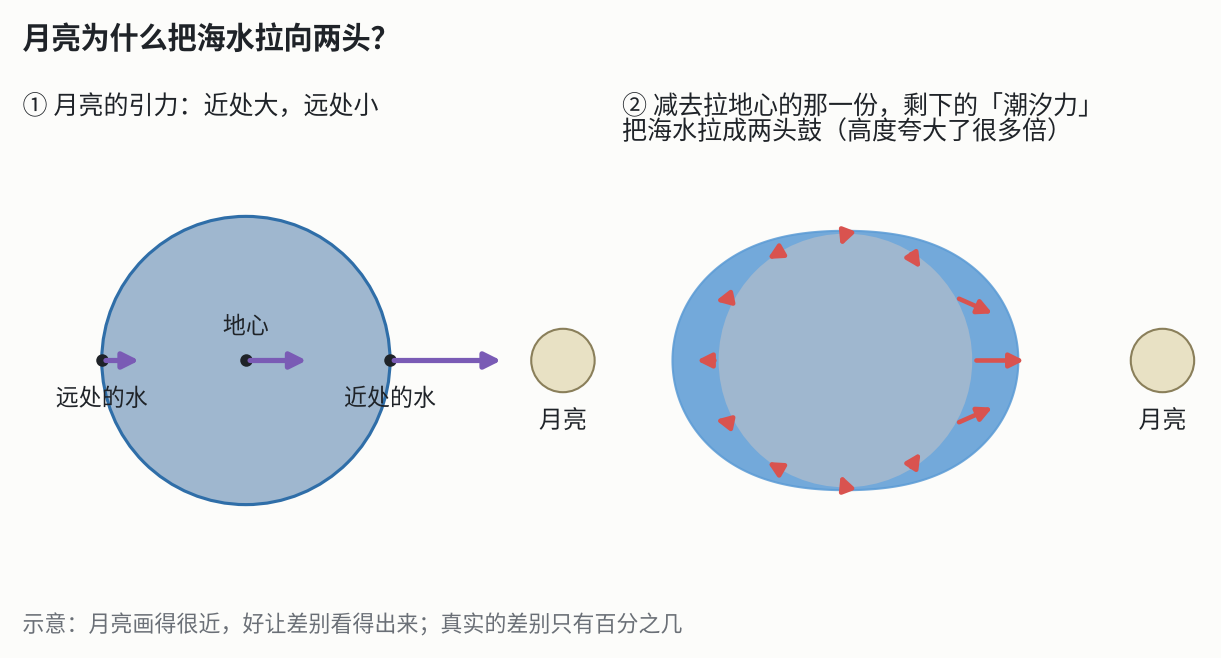
Picture three people in a line, being pulled forward: the one in front goes fastest, the one in the middle a bit slower, and the one at the back slowest. All three move forward, but they spread apart. The same happens with Earth: the water facing the Moon pulls ahead of Earth, and Earth pulls ahead of the water on the far side. The sea is stretched into an egg shape, with a bulge at each end.
This difference in pull is tiny, about one nine-millionth of Earth’s gravity. But it acts on whole oceans, all day and all night, and it is enough to raise the sea at the two ends and lower it in between, by a bit more than half a meter from high to low.
Why twice a day, and 50 minutes later each day?
The two bulges stay lined up with the Moon, and Earth turns underneath them.
Note that the water doesn’t stay put under the Moon: it turns with Earth. A bulge is not a lump of water but a shape of the sea surface, a bit like a stadium wave: everyone stays in their seat and just stands up when their turn comes, yet the “wave” travels around the stands. The sea does the same: water is raised a little as it passes under the Moon (or the opposite side), and drops again as it moves on, so the bulges stay facing the Moon. To fill up the bulges, the water only has to shift back and forth a short way; those are the tidal currents along the coast.
As Earth turns once, a place on the coast passes two bulges and two dips: two high tides and two low tides. But meanwhile the Moon has moved on, and Earth has to turn about 50 minutes more to face it again. So high tides are about 12 hours 25 minutes apart, and each day they come about 50 minutes later, just like moonrise. In NOAA’s tide predictions for New York from September to December 2026, high tides are on average about 12 hours 26 minutes apart.
Spring tides and neap tides
The Sun raises tides too. The Sun actually pulls on Earth about 180 times harder than the Moon does. But it is so far away that the near and far sides of Earth are almost the same distance from it, so the difference in its pull is small: less than half the Moon’s tidal force, about 46%. What makes tides is not how hard something pulls, but how much harder it pulls on the near side than on the far side.
At new moon and full moon, the Sun, the Moon and Earth are in a line, and the two tidal forces pull the same way: high tides are highest and low tides lowest. These are spring tides (nothing to do with the season). At first and last quarter, the two are at right angles and partly cancel: these are neap tides.
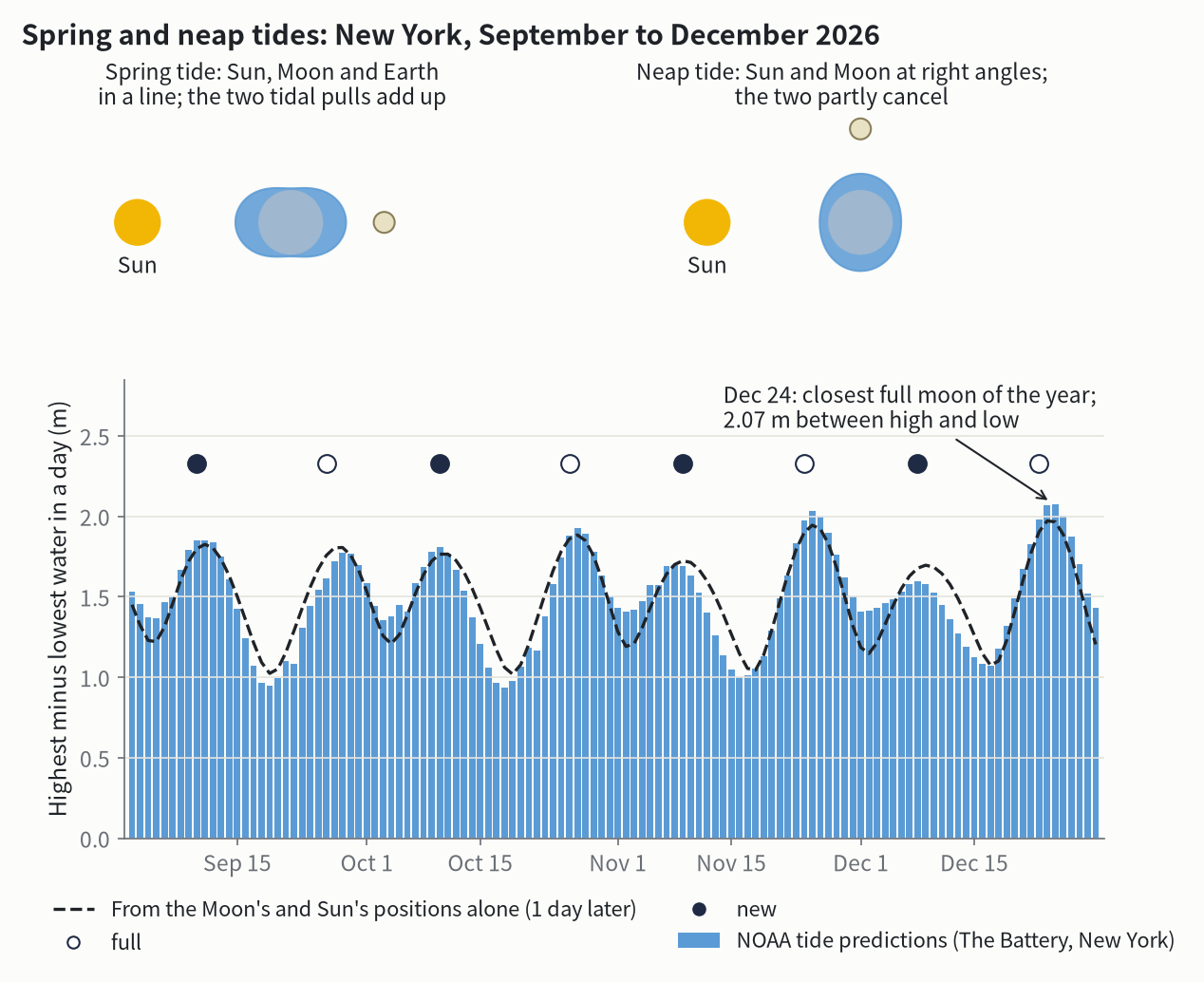
In New York, the water rises and falls about 2 meters in a day at spring tide, and only about 1 meter at neap tide. Look closely and you’ll see two more things:
- Spring tides come about a day after full and new moon. The water takes time to respond; the ocean’s tide lags a beat or two behind.
- From October to December this year, the full-moon spring tides are bigger than the new-moon ones. At these full moons, the Moon is relatively close to Earth. Tidal force goes as one over the distance cubed: 10% closer means more than 30% stronger. December 24 is the closest full moon of the year (about 357,000 km), and the Moon’s tidal force is more than 40% stronger than at the new moon two weeks earlier (about 404,000 km). So New York’s biggest tidal range of 2026 comes on December 24 and 25: 2.07 meters between high and low.
Real tides: weather joins in
A tide prediction uses only the Moon and the Sun, and can be worked out many years ahead. Wind and air pressure can’t.
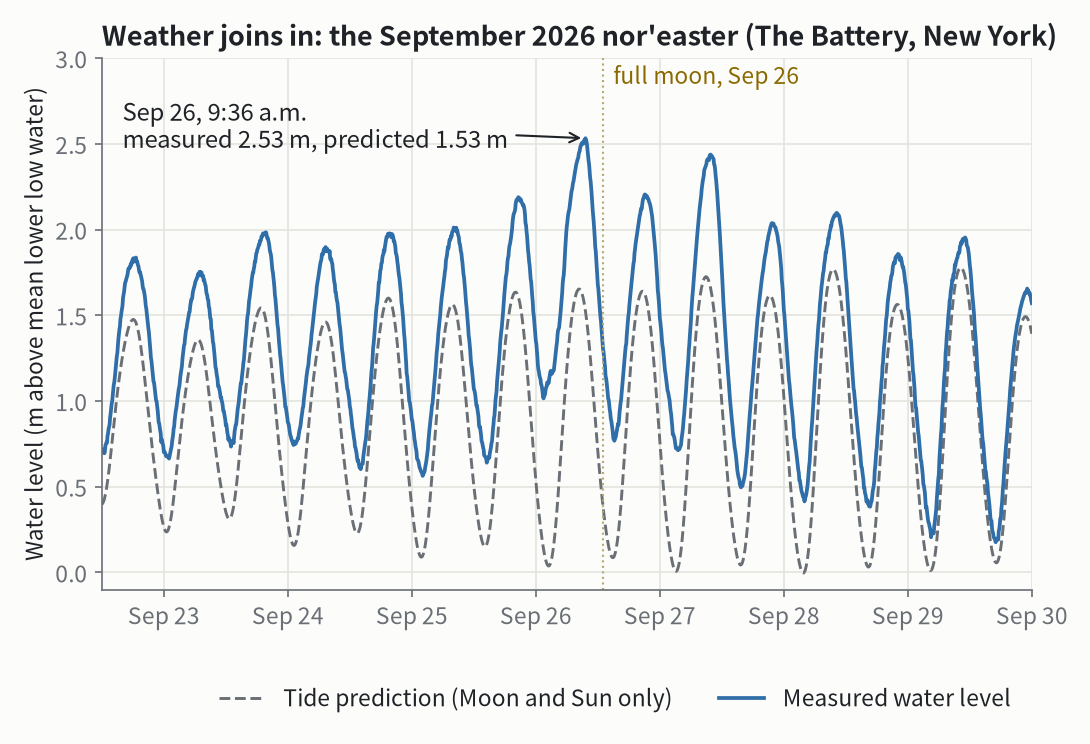
September 26, 2026 was a full moon, with spring tides. On the same day, a nor’easter was passing over the northeastern United States, its strong winds pushing seawater toward the shore. At 9:36 a.m., the water at The Battery reached 2.53 meters, a full meter above the prediction, enough for the National Weather Service’s “moderate coastal flooding,” and seawater flooded streets around Howard Beach in Queens. A spring tide plus a storm is what coasts fear most.
(If you look closely, the measured water is usually 10 or 20 centimeters above the prediction even on calm days: sea level has been rising for decades, and the sea stands a little higher in autumn anyway.)
The Qiantang bore: why the tide becomes a wall
Two days after the storm in New York, September 28 was the 18th day of the eighth lunar month, the traditional day for watching the tide on the Qiantang River in China. It was the same spring tide: full moon falls around the 15th of the lunar month, and the biggest tides there arrive two or three days later. Around the September equinox, the full moon and the Sun are both near the equator, and the twice-daily tides are strongest, so the Qiantang’s biggest tides of the year usually come around the Mid-Autumn Festival.
On the rising tide, seawater pours from Hangzhou Bay into the Qiantang River, pushing upstream and inland against the river’s flow; a few hours later, on the falling tide, it drains back to the sea. The Qiantang has two more things going for it. First, Hangzhou Bay is shaped like a giant funnel: about 100 km wide at its mouth, narrowing to about 20 km at Ganpu, so the tide is squeezed higher and higher; the tidal range at Ganpu reaches nearly 9 meters. Second, above the river mouth the riverbed is very shallow.
How fast a wave travels in shallow water depends on the depth: the deeper the water, the faster it goes. In water 3 meters deep, a wave travels a little over 5 meters per second; in water 1 meter deep, only 3. When the tide pushes into a shallow river, the risen water behind is deeper and runs faster, while the shallow water ahead runs slower. The back catches up with the front, the slope gets steeper and steeper, and finally it stands up as a wall of water: a tidal bore.
In this simplified simulation, the water at the mouth rises slowly, over several hours. But 70 km upstream, the water doesn’t move for hours, then jumps up almost 2 meters within a few minutes. The real Qiantang bore is usually one or two meters high, sometimes more than 3 meters, and pushes upstream at 5 to 7 meters per second, faster than most people can run. That’s why people watch it only from designated places, and never go down onto the riverbank or the jetties.
Not just the sea
Tidal forces pull not only on the sea but on Earth itself. Rock is much stiffer than water, but it still gets stretched a little: the ground under your feet rises and falls twice a day, by up to a few tens of centimeters. You don’t feel it because the houses, the trees and the whole landscape around you rise and fall with it.
In 1991, physicists at CERN, the European particle physics laboratory, noticed something strange. Their electron–positron collider LEP was an underground ring 27 km around, used to measure the mass of the Z particle very precisely; but the energy of the particles in the ring rose and fell through the day, in step with the Moon. The tides in the ground were stretching and squeezing the whole ring by about 1 millimeter, the particles’ path changed slightly, and so did their energy, enough to shift the measured Z mass by about 10 MeV. Since then, they have had to include the Moon in their measurements.
Do people and planes get pulled by the Moon too? Yes, but too little to matter. When the Moon is overhead (or underfoot), its tidal force makes a 60 kg person about 7 milligrams lighter, less than a grain of rice; a 300-tonne airliner about 30 grams lighter, less than an egg. A gust of wind or a bump of turbulence does far more. Rocket launches don’t need to worry about it either. But in space, over time, it adds up: communication satellites in geostationary orbit are tugged by the Moon and the Sun until their orbits tilt by nearly 1 degree a year, and they have to fire their thrusters regularly to straighten up; and spacecraft headed for the Moon must, of course, reckon with its gravity and launch at the right time.
In one sentence: the Moon pulls the near sea harder and the far sea more gently, stretching the sea surface into two bulges; the water turns with Earth and passes both bulges, so we get two tides a day. When the Sun and Moon line up, we get spring tides; in shallow water, the back of the tide catches up with the front and becomes the Qiantang bore.
How do we know?
- Tide tables. Newton explained the tides with gravity in 1687. Today’s tide tables take many years of water levels measured at a port, break them into a few dozen parts that keep time with the Moon and the Sun, and add them up again for the future. You can look up New York’s December 24 and 25 tides on NOAA’s website, and check them when the day comes.
- Count for yourself. Spend two days at the seaside and note when the water is highest: high tides are about 12 hours 25 minutes apart, and the next day’s come about 50 minutes later.
- Not everywhere gets two a day. Oceans differ in size and depth, and each basin “sloshes” in its own way. Some places, such as the Gulf of Tonkin, get only one high tide a day; in Canada’s Bay of Fundy, spring tides can rise and fall about 16 meters.
What we still don’t know
Tidal forces pull on Earth’s rocks too. Do they give earthquakes a nudge? One study found that large earthquakes happen slightly more often when tidal stresses are large (Ide, Yabe and Tanaka, 2016), but the link is weak, and whether it could ever help forecast earthquakes is still debated.
For the curious: the formulas, the simulation and the data
How big the tidal force is. The Moon’s gravitational pull at Earth is GM/d², about one three-hundred-thousandth of Earth’s gravity. At the point on Earth’s surface facing the Moon, the extra pull compared with Earth’s center is about 2GMr/d³ (r is Earth’s radius, d the Earth–Moon distance), about 1.1×10⁻⁷ of gravity, or one nine-millionth. The Sun’s pull is about 179 times the Moon’s, but tidal force goes as M/d³, so the Sun’s is only about 0.46 of the Moon’s.
How high the bulges are. If Earth were all ocean and the water kept up at every moment (the “equilibrium tide”), the Moon would make the sea about 0.53 meters higher at the bulges than at the dips, and the Sun about 0.25 meters. Real oceans are not that simple: continents get in the way, ocean basins have their own rhythms, and the tide travels as a large wave that circles around “amphidromic points” where the tide is nearly zero. So high tide doesn’t come when the Moon is overhead, and tidal ranges differ greatly from place to place.
The dashed line for spring and neap tides. Treat the Moon’s and the Sun’s tidal forces as two arrows, each with a length proportional to M/d³, at an angle of twice their difference in longitude, and add them; the length of the sum is the dashed line (positions from the formulas in the last article), shifted 1 day later and scaled to meters. Its correlation with NOAA’s predicted daily range is about 0.9. This delay of about a day is called the “age of the tide.”
New York data. From the National Oceanic and Atmospheric Administration (NOAA), station 8518750 (The Battery, New York): tide predictions for September to December 2026, and verified 6-minute water levels for September. Water levels are measured from mean lower low water (MLLW).
The bore simulation. One-dimensional shallow-water equations, flat bottom, no friction, finite volumes (HLL fluxes), 50-meter cells. The channel is 3 meters deep on average; the water level at the mouth starts at low tide and rises and falls with a period of 12.42 hours and a range of 4 meters. The speed of a wave in shallow water is √(gh): about 200 meters per second in an ocean 4,000 meters deep, as fast as a jet airliner, and about 5.4 meters per second in water 3 meters deep. In the simulation, the bore forms after about 50 km; at 70 km it is about 1.8 meters high and moves at about 8.7 meters per second (faster than the wave speed alone, because the water behind it is itself flowing upstream). The real Qiantang has friction, a funnel, a bed of varying depth, and river water flowing down; this simulation captures only the back of the wave catching up with the front.
Qiantang numbers. Hangzhou Bay is about 100 km wide at its mouth and about 20 km at Ganpu; the largest tidal range at Ganpu is 8.93 meters; the bore is usually 1 to 2 meters high, sometimes more than 3 meters, and moves at usually 5 to 7 meters per second, at most about 10. Figures differ slightly between sources.
Earth tides and LEP. The solid Earth deforms by about 60% of the equilibrium tide (Love number h ≈ 0.6); near the equator the ground rises and falls by up to about half a meter in a day. The LEP discovery is described in CERN’s 1992 announcement and in the energy calibration reports by Wenninger and colleagues: the tides changed the circumference by about 1 mm; because the collider’s magnets focus the beam so strongly, a tiny change in circumference is magnified about ten thousand times into a measurable change in energy (up to about 120 parts per million).
People and planes. The tidal force is about 1.1×10⁻⁷ of gravity: 60 kg × 1.1×10⁻⁷ ≈ 7 mg, and 300 tonnes × 1.1×10⁻⁷ ≈ 33 g. The orbital inclination of geostationary satellites grows by about 0.75 to 0.95 degrees a year because of the Moon and the Sun.
The storm. The September 2026 nor’easter lasted from September 23 to 29. The National Weather Service recorded that the water at The Battery reached moderate coastal flood levels at about 9:30 a.m. on September 26.