Why Can We See the Moon in the Daytime?
Our last article, Does Earth Really Take 24 Hours to Turn Once?, said: “Against the stars, Earth turns 4 minutes ‘extra’ every day, so each star rises 4 minutes earlier than the night before.” The Moon does the opposite: it rises about 50 minutes later each day than the day before. That is also why we so often see the Moon in the daytime.
Take a guess
Three things are often said: “The Moon comes out at night,” “The Moon rises once a day, at about the same time,” and “The Moon’s phases are Earth’s shadow covering part of it.”
None of them is right. Of the time the Moon spends in the sky, more than 40% is daytime. The time it rises keeps changing, and some days have no moonrise at all. And the Moon’s phases have nothing to do with Earth’s shadow.
Phases are the angle we see it from
The Moon makes no light of its own; it is lit by the Sun. Wherever it is, the half facing the Sun is bright and the half facing away is dark. As the Moon goes around Earth, we see sometimes more of the bright half and sometimes more of the dark half. Those are the phases.
Follow the animation once around:
- New moon: the Moon is between Earth and the Sun, with its dark side toward us, and it rises and sets together with the Sun, so we can’t see it.
- First quarter (about 7 days after new moon): the Moon has moved off to the side of the Sun. It rises around noon and sets around midnight. All afternoon it hangs in the sky together with the Sun, which makes this the easiest time to see the Moon in the daytime.
- Full moon: the Moon is on the side of Earth facing away from the Sun. It rises as the Sun sets and sets as the Sun rises, and it is up all night.
- Last quarter: it rises around midnight and is still up in the western sky the next morning. On the way to school or work in the morning, you can often see it.
What about Earth’s shadow? Only when the Sun, Earth and the Moon line up almost exactly does Earth’s shadow fall on the Moon, and that is a lunar eclipse. The Moon’s orbit is tilted by about 5 degrees from Earth’s, so at most full moons the Moon passes above or below Earth’s shadow, and there are usually only two or three lunar eclipses a year.
When is the Moon in the sky?
Here is when the Moon was above the horizon in Beijing on every day from November 9, 2026 (new moon) to December 9 (the next new moon):
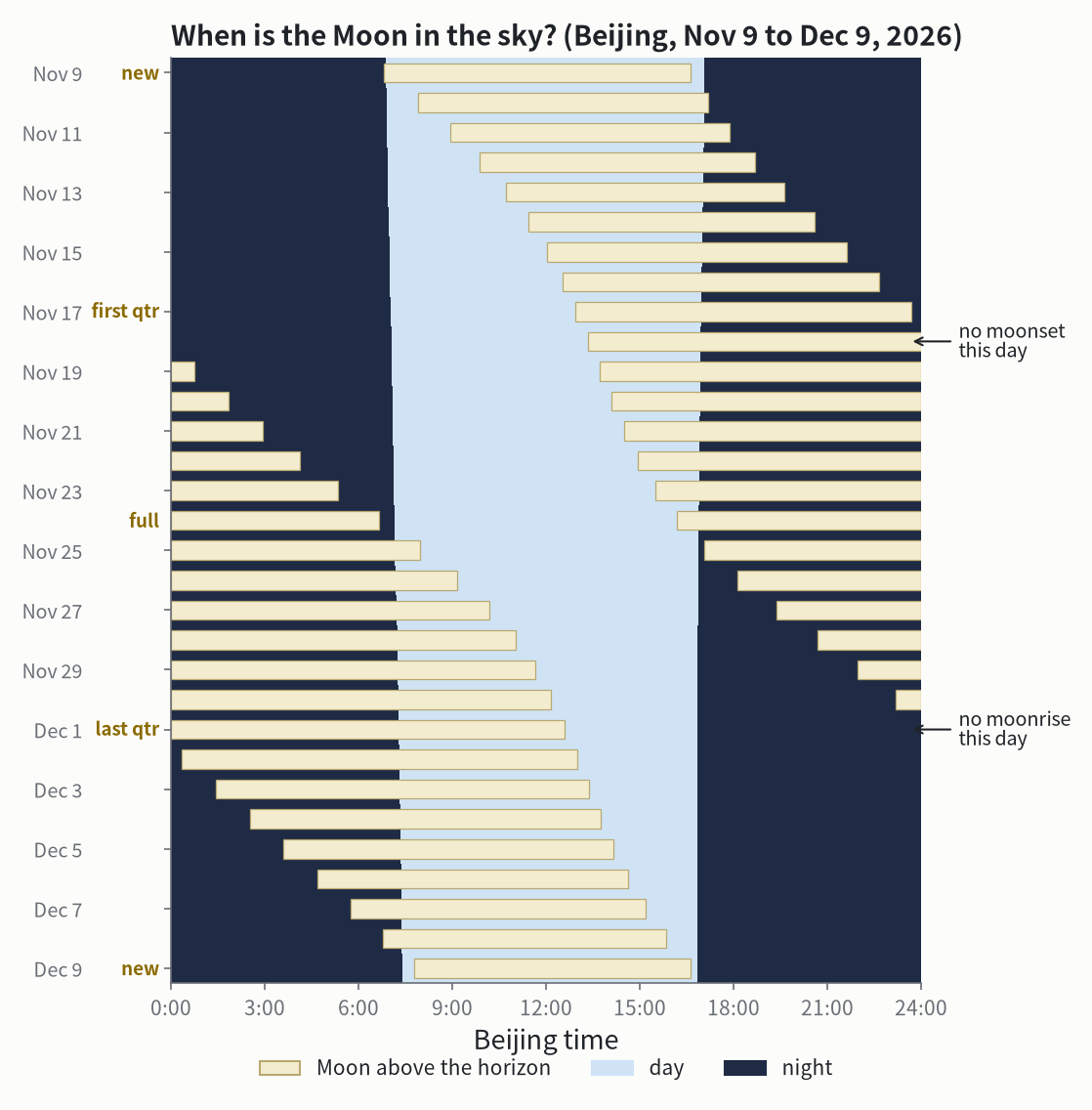
The yellow bars shift to the right day by day: the Moon rises later each day than the day before. In Beijing, the time from one moonrise to the next ranges from 24 hours 21 minutes to 25 hours 21 minutes, about 24 hours 50 minutes on average.
Since the time between moonrises is longer than a day, sooner or later one moonrise falls a little after 11 p.m., and the next one comes nearly 25 hours later, after midnight on the day after next. The calendar day in between, from midnight to midnight, has no moonrise at all. In Beijing, November 2, December 1 and December 30 are such days; in the same way, November 18 and December 17 have no moonset.
Now look at the parts of the yellow bars that fall on light blue: over this month, more than 40% of the Moon’s time in the sky was daytime (in summer, with longer days, it is close to 60%). Afternoons around first quarter and mornings around last quarter are good times to look for the daytime Moon. Around new moon the Moon is also up in the daytime, but it is too close to the Sun and shows only a thin sliver, so it is lost in the glare.
Why 50 minutes later each day?
First, how the Moon moves among the stars. Through the night, the Moon and the stars all rise in the east and set in the west; that is Earth’s spin carrying us around. But look at the same time each night, and the Moon has changed places among the stars: tonight it is next to a bright star; tomorrow at the same time it is about 13 degrees east of that star, a bit more than the width of your fist held at arm’s length.
That is because the Moon goes around Earth in the same direction that Earth spins: seen from above the North Pole, both go counterclockwise (the way the Moon moves in the first animation). Earth’s spin carries everything in the sky westward, once around each day; the Moon’s own motion carries it slowly eastward among the stars, once around in 27.3 days.
After Earth turns once, the Moon has moved a bit farther east, so Earth has to turn a little more to face the Moon again. It’s the same idea as in the last article: Earth has to turn about 1 degree more, about 4 minutes, to face the Sun again. For the Moon, the extra angle is a dozen degrees or so, so moonrise comes about 50 minutes later each day.
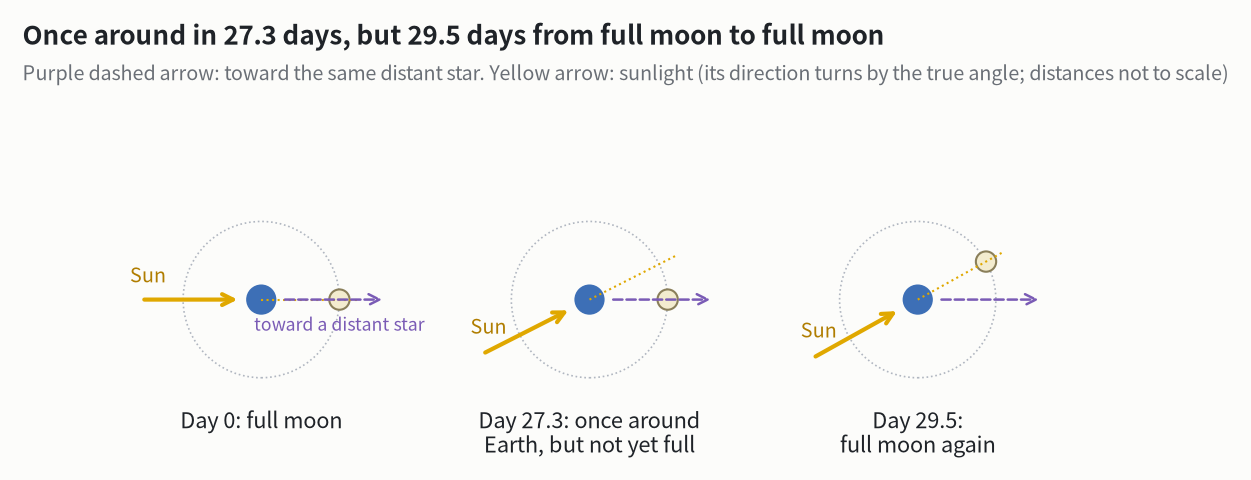
There’s another match with the last article. Against the stars, the Moon goes around once in just 27.3 days. But during that time Earth has also moved along its orbit around the Sun, so the direction of the Sun has changed, and the Moon has to travel two more days before it is again on the side away from the Sun, at full moon. So it is 29.5 days from one full moon to the next. Both the phases and the time of moonrise follow this 29.5-day cycle.
How can we see the Moon in the daytime?
The daytime sky is so bright; how can we still see the Moon? It doesn’t actually need to be brighter than the blue sky. The Moon is behind the sky, so the patch where we see it gets the sky’s light plus the moonlight. As long as that extra share is noticeable, we can make the Moon out. The Moon’s surface reflects only about 12% of the sunlight that hits it, about as much as old asphalt. By our estimate, around first and last quarter the Moon’s surface is actually darker than the blue sky next to it, only a fraction as bright; but the moonlight added on top of the sky is still enough for the eye to pick out. That’s why the daytime Moon is visible but pale, with a tint of the sky’s blue: between us and the Moon there is always that layer of blue light scattered by the air (see Why Is the Sky Blue, and Why Are Sunsets Red?).
How bright the Moon is holds another surprise:
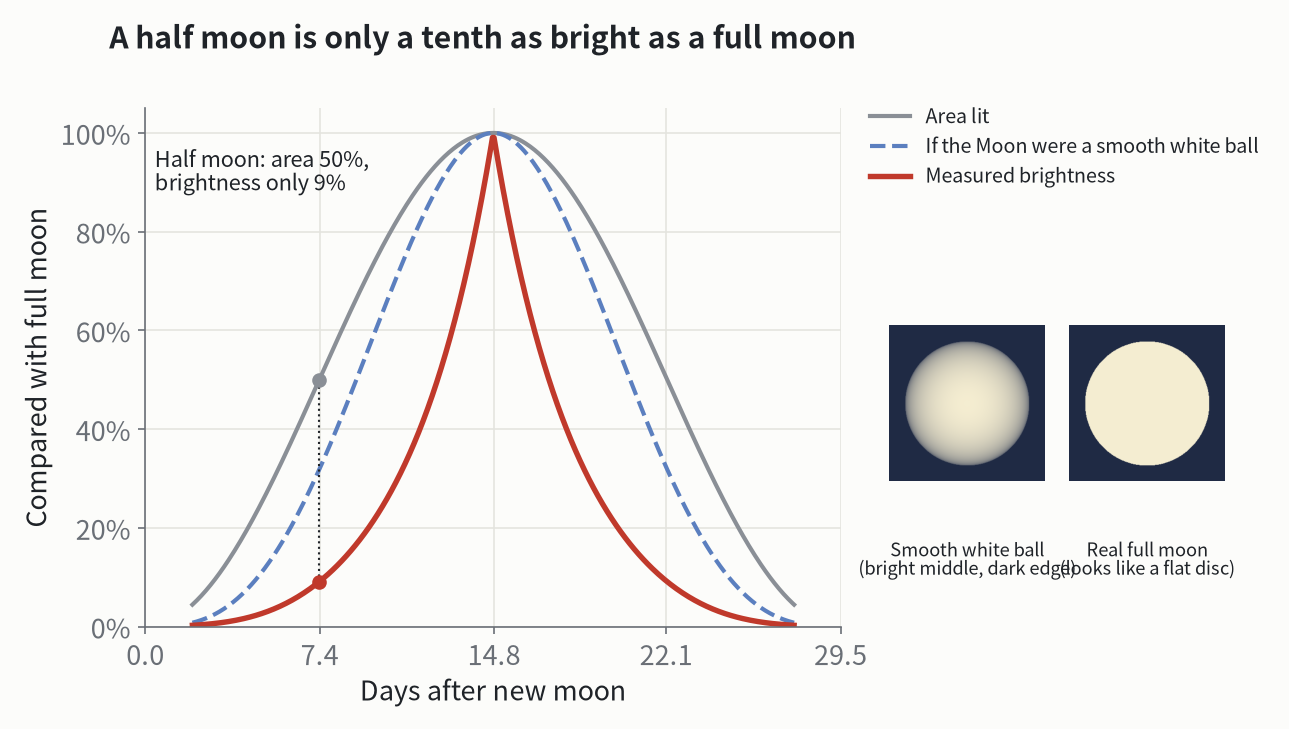
At half moon, the lit area is half that of a full moon, but the brightness is only about 9% of a full moon, roughly a tenth. Even treating the Moon as a smooth white ball, a half moon should be a third as bright as a full moon.
The difference lies in the Moon’s surface. It is covered with fine dust and full of craters and rocks of every size. When sunlight comes from the side, every grain of dust and every rock casts a shadow, and these shadows darken the surface. At full moon, the Sun is behind us and its light reaches the Moon along our line of sight. The shadows all hide behind the things that cast them, where we can’t see them, and the surface suddenly brightens. For the same reason, the full moon looks like a flat disc, no darker at the edge than in the middle.
In one sentence: the Moon’s phases are the different views we get of its sunlit half; it rises about 50 minutes later each day, so on many days in a month it hangs in the sky in the daytime.
How do we know?
- Look for yourself. November 17 is first quarter. On those afternoons, look toward the east and southeast, and you’ll find the daytime Moon. Around December 1 is last quarter; look southwest and west in the morning. Look at the same time each day, and you’ll see it shift a little farther east each day, and its shape change.
- Look for earthshine. In the evenings just after new moon, next to the thin crescent, the dark part of the Moon often shows a faint gray glow. That is sunlight reflected by Earth lighting up the Moon’s night. More than five hundred years ago, Leonardo da Vinci explained it this way in his notebooks.
- This year’s closest full moon. By our calculation, the full moon of December 24 is about 357,000 km from Earth, the closest full moon of 2026; the full moon of May 31 was the farthest, about 406,000 km. Their apparent sizes differ by about 14%.
What we still don’t know
The Moon always keeps the same face toward us, and that side is very different from the far side: the near side has broad dark “seas,” the far side has almost none, and the far side’s crust is much thicker. Why this is so is still not settled.
For the curious: the formulas, the simulation and the data
The positions of the Moon and the Sun. We use the method compiled by Paul Schlyter: first the Moon’s position from its mean orbit, then the dozen or so largest perturbations (such as the “evection” and the “variation,” by which the Sun’s pull distorts the Moon’s orbit every month). Every moonrise and moonset in Beijing in November 2026 computed this way agrees to within 3 minutes with the times computed from the Jet Propulsion Laboratory’s DE421 ephemeris (via Skyfield); the times of full moon agree with known lunar eclipses to about 3 minutes.
What counts as moonrise. Moonrise is when the Moon’s upper edge just clears the horizon. Three things come in: refraction by the air “lifts” the Moon by about 0.57 degrees; the Moon’s radius is about 0.27 degrees; and because we stand on Earth’s surface rather than at its center, we see the Moon about 0.95 degrees lower (parallax). Together, the Moon counts as risen when its center is about 0.13 degrees above the horizon as seen from Earth’s center.
The animation. The animation draws the Moon’s orbit as a circle and leaves out its 5-degree tilt. The time bar at the lower right assumes sunrise at 6 a.m. and sunset at 6 p.m., with moonrise 1 hour later for every 15 degrees the Moon moves, so the times are only rough. The real times are in the second chart.
Brightness. The measured brightness comes from an empirical formula in Allen’s Astrophysical Quantities: the Moon’s magnitude is V = −12.73 + 0.026α + 4×10⁻⁹α⁴, where α is the “phase angle” (the angle at the Moon between the Sun and Earth, 0 at full moon and 90 degrees at half moon). The smooth white ball follows Lambert’s law, which gives a half moon 1/π of a full moon, about 32%. The discs: the smooth ball uses Lambert’s law, the Moon uses the Lommel–Seeliger law (suited to dusty surfaces), under which the whole disc is equally bright at full moon.
How bright the daytime Moon is. A full moon has a magnitude of about −12.7, giving an illuminance on the ground of about 0.26 lux; the Moon’s disc covers only about 6.4×10⁻⁵ steradians, so the surface of a full moon has a luminance of about 4,000 candelas per square meter. A half moon gives only 9% of the light of a full moon, and from only half the area, so its surface is about 750 candelas per square meter. On a clear day, the blue sky about 90 degrees from the Sun is roughly 1,500 to 4,000 candelas per square meter (this can also be estimated with the model from the article on the sky), so the half moon’s surface is darker than the sky beside it. The eye can tell differences in brightness of a few percent, and the moonlight adds about 20 to 50 percent to the sky, which is enough to see.
Why the time between moonrises varies. The angle between the Moon’s path across the sky and the horizon changes over the month. When the angle is small, the Moon still moves 13 degrees east each day, but it rises only twenty-some minutes later; when the angle is large, it rises more than an hour later.