Why Is the Night Sky Dark?
It gets dark because the Sun has set. That answer is right, but only half right.
The universe holds hundreds of billions of galaxies, each with hundreds of billions of stars, shining day and night. With so many stars, why is the night sky still dark? This question, which sounds like something only a child would ask, stumped astronomers for centuries; the answer leads all the way back to the beginning of the universe.
A quick guess
Common answers include: “The stars are too far away, so their light is too faint”; “dust in space blocks the light”; “there aren’t that many stars.”
None of the three is right.
Faraway stars are fainter, but more numerous
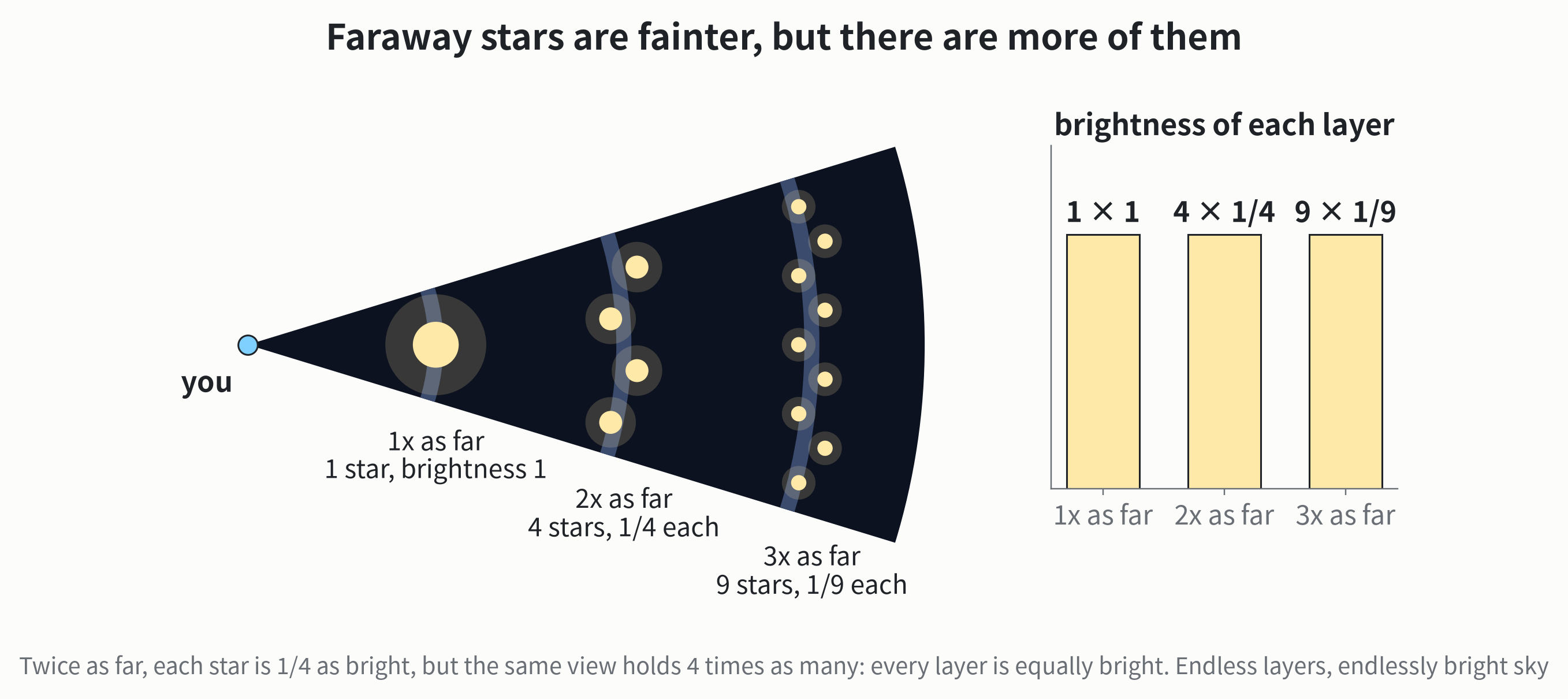
A star twice as far away looks a quarter as bright. But looking in the same direction, the view twice as far out is wider, with room for four times as many stars. A quarter as bright, four times as many: that layer adds up to the same brightness as the nearer one.
If the universe were infinitely big, with stars scattered more or less evenly everywhere, there would be endless layers like this; each equally bright, so together the sky should be infinitely bright.
Every line of sight runs into a star
Of course the sky can’t be “infinitely bright”: nearer stars block the ones behind them. But follow this through and the conclusion is the same.
Imagine standing in a huge forest and looking straight out all around: nearby there are trees, through the gaps you see trees farther off, and the farther trees look thinner but stand closer together. Whichever way you look, your line of sight ends on some tree trunk, and you can’t see out of the forest.
If the universe were infinitely big and infinitely old, the stars would be like that forest: look into the night sky in any direction and you would eventually come to a star. A faraway star looks like just a small dot, but that dot is as bright as the Sun’s surface, just as a distant lamp looks smaller without its glowing face getting any dimmer. So every point of the night sky would land on the surface of some star; the whole sky would be as bright as the Sun’s surface, and the Earth would be baked to over 5,000 degrees.
This contradiction is called “Olbers’ paradox,” after the German astronomer Heinrich Olbers, who discussed it carefully in 1823. Others got there earlier: in 1610 Kepler used the same reasoning to argue that, since the night sky is dark, there can’t be infinitely many stars. Halley and the Swiss astronomer de Chéseaux puzzled over it too.
Dust can’t block it
Olbers’ own answer was that dust in space absorbs the light from faraway stars.
But dust that absorbs light heats up. After starlight had shone on it for countless years, the dust would be as hot as the surfaces of the stars, and would glow just as brightly itself. In 1848 the English astronomer John Herschel pointed this out: dust can only pass the light on in another form; it can’t block it.
The answer: the light is still on its way
The real answer was first given not by an astronomer but by the American writer of detective stories, Edgar Allan Poe. In 1848, in his long prose poem Eureka, he wrote that the only way to understand the voids our telescopes find in countless directions is to suppose the invisible background so immensely far away that no ray from it has yet been able to reach us at all.
That is today’s answer: the universe has an age. It is about 13.8 billion years old, so the light we see has been on its way for at most 13.8 billion years. A rough estimate from the average number of stars in the universe says a line of sight must travel more than 10^23 light years (a 1 followed by 23 zeros) before it reaches a star’s surface: over a trillion times 13.8 billion light years. So within what we can see, less than a trillionth of the sky is covered by stars; the rest is dark.
“Bright” here means light entering your eye. Light travelling past you can’t be seen: sunlight streams through all of space, yet an astronaut looking where there are no stars sees only black. Light shows up only when it hits something, or comes straight into your eye. A dark night sky simply means that from those directions, no light reaches our eyes.
In 1901 Lord Kelvin was the first to work the numbers through carefully, and he came to the same conclusion: for stars to cover the sky we would have to see extremely far, and light from there would take far longer to reach us than stars can shine. In today’s numbers: the Sun can shine for about 10 billion years in all, but for stars to fill the night sky, their light would have to travel for more than 10^23 years. Even in an infinitely old universe, the stars would have burned out long before the sky could fill up.
Redshift: the universe stretches light
One more thing makes the night sky darker: the universe is expanding, with the distances between galaxies growing all the time. Light travelling through such a universe has its wavelength stretched along with space. Astronomers describe how much with “redshift”: light arrives with a wavelength (1 + z) times what it started with, and z is the redshift. Stretched visible light shifts towards the red end of the spectrum, hence the name.
Stretch it enough and visible light becomes invisible infrared: the blue and ultraviolet light sent out by very distant galaxies has turned into infrared by the time it reaches us. That’s exactly why the James Webb Space Telescope looks in the infrared: to see the earliest, most distant galaxies, it has to catch this stretched light.
Stretched light is also dimmer: each photon loses energy as it is stretched, and the photons arrive at a slower pace. But by the numbers, the expansion only makes the night sky about half as bright again, a minor reason. The night sky is dark mainly because the universe and its stars are too young: light from far away hasn’t had time to arrive.
The night sky isn’t completely dark
Yet with eyes that could see microwaves, the night sky would be bright: evenly bright in every direction.
In 1964 Arno Penzias and Robert Wilson at Bell Labs in the US were measuring microwaves from the sky with a huge horn-shaped antenna, and there was always a little “noise” they couldn’t get rid of, the same whichever way the antenna pointed. They suspected the droppings of pigeons nesting in the antenna; they cleaned them out, and the noise was still there. When Robert Dicke at nearby Princeton heard about it, he told his colleagues: we’ve been scooped. It was exactly what they were looking for: the afterglow of the Big Bang. Penzias and Wilson shared the 1978 Nobel Prize in Physics for it.
About 380,000 years after the universe began, it was full of hot gas at nearly 3,000 degrees, glowing orange; the universe had just turned transparent, and this light has been travelling ever since. Over 13.8 billion years the universe has expanded about 1,100 times, and the light waves have been stretched by the same factor, a redshift of about 1,100: from red light to infrared, all the way to microwaves about a millimeter long.
Why does the temperature drop too? This light is like the glow of a red-hot piece of iron, whose temperature sets its strongest wavelength: the hotter, the shorter. Stretch every wavelength 1,100 times and the spectrum keeps its shape, just moved to longer wavelengths, exactly like the glow of a piece of “iron” 1,100 times colder: about 3,000 K ÷ 1,100 ≈ 2.7 K, minus 270 degrees Celsius.
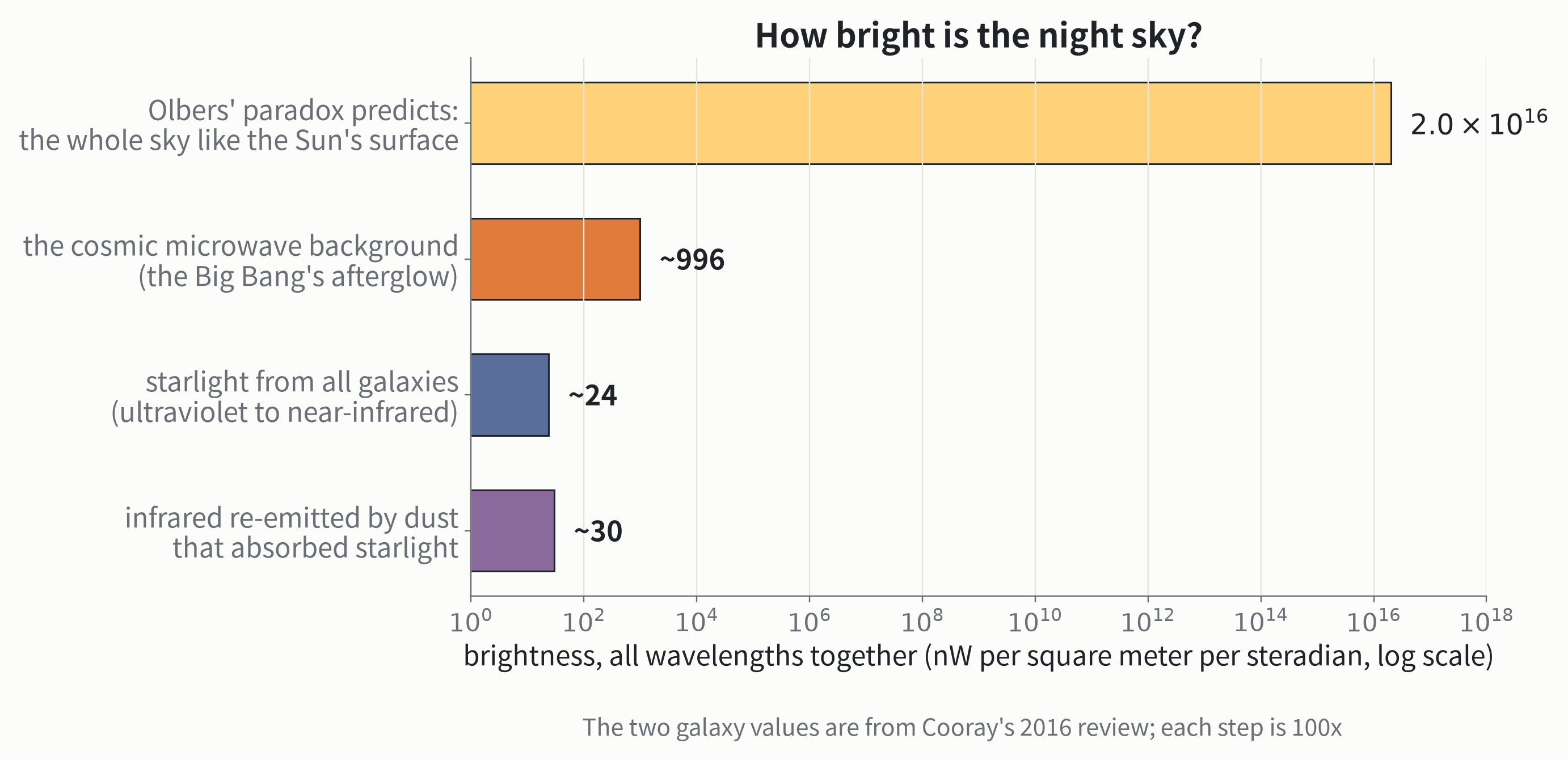
This afterglow is called the “cosmic microwave background.” Adding up all wavelengths and comparing energy, it is far brighter than all the starlight from all galaxies: the starlight from every galaxy (ultraviolet to near-infrared) adds up to about 24, the infrared re-emitted by dust that absorbed starlight to about 30, while the Big Bang’s afterglow is about 1,000, around 40 times the starlight. But a sky truly filled with stars would be about 20 trillion times brighter still.
Later the COBE, WMAP and Planck satellites measured this afterglow in ever finer detail: it is almost perfectly the same in every direction, differing by only a few parts in a hundred thousand. That tiny unevenness of hot and cold later grew into galaxies, and into us.
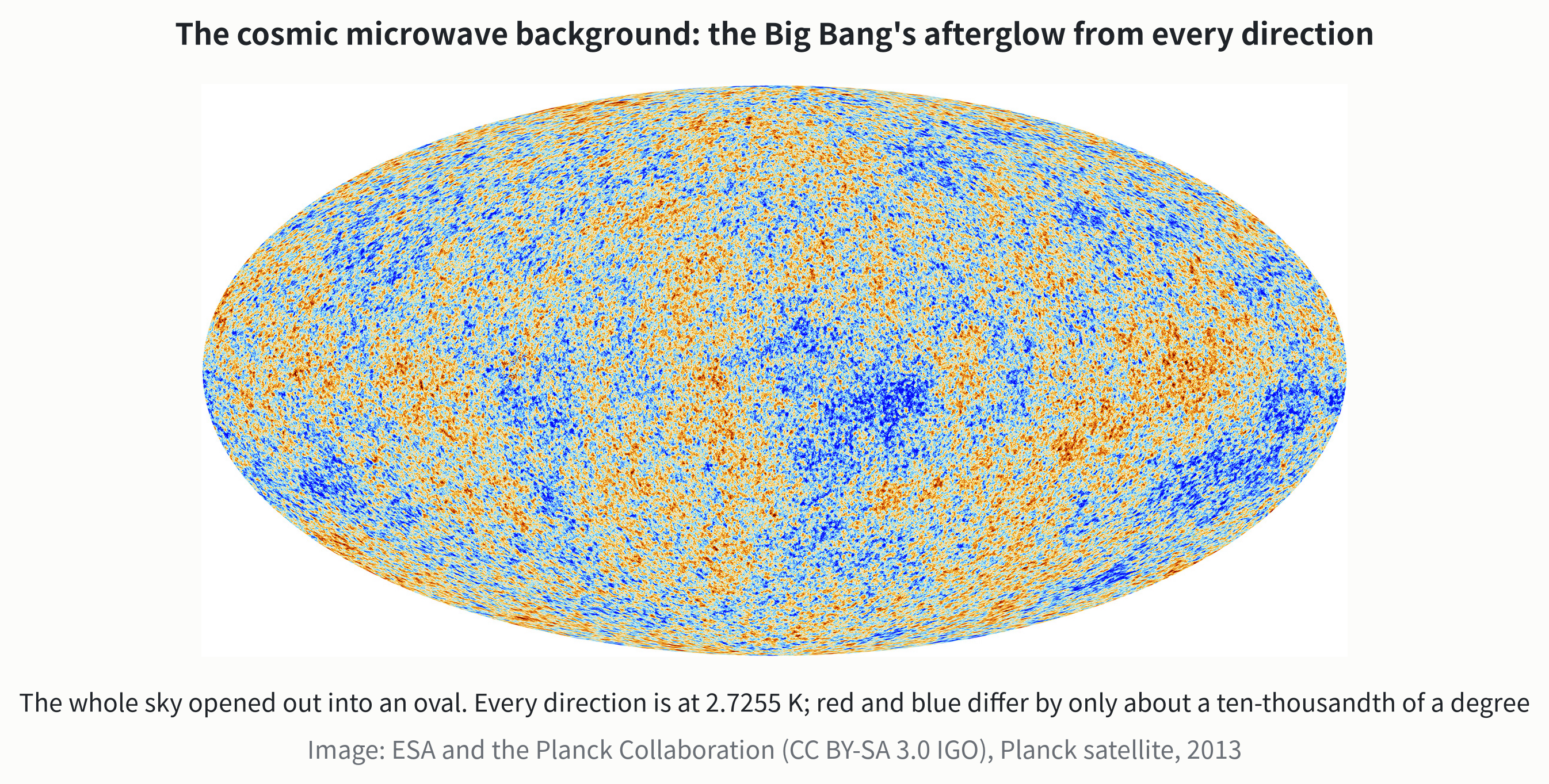
You have “seen” it too: of the snow on an old TV screen with no signal, an estimated one percent or so comes from the cosmic microwave background.
How dark is the universe, really?
Near the Earth it is hard to measure how dark the universe itself is: the solar system is full of fine dust that scatters sunlight into a faint glow across the sky, drowning the light of distant galaxies, and even the Hubble telescope can’t escape it.
New Horizons, launched in 2006, flew past Pluto in 2015 and kept going, out to more than 50 astronomical units from the Sun (over 50 times the Earth–Sun distance), where there is far less dust. Scientists used its camera, pointed at sky far from the Milky Way, to measure the darkness of the universe. It measures brightness near visible light (about 0.6 micrometers), so its numbers can’t be compared directly with the “all wavelengths together” numbers above.
In 2022 the result was a surprise: the sky was twice as bright as all known galaxies put together, and the extra half came from no one knew where. Faint galaxies we can’t see? Dark matter glowing? In 2024 the same team observed more patches of sky and subtracted the starlight and dust of our own galaxy more carefully, and the light of galaxies explained almost all of it; what was left of the “extra light,” about 3.0 ± 2.0, is only about one and a half error bars above zero. It may well be measurement error itself, such as starlight and dust glow from our own galaxy that wasn’t fully subtracted; nor can some very faint sources be ruled out, such as stray stars scattered around the outskirts of galaxies, belonging to no galaxy in particular.
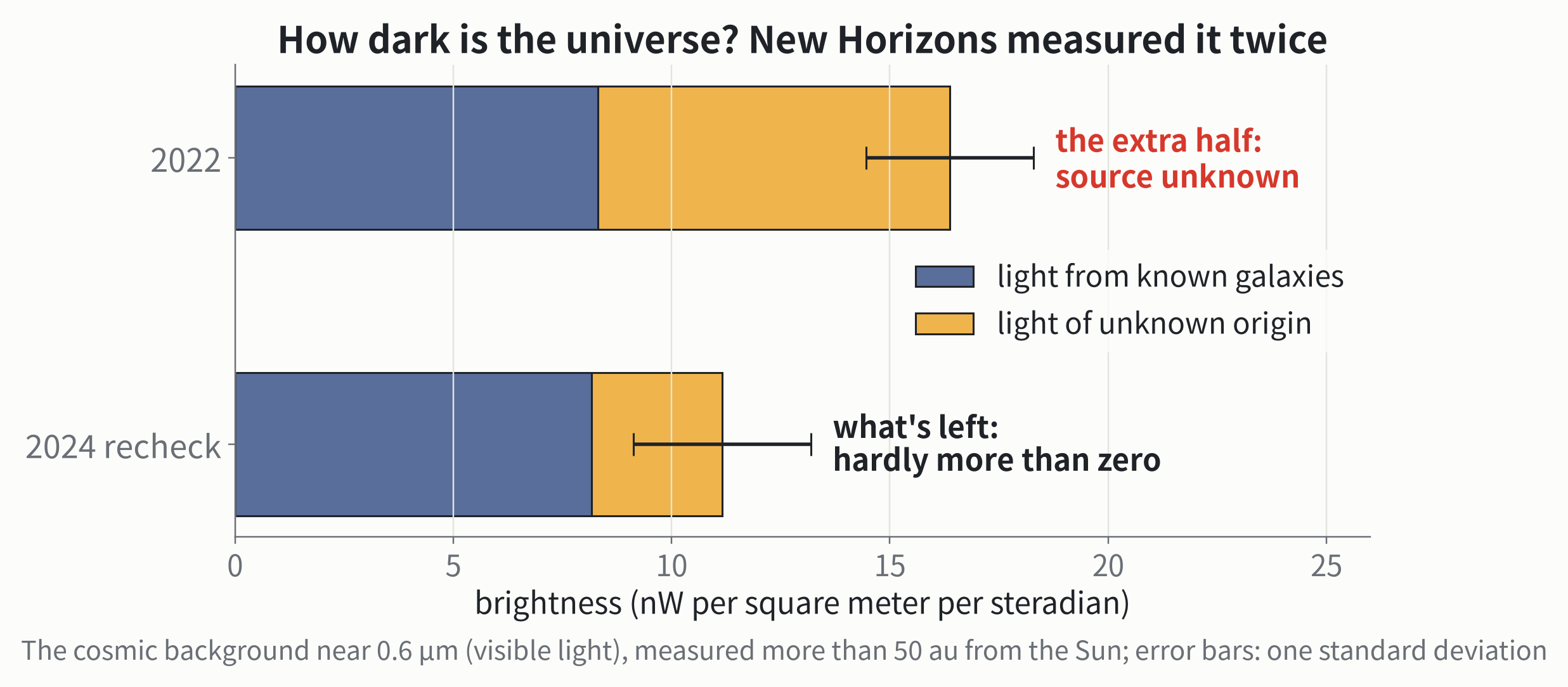
A startling result, rechecked and corrected by the very people who found it: that’s what science looks like.
In one sentence: faraway stars are fainter, but more numerous; in an infinitely big, infinitely old universe, every line of sight would run into a star, and the night sky would be as bright as the Sun’s surface. The night sky is dark because the universe is only 13.8 billion years old: light from far away is still on its way, and stars don’t live long enough anyway. With eyes that could see microwaves, the night sky would glow in every direction: the afterglow of the Big Bang.
How do we know?
- Look into a forest: walk into a dense wood and look straight out into the distance: in every direction, your line of sight ends on a tree trunk. That’s what “every line of sight runs into a star” in Olbers’ paradox looks like.
- Try the inverse-square law with a flashlight: in a dark room, shine a flashlight at a wall. Twice as far from the wall, the patch of light covers 4 times the area, and each part of it is about a quarter as bright.
- Find somewhere truly dark to look at the stars: away from city lights, after half an hour for your eyes to adjust, you’ll see thousands of stars, and between them, still darkness.
- The snow on an old TV: if you still have an old analog TV, tune it to a channel with no signal: a small part of the snow on the screen comes from the cosmic microwave background.
What we still don’t know
What we can see is only the part of the universe that light has had time to cross in 13.8 billion years. How big is the universe beyond that? Is it infinite? Its light will never reach us, so perhaps we can never know directly.
A question closer to home isn’t quite settled either: is the little “extra light” left in New Horizons’ 2024 result really zero, or is there still a source of light we don’t know about? The James Webb Space Telescope, launched on Christmas Day 2021 and observing since 2022, is counting the faintest, most distant galaxies one by one and adding up their light; set against New Horizons’ result, it will pin down the darkness of the universe ever more precisely.
For the curious: adding up the layers, how far a line of sight goes, and some numbers
Adding up the layers. Let stars have number density and luminosity . A spherical shell from distance to holds stars, each with brightness here, so the shell contributes , independent of . With endless shells, the total diverges.
How far a line of sight goes before hitting a star. Each star blocks a cross-section , so a line of sight travels on average before hitting one. Today’s average density of stars in the universe is about 500 million solar masses per cubic megaparsec (order of magnitude); counting them all as Suns gives per cubic meter, and with m, m light years. Real stars come in all sizes, and there were fewer stars in the past; different assumptions give to light years, which is why the text only says “more than light years.” The ratio of 13.8 billion light years to this, under , is roughly the share of the sky covered by stars.
Some brightnesses. In nanowatts per square meter per steradian, all wavelengths together. The Sun’s surface and the cosmic microwave background are both close to blackbodies, so their brightness follows from the Stefan–Boltzmann law:
with W m⁻² K⁻⁴. is the total power a blackbody surface sends out into the half of space in front of it; integrating over directions brings in the cosine of the tilt, which adds up to , so the brightness per direction (per steradian) is divided by . The Sun’s surface, K: about . The cosmic microwave background, K: , and W, that is about 996 nW (often quoted as about 960 to 1,000). The two differ by .
Galaxy light: starlight from all galaxies about 24, infrared re-emitted by dust about 30 (Cooray’s 2016 review). New Horizons measures near 0.6 µm (same units, but at one wavelength only): in 2024, galaxy light and the remainder ; in 2022, , of which was of unknown origin.
Redshift and temperature. Stretching wavelengths by cuts each photon’s energy to . A thermal spectrum is set by temperature alone; stretched as a whole, it is still a thermal spectrum, at of the temperature: .
The afterglow stretched. When the universe turned transparent (redshift about 1090), the temperature was about K; by Wien’s displacement law the strongest wavelength was about 975 nm. Today, at 2.7255 K, it is about 1.06 mm. The ages in the stretching animation come from a flat ΛCDM model (Hubble constant 67.7, matter 31%); the moment of transparency uses the Planck satellite’s 2018 result, about 378,000 years.
Sources. The Planck all-sky map is from the European Space Agency (ESA and the Planck Collaboration, CC BY-SA 3.0 IGO). The New Horizons results are in Lauer et al. 2022, The Astrophysical Journal Letters 927, L8, and the 2024 recheck in The Astrophysical Journal. The total amounts of the background lights are reviewed by Cooray, 2016, Royal Society Open Science. Kelvin’s calculation was published in 1901 (Philosophical Magazine); Edward Harrison’s 1987 book Darkness at Night tells the whole history.