Why Is a Rainbow Curved, and Why Are There Sometimes Two?
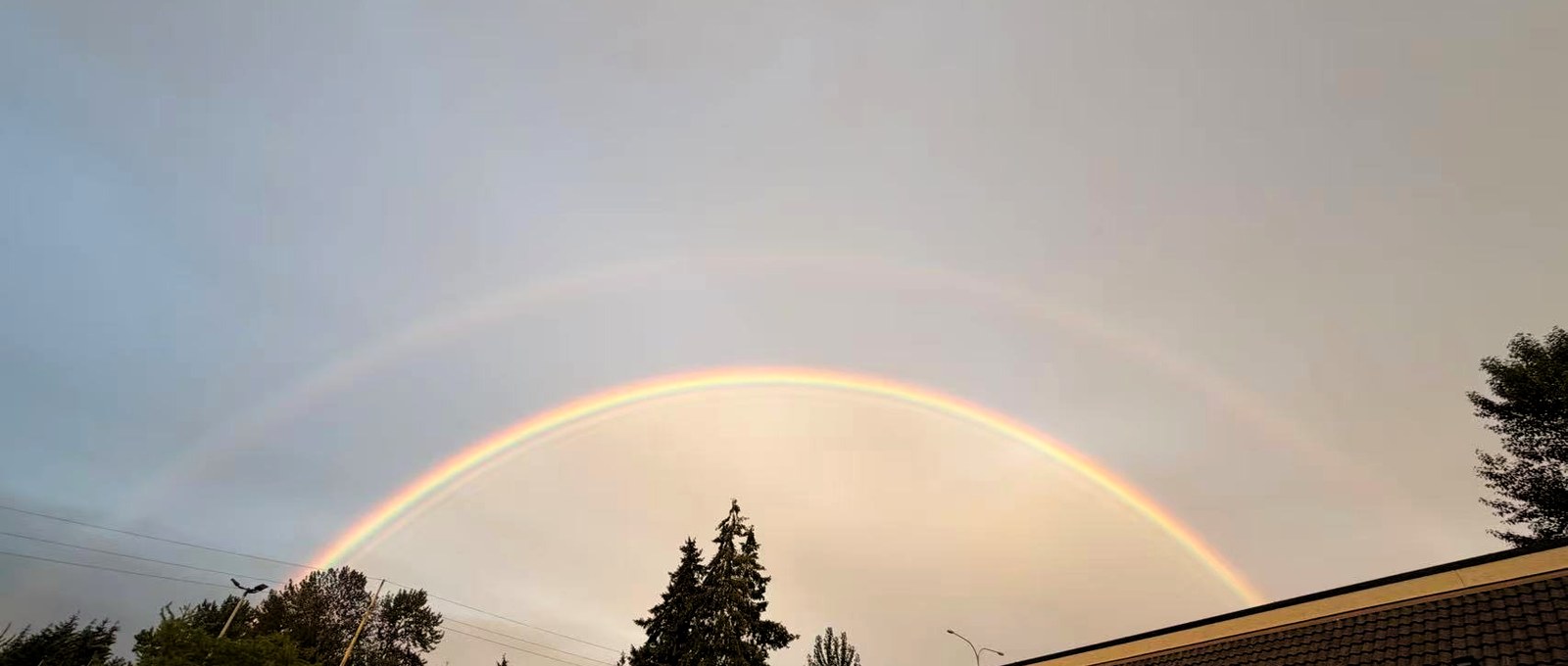
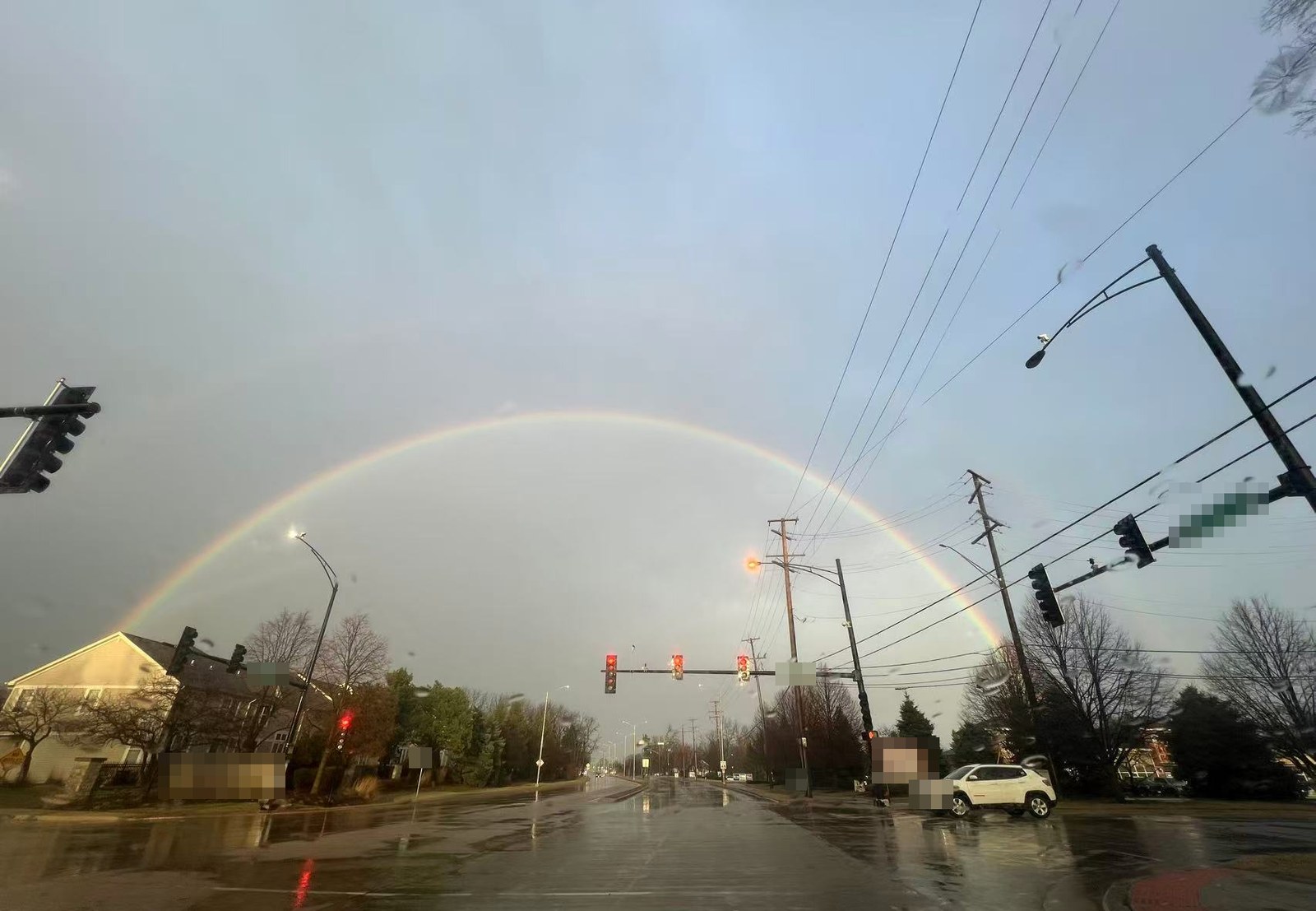
Early winter, and the sky outside is grey. Sorting through the photos on my phone, I came across this old one of a double rainbow: one bright, one faint, one above the other, curving across the sky after rain. My kid leaned in, and the questions came one after another: Why are there two? Why is it curved? Can we walk to the bottom of it?
A quick guess
Many people think a rainbow hangs in one particular patch of sky where the raindrops are a little special, and that if you ran fast enough you could get underneath it.
In fact the raindrops are all the same. Every one of them splits sunlight into colors and sends it off in all directions. The rainbow you see is just the light that happens to reach your eye at one particular angle. So a rainbow isn’t in a fixed place: walk forward and it moves forward with you; the person standing next to you sees a different rainbow, their own.
A raindrop turns sunlight back
A rainbow always appears on the side of the sky facing away from the Sun. Sunlight comes from behind you and enters the raindrops ahead: it turns once as it enters the water (refraction), reflects once off the back of the drop, and turns again on the way out, heading back towards you.
Where the light enters the drop decides how far it ends up from the way it came. Light entering dead center goes straight back, 0° off; the nearer the edge it enters, the more it turns. But at about 42° it can’t turn any further; entering even nearer the edge, it turns less again. So light entering over a wide stretch of the drop all comes out near 42°. At other angles the light is thin and scattered; only at 42° is it especially bright: that’s the rainbow. The bow made this way, with one reflection, is the brightest one, the “primary bow”; light can also reflect twice inside a drop, making a fainter “secondary bow,” which comes later.
The French philosopher René Descartes worked this out in 1637, calculating the paths one ray at a time by hand.
Where the colors come from
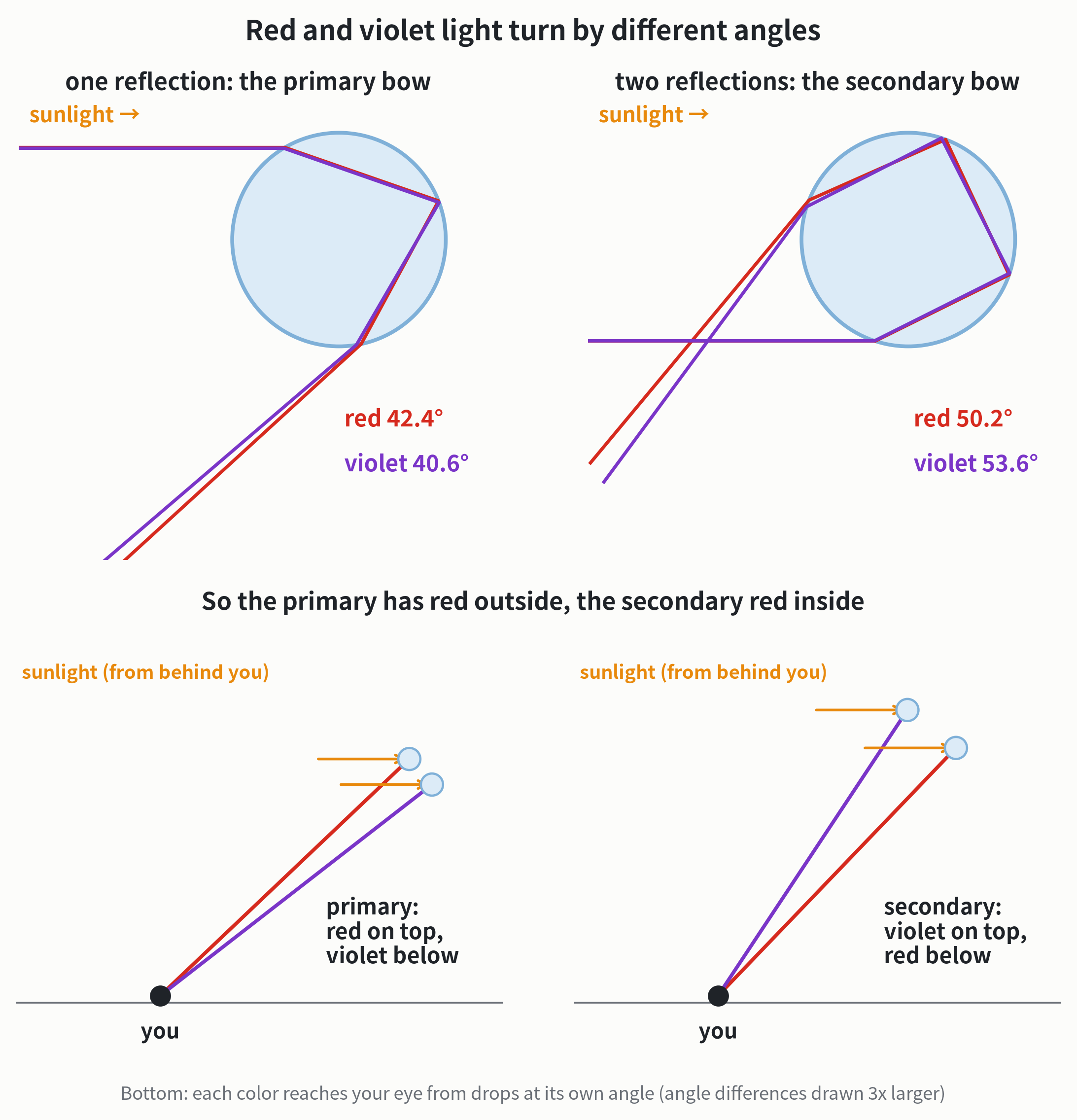
What Color Is Sunlight? explained that sunlight is all the colors of light mixed together. Water bends each color a little differently: violet a little more, red a little less. As a result, red light piles up at about 42.4° and violet at about 40.6°; with the colors spread over less than 2°, they line up into a band.
Why is red on the outside of the rainbow? Because the red light in your eye comes from drops 42.4° from the direction of your shadow, and the violet from drops at 40.6°, nearer your shadow. So red is outside (on top) and violet inside (underneath).
Why the rainbow is curved
The Sun is behind you, and your shadow points straight ahead. All the directions exactly 42° from your shadow’s direction join up into a circle, centered on the shadow of your head. Every raindrop on that circle sends light to your eye, so the rainbow is a circle.
Usually you see only an arc because the lower half of the circle falls below the horizon, where there are no raindrops (or the ground is in the way). From a mountain top, or looking down from a plane, you can sometimes see a whole circle.
That’s also why rainbows usually appear in the morning and evening: the lower the Sun, the higher the rainbow; when the Sun is about to set, the rainbow is a half circle. At mid-latitudes, the summer noon Sun is higher than 42°, and you can’t see a rainbow.
Winter is different: at about 40° north, the noon Sun at the winter solstice is only about 27° up, so in principle you could see a rainbow at noon. It’s just that winter brings little rain, and the drops have often turned to snow. On cold winter days, though, you can sometimes see a different ring around the Sun itself, a “halo” about 22° from the Sun, made by light refracted through ice crystals. That has nothing to do with rainbows.
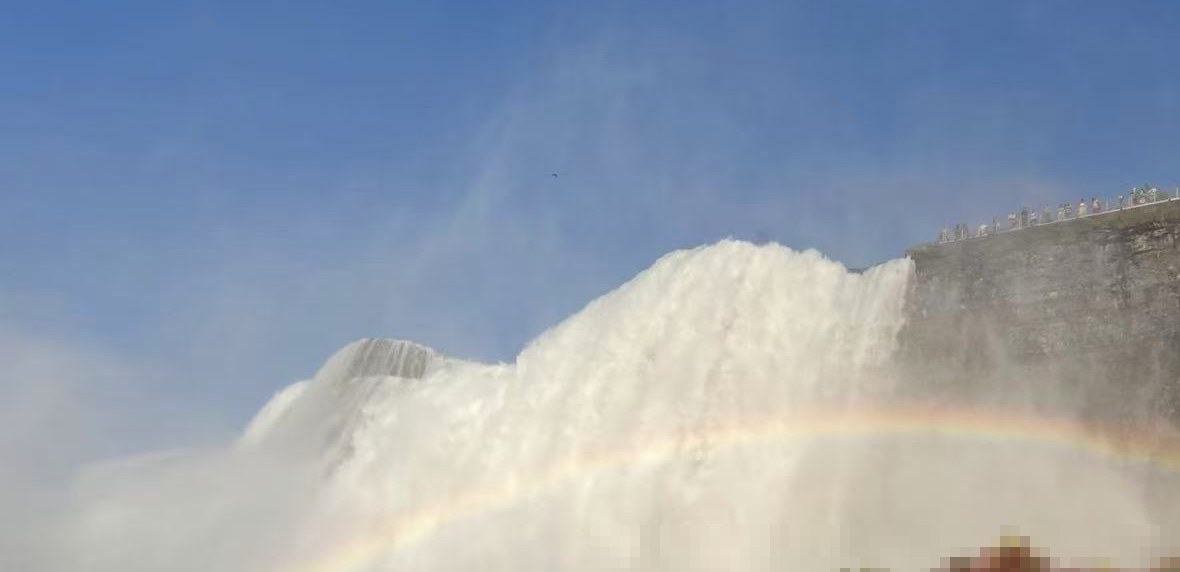
A rainbow doesn’t even need rain: all it needs is sunlight from behind you and plenty of small water drops in front. The spray from waterfalls and fountains carries rainbows even on a clear sunny day.
The second rainbow, and the dark band between
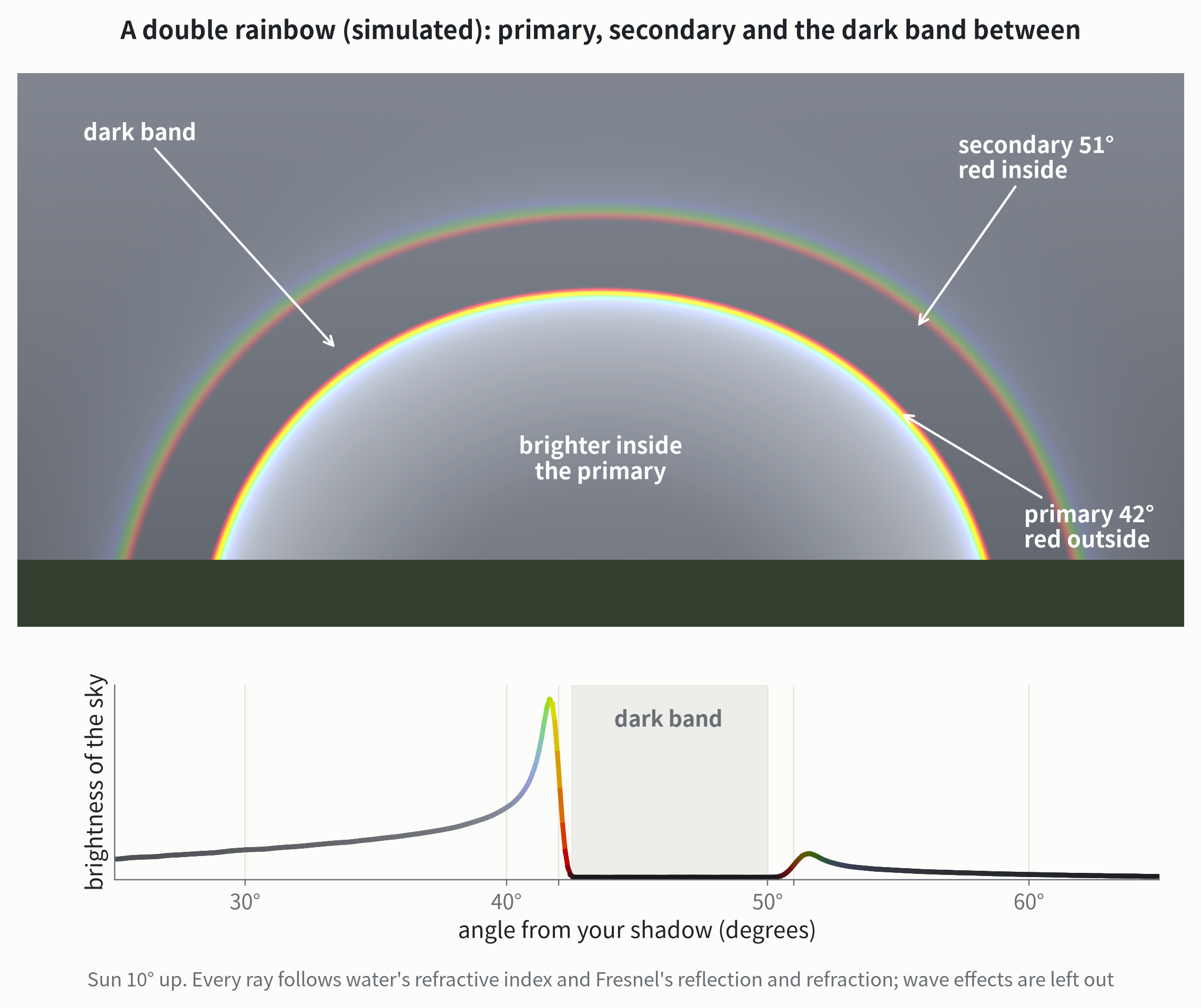
Light that reflects twice inside a drop can come out too. This light piles up about 51° from your shadow’s direction: that’s the secondary bow. 51° is farther from your shadow than the primary’s 42°, so the secondary is always outside the primary: in the sky, the primary is below and the secondary above.
- The secondary’s colors are reversed: after two reflections the light turns the other way round, with red piling up at 50.2° and violet at 53.6°, so the secondary has red inside and violet outside.
- The secondary is fainter: each time light reaches the water’s surface from inside, most of it passes out; only a small part reflects. One more reflection leaves even less light.
- The sky between the two is darker: light reflected once reaches at most 42° from your shadow’s direction; light reflected twice is at least 51° away. Between 42° and 51°, neither can reach, so the sky is a shade darker. People noticed this band about 1,800 years ago; it’s called “Alexander’s dark band.”
- It’s brighter inside the primary: light reflected once is most crowded at 42°, but it also reaches every angle below 42°, so the sky inside the primary bow is brighter than outside.
Look back at the photo at the top: the sky between the two bows really is a shade darker than inside the primary, and the sky inside the primary has a warm glow. Next time you see a double rainbow, take a look too: is the sky between the two darker? Are the secondary’s colors reversed?
In one sentence: sunlight that enters a raindrop and reflects once can turn at most 42°, so the light piles up at that angle; each color piles up at a slightly different angle, lining up into a band. The directions 42° from your shadow’s direction form a circle, so a rainbow is curved, and everyone sees their own. Light reflected twice piles up at 51°, making a fainter secondary bow with its colors reversed.
How do we know?
- Make your own rainbow: on a sunny day, stand with your back to the Sun and spray a fine mist from a spray bottle or a garden hose; look for the rainbow in the mist ahead of your shadow. In winter the Sun is low, so the rainbow is high and big.
- Measure 42°: hold your arm out straight and spread your hand: thumb tip to little-finger tip is about 20°. A little more than two hand spans up from the shadow of your head is where the rainbow is.
- A glass of water as a raindrop: put a round glass or a round fishbowl full of water in sunlight by a window, and hold a white card at an angle on the window side: you can catch a small patch of colored light.
- Look at a rainbow through polarized sunglasses: a rainbow’s light is almost entirely “polarized.” With polarized sunglasses on, the top of the rainbow goes dark; tilt your head to one side, and the dark part moves to the sides.
What we still don’t know
Once in a while someone photographs a stranger rainbow: a primary bow that starts as one at the bottom and splits into two higher up, called a “twinned rainbow.” One explanation: large raindrops are flattened by the air as they fall, like little hamburgers; when two showers with drops of different sizes mix, each draws a slightly different rainbow. A computer simulation in 2012 did produce rainbows like this, but the researchers themselves said it hasn’t been checked in the real sky.
For the curious: the rainbow’s angles, the simulation and the history
The most crowded angle. Light enters a raindrop at an angle of incidence ; the angle of refraction satisfies , where is water’s refractive index. After one reflection, the light leaves at from the way it came; after two, . The light is most crowded where stops changing as the entry point moves, which happens when (primary) or (secondary).
Water’s refractive index from Daimon and Masumura’s formula (2007), at 20 °C:
- violet, 400 nm: , primary 40.6°, secondary 53.6°;
- yellow, 589 nm: , primary 42.0°, secondary 51.0°;
- red, 700 nm: , primary 42.4°, secondary 50.2°.
The Sun itself is about 0.5° across, which smears each color a little more, so the rainbow’s band of color is about 2° wide.
Simulating the sky. Over a million rays are picked at random across the drop’s cross-section. For each, Fresnel’s equations give how much light is kept at each reflection and transmission (for the two polarizations separately); light reflected straight off the drop’s surface is added, and the light landing at each angle is counted. Then the Sun’s spectrum and the CIE 1931 color-matching functions of the human eye turn it into color, smeared by the Sun’s 0.53° disc. Wave effects are left out: just inside a real primary bow you can sometimes see a few faint pink and green stripes (“supernumerary bows”); explaining them needs the interference of light, first proposed by Thomas Young in 1803. In the photo at the top, a faint pink and green stripe hugs the inside of the primary bow; it is very likely a supernumerary bow.
The Sun’s height. At 40° north, the noon Sun is about 73° up at the summer solstice, 50° at the equinoxes, and 27° at the winter solstice. The top of the rainbow is 42° minus the Sun’s height. Strictly, with the Sun between 42° and 51°, the primary has sunk but the top of the secondary still shows above the horizon, faint and low.
History. Around AD 200, Alexander of Aphrodisias, a commentator on Aristotle, described the dark band between the two bows. Around 1304 to 1310, Theodoric of Freiberg in Germany experimented with water-filled glass spheres as enlarged raindrops, showed that a rainbow forms from each raindrop refracting and reflecting sunlight on its own, and also traced the light path of the secondary bow. In 1637, Descartes calculated the 42° and 51°. Newton, splitting white light into colors with a prism, explained why the rainbow has colors.