Why Are Soap Bubbles Colorful?
At the end of my kid’s summer happy-football class, the kids were given two bubble machines, and on a fine day recently my kid and a friend took turns playing with them outside. In the sunshine, strings of bubbles floated up, their gold, purple, blue and green especially vivid, swirling, flowing and changing.
Bubbles are colorful; that seems like a given. Yet the bubble mixture in the bottle is clear and colorless. Where do the colors actually come from?
A quick guess
Common guesses: “There’s dye in the soap”; “a bubble is like a prism, splitting sunlight into the colors of the rainbow.”
Neither is right. That soapy water has no color is easy to check. The prism idea takes a bit more thought: a prism separates colors because glass bends each color by a different amount, violet a little more than red, so after passing through two slanted faces, the colors fan apart. A bubble’s film, though, is a thin sheet with almost parallel faces: light passing through bends one way going in and back again coming out, so its direction barely changes, and the colors aren’t separated.
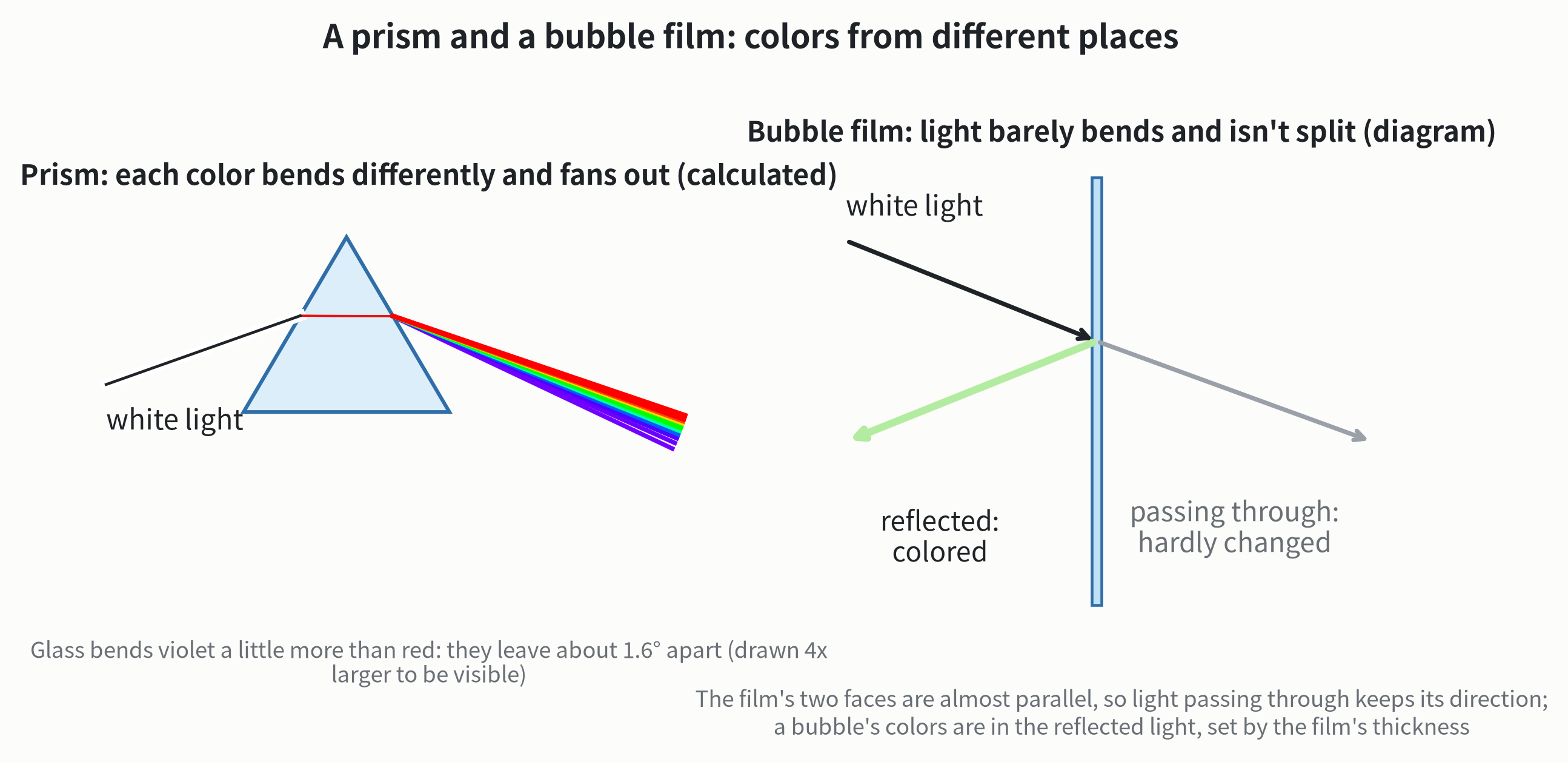
A bubble’s colors are hidden in the light it reflects. The secret is that a bubble’s film is very, very thin: about as thin as the wavelength of light.
How thin is a bubble’s film?
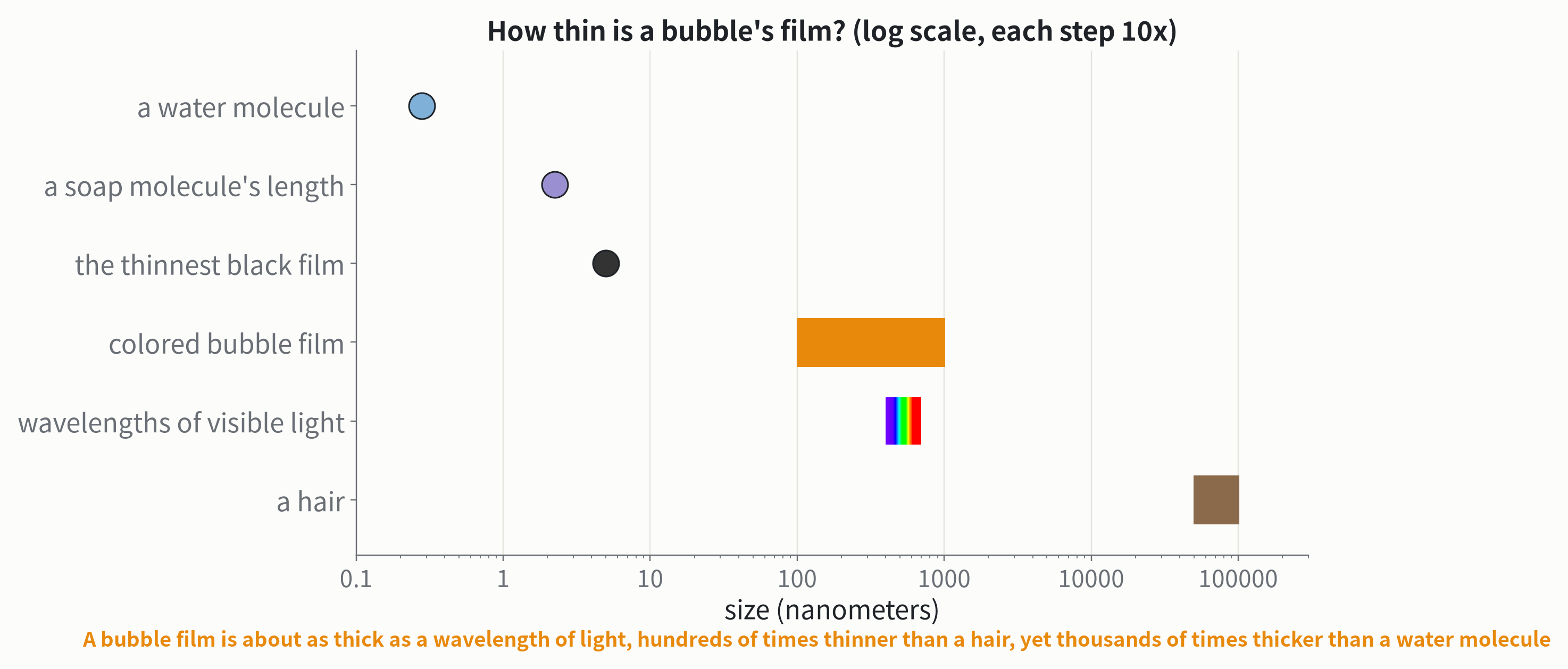
A bubble’s film is a layer of water sandwiched between two layers of soap molecules. Just after it’s blown, the film is about 1 micrometer thick (a thousandth of a millimeter); at its most colorful, only a few hundred nanometers. A hair is about 70 micrometers across, a hundred times thicker than a bubble film.
Visible light has wavelengths between 400 and 700 nanometers, about the same as the film’s thickness. That’s exactly what gives a thin film its colors.
Light meets water: refraction and reflection
When light falls on a bubble, two things happen.
- Refraction: most of the light goes into the film. Light travels more slowly in water than in air, at only 1/1.33 of its speed in air; this 1.33 is water’s “refractive index.” When light enters water at a slant, the change of speed turns its direction a little: that’s refraction. Slowed down in water, light’s wavelength also shrinks to 1/1.33 of what it is in air.
- Reflection: a small part of the light is reflected by the water’s surface. Lit face on, each water surface reflects only about 2%; a bubble film has a front and a back surface, and when the two reflections reinforce each other they reach at most about 8%. The more slanting the light, the more is reflected, which is why a bubble’s edge looks brighter.
That number really is small: over nine tenths of the light passes straight through, which is why a bubble is mostly transparent and you can see what’s behind it. The colors we see come from this small reflected part. Against a dark background, such as in the shade of a tree, the colors stand out most; against a bright sky, they look much paler.
Reflection has one subtlety: when light reflects off water coming from air, the wave is “flipped over,” crests becoming troughs; reflecting off the film’s back surface, from water to air, it isn’t.
Why the flip? Think of a rope. Tie a thin rope to a thick, heavy one, and send an upward pulse along the thin rope: at the knot, the heavy rope is too sluggish to follow, and the pulse bounces back downward, flipped over. The other way round, from the heavy rope to the thin one, the thin rope is light and gets carried along, and the pulse bounces back unflipped. Light is the same: from “fast” air to “slow” water is like thin rope to heavy rope, and the reflection flips; from water to air, it doesn’t.
Two reflections, added together
So a bubble reflects two beams: one from the front surface of the film and one from the back. The back one makes an extra round trip, twice the film’s thickness; and since that stretch is in water, where the wavelength is shorter, it counts for even more.
Light is a wave. When two waves add up crest on crest, they reinforce each other and get brighter; crest on trough, they cancel and get darker. This is called “interference.”
If the film were almost no thickness at all, the two reflections would differ only by the front surface’s “flip,” exactly opposite, and cancel completely: a film that thin reflects no light at all.
Sunlight contains every color, each with its own wavelength. At a given thickness, the two reflections may line up for red light and be out of step for blue. So some colors are reinforced and some cancelled, and the reflected light comes back colored.
Thickness sets the color
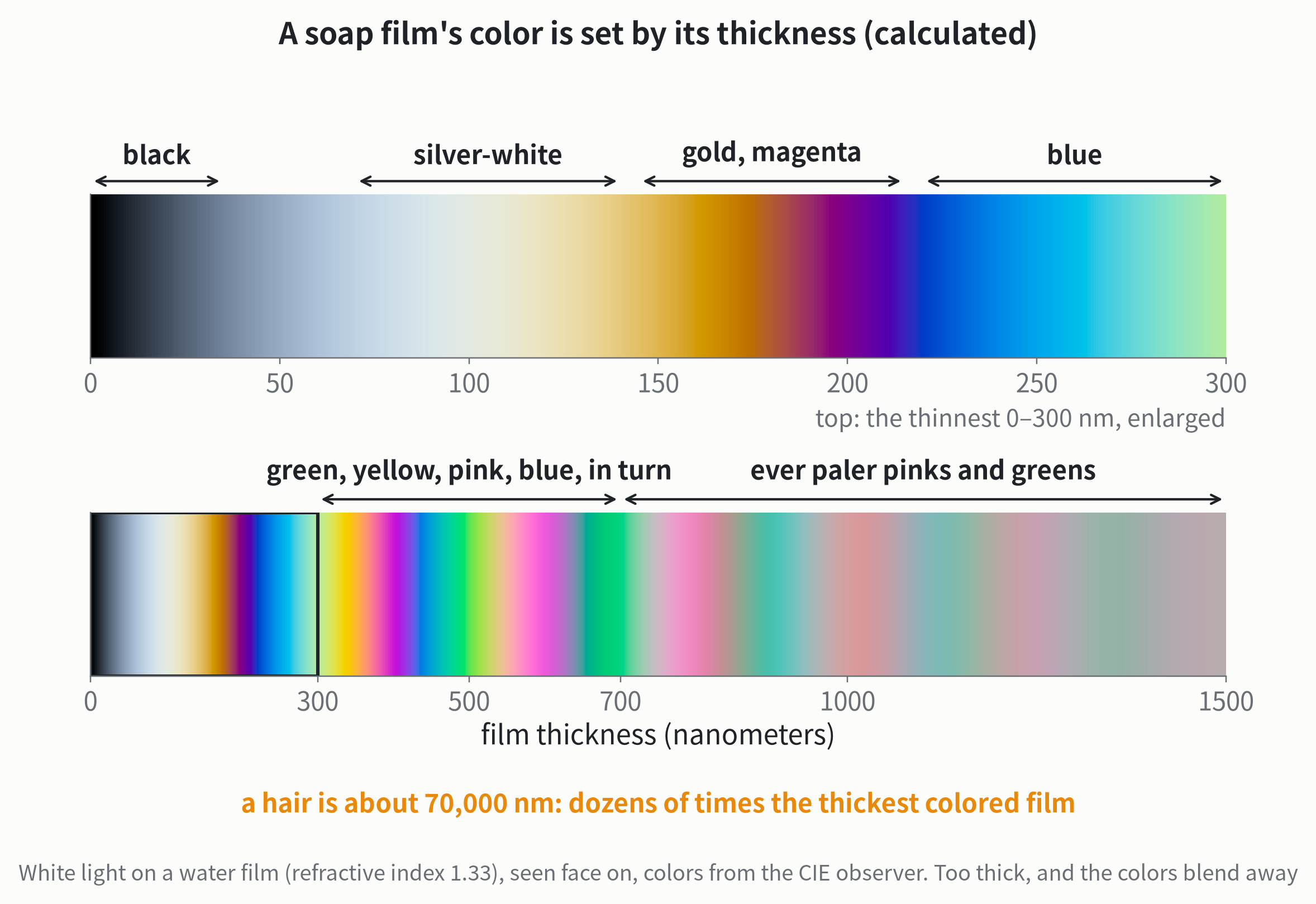
So the color at each point of a bubble depends only on how thick the film is there. With the interference formula and the eye’s sensitivity to each color, we can calculate the color for every thickness:
This also explains a few things:
- Too thick, no color: at a few micrometers thick, the reinforced and cancelled colors crowd together and mix into white. That’s why a bowl of soapy water or a pane of glass doesn’t show these colors.
- Colors in bands: points on a bubble with the same thickness join up into lines, so the colors line up into bands following the thickness.
- The thinnest parts are black: below a few tens of nanometers, every color is cancelled.
The life of a bubble
Just after a bubble is blown, its film is fairly thick and its colors pale. Then the water in the film slowly drains down under gravity, while evaporating all the time: the top of the bubble gets thinner and thinner, the bottom thicker. So the color bands slide down from the top, the top moving towards the “gold, magenta, silver-white” end.
Finally a black spot appears at the top. The film there is only tens of nanometers thick, too thin to reflect any light. Once the black spot appears, the bubble is about to pop.
Do real bubbles really live like this? Yes, but you need still air to see it clearly. Indoors, blow a bubble onto the wet rim of a cup so it stays put: within tens of seconds to a few minutes, you’ll see the color bands drain down, the top fade to silver-white, and then sharp-edged black spots appear and slowly merge. Outdoors, bubbles drift about and wind and air currents stir the liquid in the film, so the colors look more like flowing swirls; and most bubbles are popped by wind, dust or dry air before any black spot appears.
The thinnest black film is only about 5 nanometers: two layers of soap molecules back to back, with almost no water between them. It’s called a “Newton black film,” because more than three hundred years ago Newton noticed the black spots at the tops of bubbles.
Newton’s rings: how Newton measured film thickness
In 1665 the English scientist Robert Hooke described, in his Micrographia, the colors of thin flakes of mica and of soap bubbles. Newton turned this into an experiment he could measure: he pressed a slightly curved lens onto a flat piece of glass. Between them was a very thin layer of air, zero at the center and thicker outwards. Lit from above with white light (daylight) and seen from above, it showed rings of color, with a black center. Newton also lit it with single colors split off by a prism, and the colored rings became rings of light and dark; in red light the rings were bigger, in violet smaller.
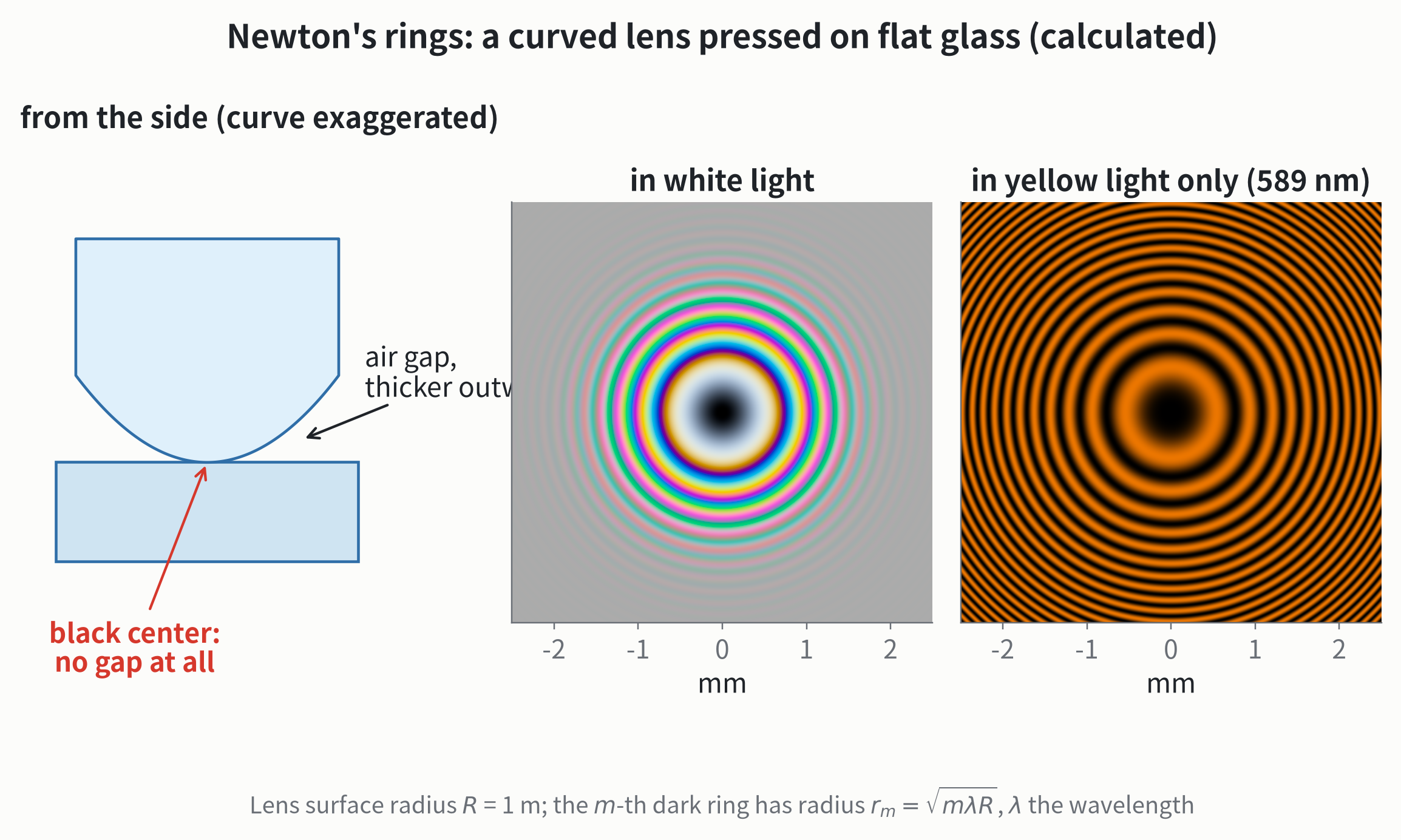
Here the thin film is air instead of water, but the idea is the same: light reflects once from the top and once from the bottom of the air gap, and the two reflections add up. At the center, where the gap is zero, the two are exactly opposite and cancel, so it’s black.
The size of the rings can be worked out too. The lens surface is a small piece of a large sphere; the farther from the center, the higher the lens surface stands above the flat glass, and the height grows with the square of the distance from the center: twice as far out, four times the gap. So the rings crowd closer together farther out. In light of a single color, each extra half wavelength of gap brings a new dark ring, and the radius of the m-th dark ring grows with the square root of m (derived at the end).
The curve of the lens was known, so the thickness of air at each ring could be calculated. In his Opticks of 1704, Newton recorded how thick the air gap was where each color appeared, in units of hundred-thousandths of an inch. But he believed light was made of tiny particles, and couldn’t explain why the rings appeared.
Nearly a hundred years later, around 1801, the English scientist Thomas Young explained Newton’s rings by treating light as a wave whose two reflections interfere. Using Newton’s own measurements, he also worked out, for the first time, the wavelengths of the different colors: about 0.7 micrometers for red and about 0.4 for violet. The colors of soap bubbles helped humanity measure the length of light waves.
Why bubbles are round
A bubble floating in the air is a sphere.
A soap film is a bit like the skin of a blown-up balloon, always taut, always trying to shrink: this is “surface tension,” every little patch of film pulling on its neighbors. The difference is that a balloon’s skin pulls harder the more it’s stretched, while a soap film’s pull stays about the same: stretch it, and water molecules from inside move up to fill the surface.
The film wants to shrink, but it holds a fixed amount of air, so it can’t shrink without limit. How far can it go? Of all shapes holding the same amount of air, the sphere has the smallest surface. For the same volume, a cube has about 24% more surface than a sphere. So whether the bubble wand is round, square or star-shaped, the bubbles that float away are round.
Behind this is a deep idea: nature often takes the “cheapest” way. A soap film’s energy is proportional to its area; shrinking its area releases energy, so the film keeps adjusting until its area can’t get any smaller. Mathematicians call problems like this “variational problems”: among all possible shapes or paths, find the one that makes some quantity smallest. Light’s path works the same way: going from one point to another, light takes the path that takes the least time. This is “Fermat’s principle,” and refraction, light bending as it enters water, is exactly the fastest route. Legend says Queen Dido of ancient Carthage cut an oxhide into thin strips to mark out land, and found a semicircle against the coast enclosed the most: the oldest example of the same kind of problem.
Soap films, nature’s “minimum-area calculators,” have even been put to work: the German architect Frei Otto used soap-film models to find the most economical curved surfaces when designing the rippling tent roof of the stadium for the 1972 Munich Olympics.
The 120° in foams
The Belgian physicist Joseph Plateau spent his life studying soap films; blind in his later years, he still had family and students observe and describe them for him, and in 1873 he published a book on soap films and foams. The rules he found are still called “Plateau’s laws.” The most famous: in a foam, films always meet three at a time along a line, at 120° to each other.
Which three films? When two bubbles stick together, a shared “wall” grows between them. On the ring where the two bubbles meet, exactly three films come together: the left bubble’s outer wall, the right bubble’s outer wall, and the wall between them. In a big foam, every edge is likewise where three films meet.
Why 120°? Because every film pulls equally hard. Imagine three people, each pulling equally hard on a rope, with the three ropes tied to one knot: only when the ropes are at 120° to each other does the knot stay still; if two ropes are closer together, their combined pull beats the third, and the knot is dragged over until they’re back at 120°.
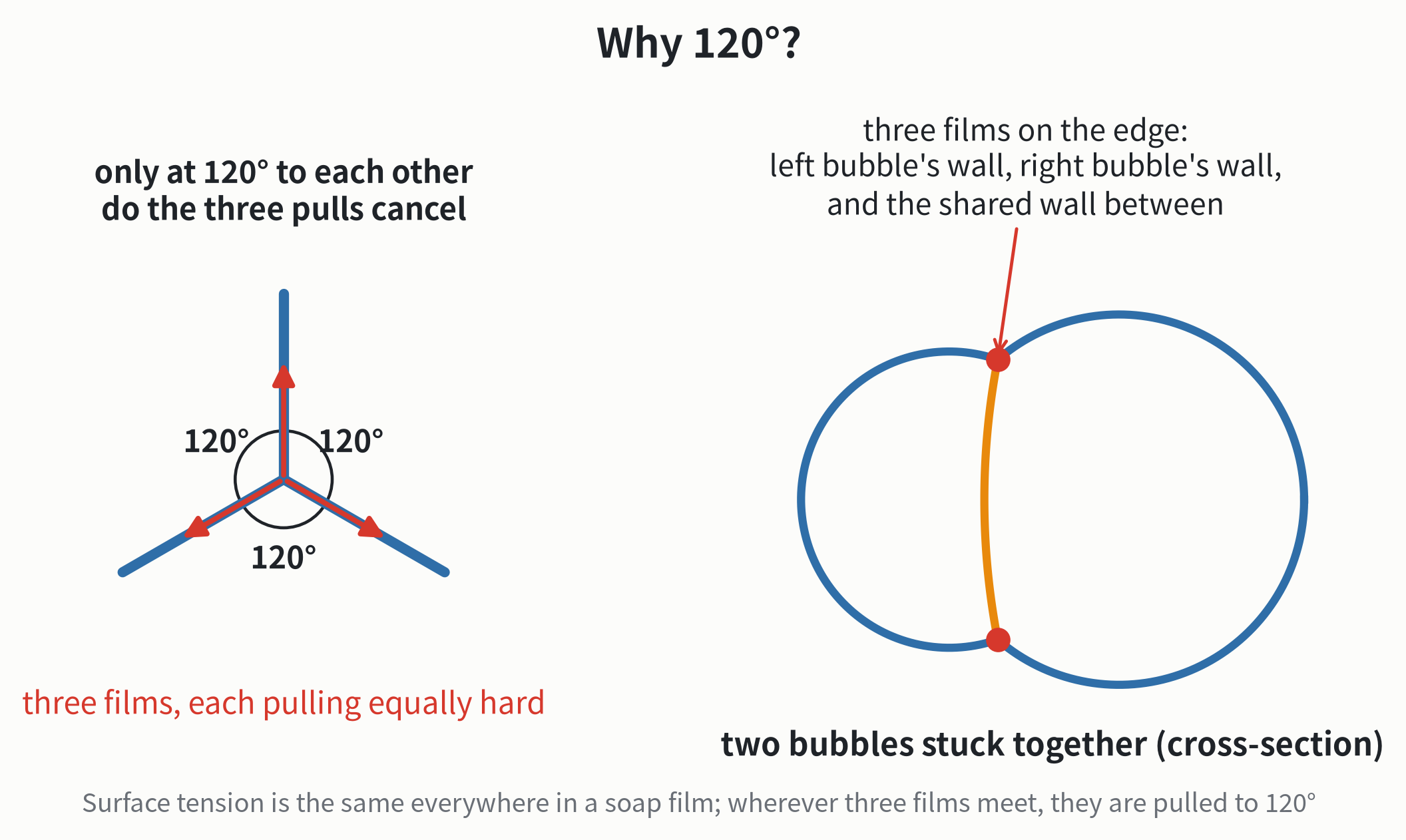
The air pressure inside a small bubble is higher than in a big one, so when two bubbles stick together, the wall between them bulges a little into the bigger bubble.
“Bubble colors” all around us
- Oil on the road: after rain, a thin layer of oil spread over water on the road shows the same colors.
- Glasses and camera lenses: lens surfaces are coated with a very thin film whose thickness makes the two reflections cancel, so there’s less glare and you see more clearly. Seen from the side, a coated lens shows a faint green or purple tint: the colors that aren’t fully cancelled.
- Butterflies and peacocks: the wings of blue morpho butterflies, peacock feathers and the shells of some beetles have no blue pigment; their colors come from interference in layers of extremely thin structures, called “structural color.” Look from a different angle, and the color changes.
How to mix a good bubble solution
Plain water won’t make bubbles: its surface tension is too strong, and the film breaks as soon as it’s stretched. Add soap, and soap molecules line up on the surface, lowering the surface tension. More importantly, wherever the film gets stretched thin, the soap molecules there spread out, the surface tension rises, and it pulls the surrounding liquid in to fill the gap. That’s how a soap film “heals itself.”
A common recipe for making bubble solution at home:
- 1 liter of water, preferably purified or boiled and cooled; minerals in tap water make bubbles worse;
- about 50 milliliters of dish soap;
- 10 to 20 milliliters of glycerin (sold in pharmacies), or a spoonful or two of sugar: both hold on to water, slowing evaporation and making bubbles last longer.
Stir gently without making too much foam, and let it stand overnight for better results.
For giant bubbles, add a little long-chain polymer. In 2020 Justin Burton and colleagues at Emory University in the US studied “how to make a giant bubble”: adding a little guar gum (a common food thickener) to bubble solution, the long polymer molecules tangle together and make the film more elastic, so it can stretch several meters without breaking. Their published recipe: 1 liter of water, 50 milliliters of dish soap, 50 milliliters of rubbing alcohol, 2 to 3 grams of guar gum and 2 grams of baking powder. They also found that a mix of long and short polymers works better. On humid days, bubbles break less easily too, because evaporation is slower.
A bubble that lasted 465 days
Ordinary bubbles pop within seconds to minutes. In 2022 researchers at the University of Lille in France made a bubble that went 465 days without popping.
They didn’t use soap, but water, glycerol and a layer of tiny plastic particles. The particles, spread over the film, stopped the water from draining down; the glycerol drew in moisture from the air, exactly replacing the water that evaporated. When the bubble finally popped, it was because microbes had grown in the film; in its last month, the bubble had turned slightly green.
In one sentence: a bubble’s film is only a few hundred nanometers thick; light reflects once from each side of it, the first reflection flipping the wave over, and the two reflections add up, reinforcing some colors and cancelling others, so the bubble is colored, and the color depends only on how thick the film is. Water drains down, the top thins, the color bands slide down, and finally it turns black and pops. Bubbles are round because surface tension shrinks the film to the smallest area; films in a foam meet at 120° because the three pull equally hard.
How do we know?
- Watch a bubble’s life: somewhere without drafts, blow a bubble onto the wet rim of a cup so it stays put. Watch the color bands drain down and the top turn black, and time how long it lasts.
- A rainbow from a drop of oil: put a tiny drop of cooking oil or nail polish into a bowl of water, set the bowl on a dark background, and watch the colors as the oil film spreads.
- Two panes of glass: press two clean flat panes of glass (such as from picture frames) tightly together and look at them at an angle under a lamp: you’ll see wavy colored fringes, “relatives” of Newton’s rings.
- Look for 120°: make a heap of foam, or trap a layer of soap foam between two panes of glass, and check where films meet: is it always three of them, at 120° to each other?
- Compare recipes: with the same water, add dish soap, dish soap plus glycerin, and dish soap plus sugar, and compare which makes the biggest, longest-lasting bubbles.
What we still don’t know
Exactly when a bubble will pop is still hard to predict. Dust, evaporation, the slightest unevenness in the film can make it suddenly burst; even in the lab, identical bubbles can last several times longer or shorter than each other. How big a giant bubble can be, and how foams coarsen and dry over time, are also questions physicists are still studying.
For the curious: the interference formula, deriving Newton’s rings and the data
Why reflection flips. For light going from refractive index to and reflecting face on, the amplitude ratio is . From air () to water (), : the minus sign is the “flip.” From water to air, : no flip. The reflected intensity is .
Thin-film interference. For a film of refractive index and thickness lit face on, the back reflection travels an extra , which in water counts as in air; the front reflection carries an extra half-wavelength flip. So light of wavelength is brightest when and darkest when (). Seen at an angle, replace with , where is the refraction angle inside the film, so the colors at a bubble’s edge differ slightly from the middle.
How strong is the reflection? The two surfaces together reflect (Airy’s formula)
at most about 8%, so a bubble is mostly transparent, and its colors come only from this small reflected part. The colors in the figures are computed from the daylight (D65) spectrum and the CIE 1931 color-matching functions, then brightened uniformly.
Deriving Newton’s rings. The lens surface is part of a sphere of radius . At distance from the center, the lens surface stands a height above its lowest point. By Pythagoras, , which expands to . The gap is far smaller than , so can be dropped:
This time the film is air: the upper reflection, at the glass-to-air surface, doesn’t flip; the lower one, at the air-to-glass surface, does. The two differ by plus half a wavelength, so dark rings appear where . Substituting :
In the figure m; in 589 nm yellow light the first dark ring has a radius of about 0.77 mm, the fourth about 1.53 mm.
Black films. An ordinary black film is about 30 to 50 nm thick; a Newton black film about 5 nm, two layers of soap molecules back to back.
Sphere and cube. A sphere of volume has surface area ; a cube, . The cube has about 24% more.
The prism. The figure uses the refractive index of BK7 optical glass (1.531 for 400 nm violet, 1.513 for 700 nm red), a 60° apex angle and 50° incidence: violet is turned by 39.9°, red by 38.3°, about 1.6° apart.
Sources. Giant bubbles: Frazier, Jiang and Burton, Physical Review Fluids 5, 013304 (2020). The 465-day bubble: Roux et al., Physical Review Fluids 7, L011601 (2022). Bubble colors and thickness, and Plateau’s laws: Isenberg, The Science of Soap Films and Soap Bubbles (1992).