Braking Atoms with Light: How Do Lasers Cool Atoms to Near Absolute Zero?
Lasers may make you think of the laser pointer in your hand during a talk, the red light that scans barcodes at the supermarket checkout, or the light carrying data in optical fibre. Factories also have powerful lasers that cut steel. But in physics labs, lasers have a surprising talent: they can cool atoms to just a millionth of a degree above absolute zero.
Light is energy; shining it on something ought to heat it up. How can light make atoms colder?
First: what is temperature?
Temperature is how fast atoms and molecules jiggle about. At room temperature, the nitrogen molecules in the air move at about 470 m/s on average, bumping into each other at random; the colder it is, the slower they go. So “cooling atoms down” means “slowing atoms down.”
Here we use rubidium as the example because it is the most common atom in cold-atom experiments. Like sodium and caesium, rubidium has a single outermost electron and one colour it especially “likes”: near-infrared light at 780 nm, almost the same as the laser in a CD drive. In 1986 Carl Wieman in the US used cheap semiconductor lasers to “brake” caesium atoms, showing that expensive large lasers weren’t needed; rubidium’s colour happened to match CD-drive lasers too, and cold-atom experiments spread to many ordinary labs. At room temperature a rubidium atom moves at about 300 m/s, faster than an airliner.
To stop it, you have to push it the other way. Light can push things, and to push atoms it has to be laser light.
How does a laser make its light?
An ordinary lamp is a huge number of atoms each giving off light at random, mixed in colour and in every direction. A laser is different: first another beam of light or an electric current “lifts” a group of atoms to a high-energy state; then a passing photon “pulls out” an identical photon from such an atom, one becomes two, two become four. This is stimulated emission, which Einstein proposed in 1917 in a paper on how light and atoms exchange energy; in the same paper he also pointed out that every photon carries momentum, exactly the “push” that laser cooling relies on. Two mirrors send the photons back and forth so they multiply, and some leave through a slightly transparent mirror: that is the laser beam.
Each new photon matches the old one in colour, direction and step, so laser light is very pure in colour and very precise in direction. The laser pointer used in talks is a tiny semiconductor laser: a red one is about 650 nm, usually a few milliwatts or less. At 1 mW it gives off about photons a second, and shining on a wall it pushes with a force of only about N, less than the weight of a fine speck of dust, far too small to notice in everyday life.
Laser cooling needs exactly that purity: the laser’s colour has to sit off the atom’s favourite colour by about one part in a hundred million. Lamplight can’t do that; only a laser can.
One photon, one push
Light is made of photons, and each carries a little momentum. When an atom absorbs a photon, it gets a push along the direction the light is travelling; a moment later it gives the photon off again, in a completely random direction, so the recoils point every which way and average out. Absorb and emit, and what the atom keeps is a small push along the light.
That push is nothing to a wall, but not small to an atom: a rubidium atom absorbing one 780 nm photon changes its speed by about 6 mm/s. An atom can absorb and emit tens of millions of photons a second; added up, light can decelerate an atom at about m/s², ten thousand times gravity. An atom running into the laser at about 300 m/s can be “braked” to a stop by about 50,000 photons, in under 3 ms, over a few tens of centimetres.
Taking only the light coming at it
But light pushes from one direction. Atoms move left and right; a push to the right slows the ones moving left, but speeds up the ones moving right, doesn’t it?
In 1975 Theodor Hänsch and Arthur Schawlow at Stanford, and David Wineland and Hans Dehmelt, independently found a way. The trick is that atoms are “picky eaters”: an atom only absorbs light of exactly the right colour, and if the frequency is a little off it hardly absorbs at all. Physicists deliberately tune the laser slightly “redder” than the atom’s favourite colour (a slightly lower frequency).
Now the Doppler effect comes in: an atom running into the light sees its frequency go up, a little “bluer,” just right, so it absorbs eagerly and is pushed back; an atom running away from the light sees it even “redder” and hardly absorbs. Shine one such beam from each side, and whichever way an atom runs, it mostly takes the light coming at it and gets pushed back.
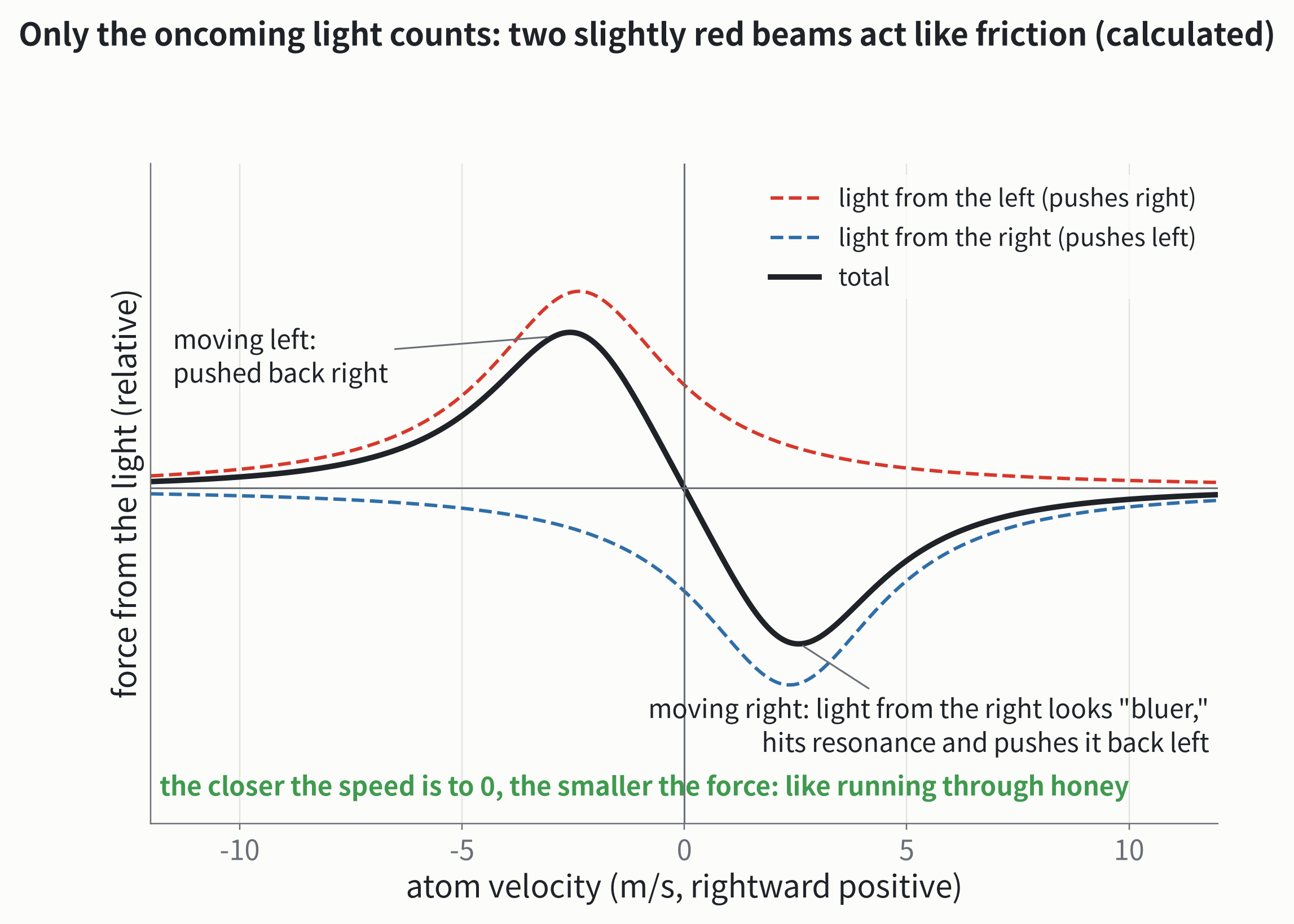
The total force always opposes the atom’s motion, and the faster it moves the bigger the drag, like running through honey. With a beam from each of six directions, up and down, left and right, front and back, an atom is held back whichever way it goes. This “honey” made of light was first made in 1985 by Steven Chu’s team at Bell Labs, who called it “optical molasses.”
How cold can it go? A beautiful accident
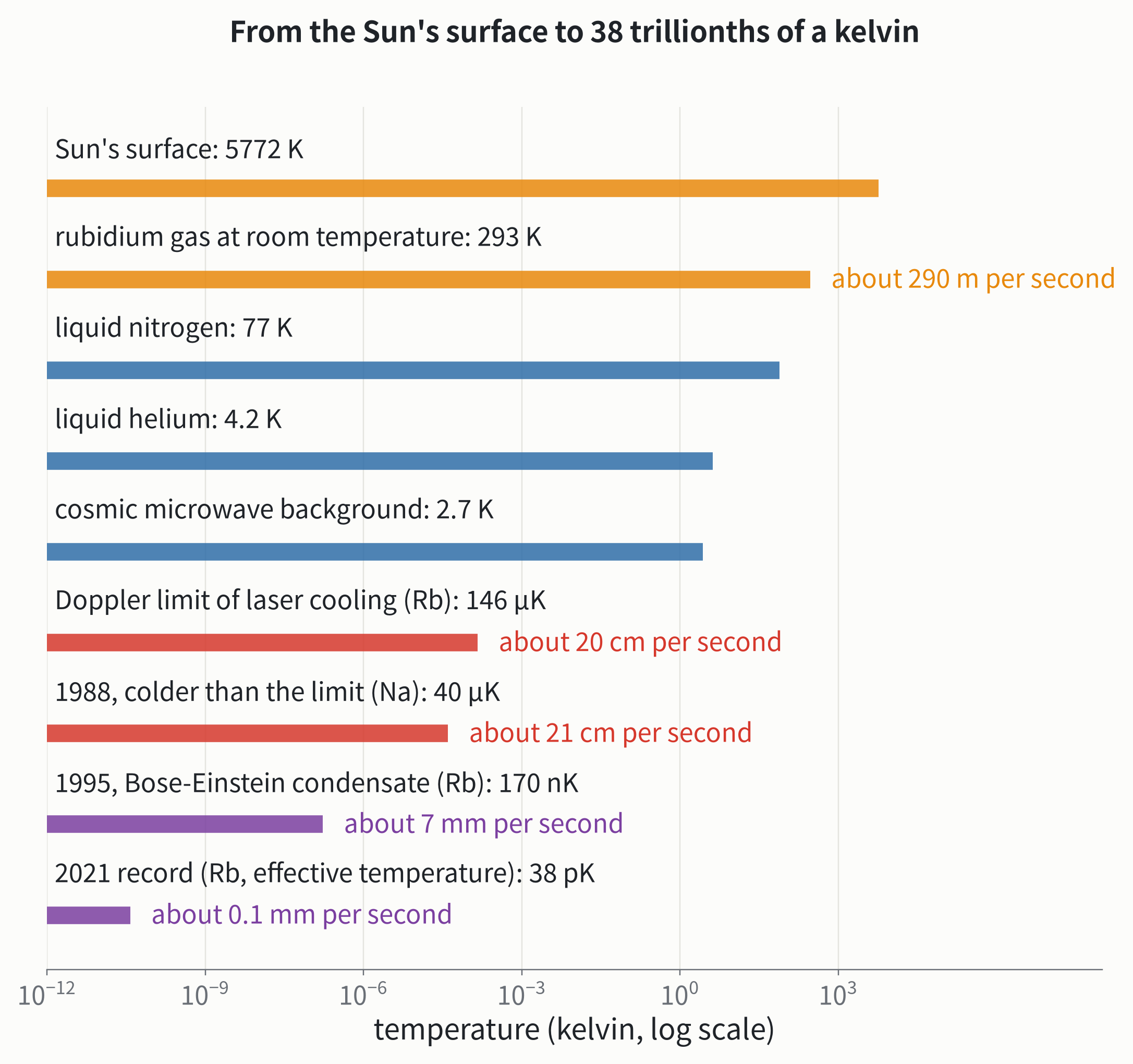
But while light brakes the atoms, it also keeps them from coming to rest. Each time an atom gives off a photon in some random direction, it recoils the opposite way, by about 6 mm/s each time; and the moments when it absorbs photons are random too. These little random recoils add up, like a person being nudged gently from all sides by a crowd, swaying back and forth on the spot. The braking gets weaker as the atom nears rest, but the random nudges never stop; when the two balance, the temperature can fall no further. In theory this floor is the “Doppler limit”: about 146 µK (millionths of a kelvin) for rubidium, about 240 µK for sodium. In 1985 Chu measured his sodium atoms at almost exactly 240 µK, and everyone was satisfied.
But in 1988 William Phillips’s team at the US National Bureau of Standards used a more accurate way of measuring temperature and found their sodium atoms at only about 40 µK, six times below the theoretical limit. Everyone was surprised: experiment had done what theory said was impossible.
The answer soon came from Claude Cohen-Tannoudji and Jean Dalibard in France: real atoms have more than two energy levels, and laser light has polarisation. An atom moving through light whose polarisation keeps changing is like someone forever climbing a hill; every time it reaches the top, the light “pumps” it back to the bottom, taking away a little kinetic energy each time. This is called “Sisyphus cooling,” after the figure in Greek myth condemned to push a boulder uphill forever.
In 1997 Chu, Cohen-Tannoudji and Phillips shared the Nobel Prize in Physics “for development of methods to cool and trap atoms with laser light.”
Colder still: atoms become waves
Laser cooling reaches microkelvins, but it is possible to go colder. In 1995 Eric Cornell, Carl Wieman and Wolfgang Ketterle (Ketterle, at MIT, used sodium) first laser-cooled atoms and then, like blowing on a hot cup of tea, let the fastest atoms “evaporate” away, cooling about 2000 rubidium atoms to about 170 nK (billionths of a kelvin). At that point each atom’s quantum “wave” spreads out and overlaps with the others, and all the atoms move in step like one giant atom: a “Bose-Einstein condensate.” Einstein had predicted it in 1925; it took 70 years. The three won the 2001 Nobel Prize in Physics.
On the ground, though, atoms fall as soon as they are released and drop out of view within tens of milliseconds, too fast to watch carefully. In 2021 researchers in Germany dropped their whole apparatus down a drop tower in Bremen more than 120 m tall: in free fall, the atoms and the apparatus are “weightless” together, so the atoms hang almost still relative to the apparatus and can be watched for seconds. During those seconds they used a “matter-wave lens” to make the cloud almost stop expanding, an effective temperature of only about 38 pK, about 70 billion times colder than outer space (2.7 K). The aim was not to measure gravity, but to prepare for precise measurements with cold atoms in space in future, such as tests of the laws of gravity.
What cold atoms are used for
- Atomic clocks. The most accurate atomic clocks first cool the atoms so they fly slowly and can be “counted” carefully (see Why Are Atomic Clocks So Accurate?).
- Quantum computers. Lasers can hold individual cold atoms and arrange them in neat arrays, each atom a quantum bit. In 2025 researchers at Caltech lined up 6100 caesium atoms this way with “optical tweezers.”
- Measuring gravity. As cold atoms fall, their quantum waves are extremely sensitive to gravity, which can reveal hollows and ores underground and test the laws of gravity.
In a sentence: temperature is how fast atoms jiggle. An atom gets a push each time it absorbs a photon; tune the laser slightly redder than the colour the atom likes, and the Doppler effect makes it take only the light coming at it, so whichever way it runs it is pushed back, as if running through honey. This cools atoms to around a millionth of a degree; with evaporation and other tricks they can go down to nanokelvins and picokelvins, where atoms become a single quantum wave moving in step.
What we don’t know yet
Cold atoms can already be arranged in arrays of thousands, but a truly useful quantum computer needs more atoms and fewer errors. Another direction is space: without gravity, atoms can drift slowly for seconds or longer, allowing colder, more precise experiments than on the ground, perhaps even searches for dark matter and tests of gravity. The answers are still to come.
Going further: numbers, formulas and sources
Laser pointer. 1 mW at 650 nm: each photon carries J, about photons a second; fully absorbed, the force is N (twice that if reflected). A dust grain 10 µm across weighs about N. Figure 1 is a diagram, not a calculation.
How precise the colour must be. For cooling, the laser sits about half a linewidth below the atomic resonance, MHz; light at 780 nm has a frequency of about 384 THz, a relative offset of about .
A photon’s push. Photon momentum is . For the rubidium-87 D2 line, nm and the atomic mass is 86.909 u, so the recoil velocity is mm/s. The excited state’s linewidth is MHz; in strong light an atom scatters at most photons a second, a maximum deceleration of m/s², about . At 293 K a rubidium atom’s mean speed is m/s and its root-mean-square speed m/s; stopping from 290 m/s takes about photons, 2.6 ms and 0.38 m. Nitrogen molecules at 293 K have a mean speed of about 471 m/s.
Scattering force. One beam pushes an atom of velocity with , where is the laser frequency minus the atomic resonance (negative when tuned red) and is the saturation parameter. Figure 1 uses and per beam, adding two opposite beams.
Doppler limit. : 146 µK for rubidium-87, 240 µK for sodium. Figure 2 is a one-dimensional Monte Carlo calculation: at each time step, absorptions from each beam are Poisson-distributed with the rates above, each absorbed photon changes the velocity by , and each photon is re-emitted at random to the left or right, changing it by another . The final one-dimensional temperature is about 150 µK, close to the Doppler limit.
Root-mean-square speed. Figure 4 uses for the atom in brackets (86.909 u for rubidium-87, 22.990 u for sodium); the Sun’s surface, liquid nitrogen, liquid helium and the cosmic microwave background are only there to compare temperatures, with no speed. 38 pK is an effective temperature from a matter-wave “lens” that slows the expansion, not a temperature in thermal equilibrium; the Bremen drop tower’s tube is about 120 m tall, a drop lasts about 4.7 s, and the experiment observed for about 2 s.
Sources. A. Einstein, Physikalische Zeitschrift 18, 121 (1917). R. Watts and C. Wieman, Optics Letters 11, 291 (1986). D. Wineland and H. Dehmelt, Bulletin of the American Physical Society 20, 637 (1975). C. Wieman and L. Hollberg, Review of Scientific Instruments 62, 1 (1991). T. Hänsch and A. Schawlow, Optics Communications 13, 68 (1975). S. Chu et al., Physical Review Letters 55, 48 (1985). P. Lett et al., Physical Review Letters 61, 169 (1988). J. Dalibard and C. Cohen-Tannoudji, Journal of the Optical Society of America B 6, 2023 (1989). M. Anderson et al., Science 269, 198 (1995). C. Deppner et al., Physical Review Letters 127, 100401 (2021). H. Manetsch et al., Nature 647, 60 (2025). 1997 and 2001 Nobel Prizes in Physics: nobelprize.org.