How Do Noise-Cancelling Headphones Make Sound Disappear?
Put on noise-cancelling headphones on a plane, flip the switch, and the engines’ steady roar suddenly retreats into the distance, as if someone had turned down the volume of the world. Yet, strangely, you can still hear the person next to you talking.
There’s nothing in a headphone but a speaker. How can it make sound “disappear”? And why can it cancel a hum but not a voice?
A quick guess
A common answer: “Noise-cancelling headphones just have extra-tight ear cups that keep the sound out.”
That’s only a small part of it. Good ear cups and ear tips do block a fair amount of sound; that’s called “passive isolation.” But the real trick of noise-cancelling headphones is “active noise cancelling”: they play a sound of their own that cancels the noise outside. Sound defeating sound.
To put it more provocatively: while you wear noise-cancelling headphones, they are playing you the airplane’s roar the whole time, only “upside down.”
How a speaker makes sound
How Does Radio Carry Sound and Data to Your Phone? ended with the radio turning the signal back into “the sound as an electric current, which drives the paper cone of the loudspeaker back and forth.” The tiny speaker in a headphone works the same way.
A speaker has a magnet, and around it sits a coil of wire, glued to a cone (or a thin membrane). When current flows through the coil, the coil next to the magnet feels a force: current one way pushes the coil forward, current the other way pulls it back. The current of a sound swings back and forth, and the cone vibrates along with it.
When the cone pushes forward, it squeezes the air in front of it a little; when it pulls back, the air thins a little. This pattern of squeezed and thinned air passes on, layer pushing layer: that’s sound. The air itself doesn’t travel to you; each little parcel of air just jiggles back and forth in place. What travels is the pattern of squeezing and thinning.
The animation shows only a strip straight in front of the cone. Real sound spreads out from the cone in all directions, like the rings of ripples from a stone dropped in water. Which way more of it goes depends on how the wavelength (more on that below) compares with the cone. A low sound’s wavelength is several meters, much bigger than the cone, so it spreads almost equally in every direction; that’s why a subwoofer can sit under the desk. A high sound’s wavelength is just a few centimeters, smaller than the cone, so it beams mostly straight ahead; walk around to the side of a speaker and the treble fades.
How many times a second the air is squeezed and thinned is the sound’s “frequency,” in hertz. The higher the frequency, the higher the pitch: an airplane engine’s low roar is mostly tens to hundreds of hertz, while a voice is mostly a few hundred to a few thousand hertz. Sound travels about 343 meters a second in air, so in a 100 Hz sound neighboring squeezes are 3.4 meters apart: its “wavelength.” A 1,000 Hz sound has a wavelength of only 34 centimeters.
Transverse and longitudinal waves
The wavy curve under the animation looks like a wave on a rope, but it’s only a graph of the air pressure along the way; the air doesn’t move up and down. The air jiggles back and forth, along the direction the sound travels.
A wave can jiggle in two ways. If the jiggling is at right angles to the direction the wave travels, it’s a “transverse” wave: shake a rope, and the rope moves up and down while the wave runs along it. If the jiggling is along the direction of travel, it’s a “longitudinal” wave: sound in air is longitudinal, like a stretched spring pushed back and forth at one end, with the squeezes and stretches running down the spring.
Why only longitudinal waves in air? A transverse wave needs the neighbors to “pull you back sideways.” A rope or rock can do that, but air and water just flow away when pushed sideways, and can’t pull back. Earthquake waves in rock come in both kinds: the “P waves” that arrive first are longitudinal and fast; the “S waves” that arrive later are transverse, slower, and can’t pass through liquid. Light is a transverse wave too, though what jiggles isn’t any material, but electric and magnetic fields.
Cancel the noise with sound turned “upside down”
Since sound is the air being squeezed and thinned, suppose another sound arrives at the same place at the same time, thinning the air exactly when the noise squeezes it, and squeezing when the noise thins it. Add the two, and the air is neither squeezed nor thinned: silence.
That’s what noise-cancelling headphones do:
- a small microphone outside (or inside) the ear cup “listens” to the noise first;
- a chip in the headphone flips the waveform over, crests becoming troughs and troughs crests;
- the speaker plays this “anti-noise,” which meets the noise in your ear and cancels it.
Curiously, the anti-noise on its own sounds almost exactly like the noise: your ear can hardly tell whether a sound has been flipped “upside down.” Only when the two arrive at the same place at the same time do they cancel.
It’s exactly the same idea as in Why Are Soap Bubbles Colorful?: when two waves add up crest on crest they reinforce each other, and crest on trough they cancel. This is called “interference.” On a soap bubble, what cancels is light of certain colors; in noise-cancelling headphones, it’s the noise.
Why a hum cancels and a voice doesn’t
The anti-noise has to match the noise exactly: when the noise’s crest arrives, the anti-noise’s trough must arrive at the same instant. But the headphone has to “listen,” then “calculate,” then “play,” and that always takes a tiny bit of time.
That bit of time affects low and high sounds very differently.
- Low sounds: one squeeze-and-thin of a 100 Hz sound takes 10 milliseconds. If the headphone is a few tens of microseconds late (a microsecond is a millionth of a second), it’s out of step by only a sliver; the anti-noise still nearly matches the noise, and most of it cancels.
- High sounds: one squeeze-and-thin of a 1,000 Hz sound takes just 1 millisecond. Being the same few tens of microseconds late puts it ten times further out of step, and it doesn’t cancel cleanly; out of step enough, the two can even add up and get louder.
At the end of the animation, 118% of the 1,000 Hz tone is left: louder than with no cancelling at all. How? Two equal waves cancel completely only when they’re exactly opposite (half a cycle apart); the less they’re apart, the bigger their sum, until in perfect step it’s double. The anti-noise starts half a cycle apart from the noise. For a 1,000 Hz tone, 200 microseconds late is a fifth of a cycle late, leaving the two just three tenths of a cycle apart: less than a third of a cycle, and then their sum is bigger than either wave alone. Work it out and you find that once the delay passes a sixth of a cycle, cancelling turns into reinforcing; half a cycle late, the anti-noise’s crests land right on the noise’s crests, and the sound doubles.
So real headphones don’t push their luck: engineers deliberately make the anti-noise handle only low sounds, and turn it down or off for high ones. Better not to cancel than to make things louder. The animation stretches the delay to 200 microseconds to make it easy to see; real headphones are much faster.
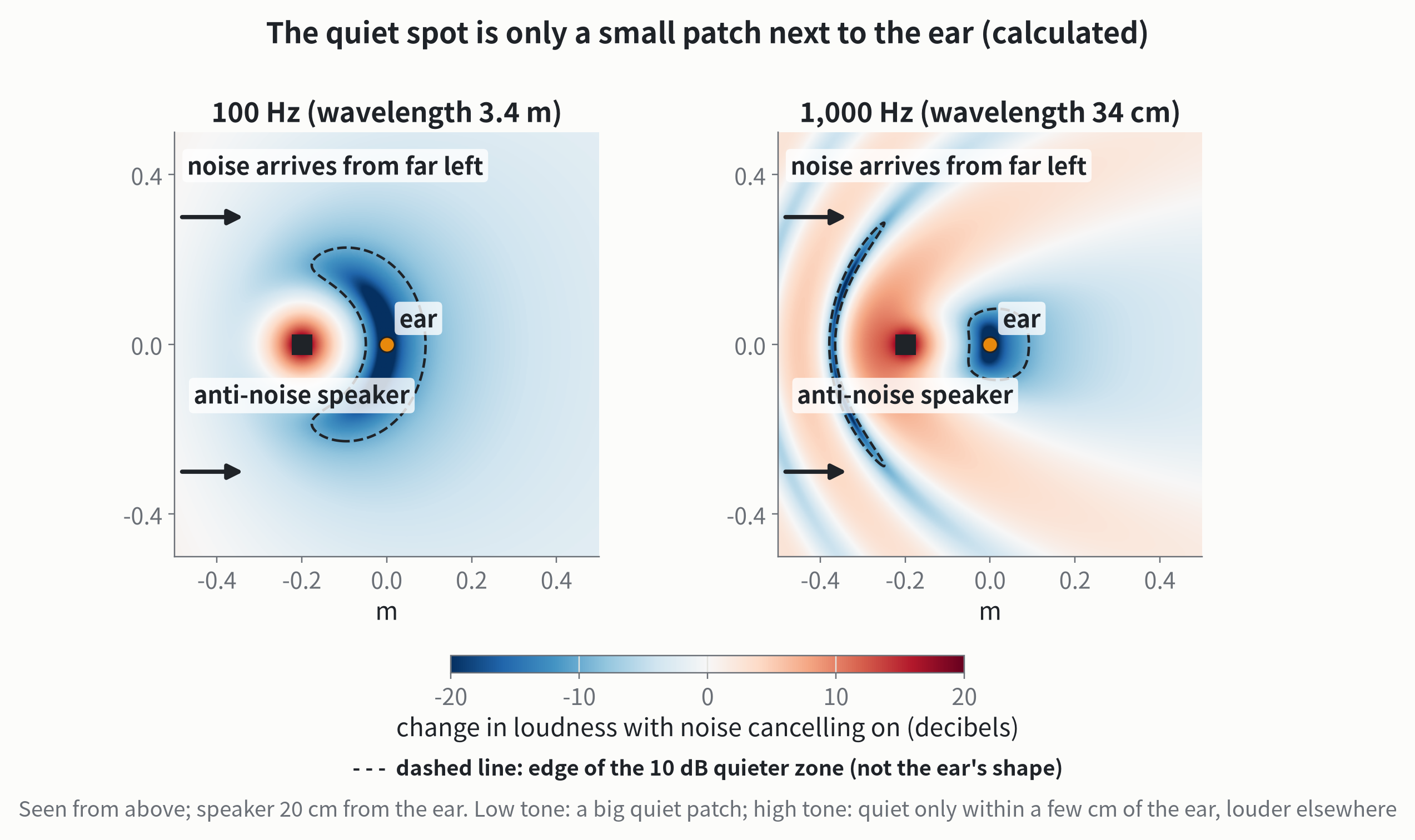
There’s another reason: the anti-noise matches the noise only close to the speaker. Away from that small patch, the two have traveled different distances and fall out of step. How far out of step, again, depends on the wavelength: a low sound’s wavelength is several meters, so moving a few centimeters, or even a dozen, hardly matters; a high sound’s wavelength is tens of centimeters or just a few, so a small move puts it out of step.
The figure below is a flat slice seen from above. The noise comes from far away on the left; 20 cm to the left of the “ear” sits a speaker playing anti-noise, set to cancel exactly at the ear. The colors show how much the sound changes at each spot with cancelling on.
That’s why the speaker in noise-cancelling headphones always sits right against the ear, and the microphone as close to the ear canal as possible.
What noise-cancelling headphones block
Putting active cancelling and passive isolation together shows why noise-cancelling headphones are such “picky eaters”:
- Low rumble, like planes and subways or the hum of air conditioners and fridges, mostly from tens of hertz to a couple of hundred: exactly where active cancelling is best, taking off twenty or thirty decibels.
- Sharp, high sounds, like a clicking keyboard or clattering dishes: active cancelling can’t handle them; the ear cups and tips block them. To get through an ear cup, a sound first has to shake the cup’s shell along with it. A high sound shakes fast, and making the same heavy shell shake that fast is much harder, so a solid ear cup is great at blocking high sounds and nearly useless against low ones.
- Voices are mostly between 250 and 4,000 Hz. The pitch of a man’s voice is around 100-odd hertz and a woman’s around 200 Hz, but what lets us make out the words is the part from a few hundred to a few thousand hertz, especially consonants like s and f, above 2,000 Hz. Here active cancelling has mostly given up, and the ear cups aren’t yet at their best: voices fall right into the gap between the two.
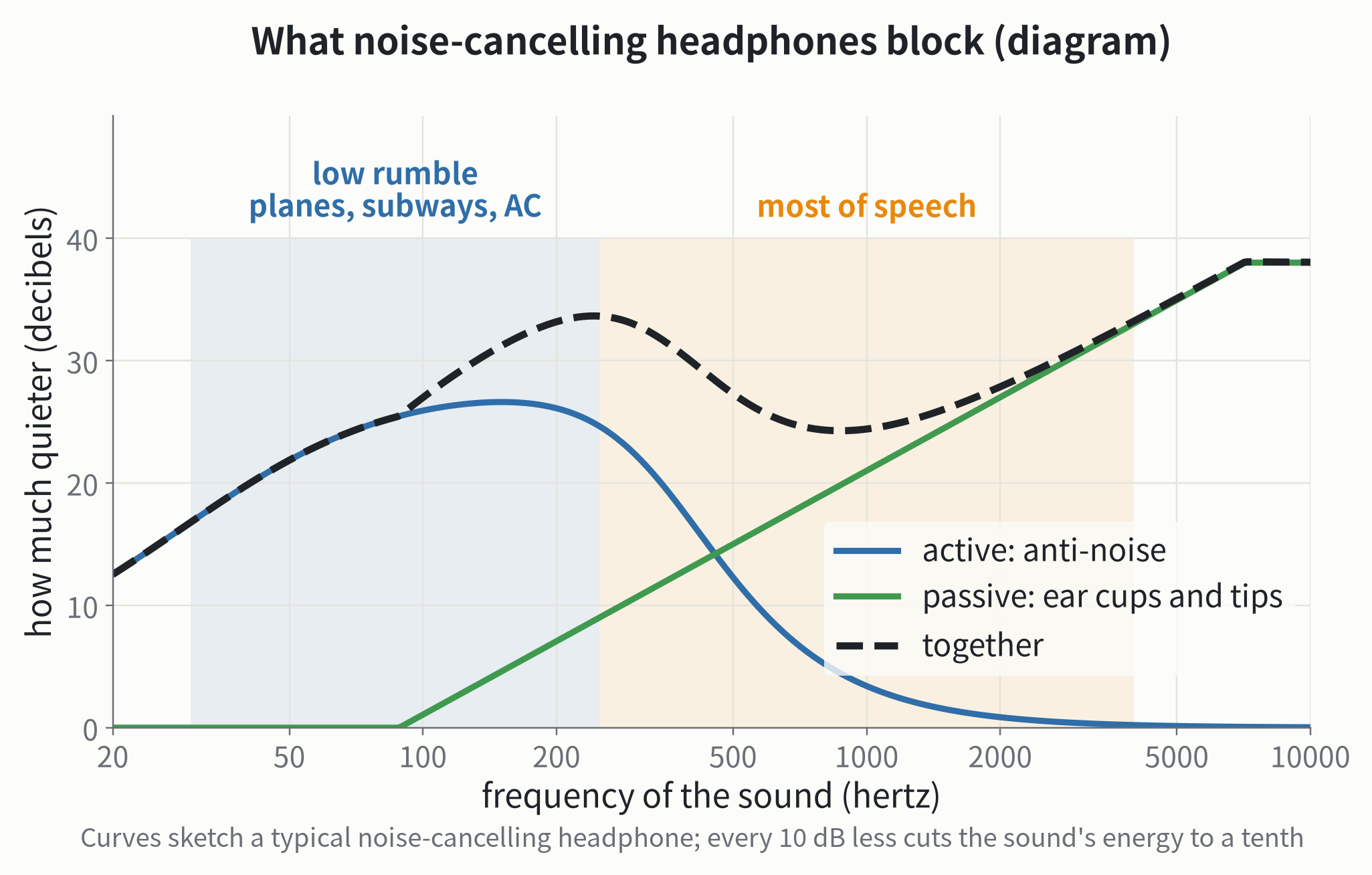
Add to that the fact that our ears are most sensitive to sounds around two or three thousand hertz and rather dull to low sounds, and voices become the sound that “leaks” most through noise-cancelling headphones.
From a patent to your ears
The idea of “silencing sound with sound turned upside down” is half a century older than noise-cancelling headphones. In 1933 the German Paul Lueg applied for a patent (granted in the US in 1936): pick up the noise with a microphone, flip the signal over, and play it back through a speaker. But the vacuum-tube electronics of the day couldn’t keep the anti-noise accurate and steady as the noise kept changing, and the idea lay on paper for many years.
In 1978 Amar Bose, a professor at MIT in the US, was flying home from Zurich to Boston. He put on the headphones the airline handed out to listen to music, but the cabin’s roar drowned everything out. He started working out the problem on the plane, and back home he set a team to work on noise-cancelling headphones. In 1986, two pilots flew the airplane Voyager around the world in 9 days without refueling or landing, wearing prototype noise-cancelling headsets. Noise-cancelling headphones went into cockpits first, and reached ordinary people around 2000.
Today a tiny pair of noise-cancelling earbuds has a microphone, a chip and a speaker working out the anti-noise tens of thousands of times a second or more.
Beyond cancelling: letting sound in
The same microphones and chip can also work the other way:
- Transparency mode: play the sound the microphones pick up outside straight into your ear, so you can hear people next to you and the cars on the street while wearing headphones.
- Adaptive modes: some headphones tell sounds apart automatically, removing a steady hum while letting voices through.
- Hearing aid: in September 2024 the US Food and Drug Administration authorized the hearing-aid feature on Apple’s AirPods Pro 2, the first over-the-counter hearing-aid software it had authorized: the earbuds test your hearing, then boost the sounds you have trouble hearing.
Cancelling, transparency, hearing aid: they all use the same skill. The headphone knows precisely what sound is at your ear, and then decides what sound to put in.
Are noise-cancelling headphones safe?
- The anti-noise itself doesn’t hurt your ears. It cancels the noise at your ear, so your eardrum actually feels smaller swings. Noise cancelling has a bonus, too: in a noisy place you don’t need to turn the music up as loud. The World Health Organization advises adults to listen at 80 dB for no more than 40 hours a week; every 3 dB louder halves that time.
- That “blocked ear” feeling. Some people feel pressure in their ears when they switch cancelling on, as in an elevator. When someone measured it with a pressure sensor, the air pressure in the ear hadn’t changed: most likely the low sounds suddenly vanish and the brain reads the silence as pressure. It’s harmless; if it bothers you, turn the cancelling down a little.
- The real thing to watch out for is the street. Cancelling also takes away some of the traffic noise. When walking or cycling, switch to transparency mode, or take one earbud out.
In one sentence: a speaker’s coil, pushed next to a magnet, drives a cone that squeezes and thins the air, and that’s sound. Noise-cancelling headphones hear the noise with a microphone, flip the waveform over and play it back, so the noise’s squeezes meet the anti-noise’s thinnings and cancel. Low sounds have long wavelengths and change slowly, so the headphone can line up in time and cancel them cleanly; high sounds have short wavelengths, and a little delay or a small offset puts them out of step, so only the ear cups can block them; voices fall in between, which is why you can still hear them.
How do we know?
- Find a “quiet spot”: use two phones with the same “pure tone” or “tone generator” app, both playing 400 Hz (wavelength about 86 cm). Put them side by side on a table, speakers toward you, and sit a meter away. Keep one still and slowly move the other one back: at around 40 cm (half a wavelength) the sound gets noticeably weaker, where the two sound waves are half a wavelength out of step and cancel. The two phones’ tones always differ by a tiny amount, so the quiet spot slowly drifts, which also shows why noise cancelling has to line up so precisely.
- Compare on and off: next to an air conditioner or fridge, put on noise-cancelling headphones, switch cancelling on and off, and listen to which sounds go away and which stay. Then have someone talk or type nearby and compare.
- Watch a speaker move: set a small speaker (or one taken from old headphones) face up, sprinkle a few grains of rice or fine sand on it, play a low tone, and watch them jump.
What we still don’t know
Engineers are trying to take noise cancelling beyond the ear: speakers in a car’s headrests to make a “quiet zone” for the driver, or a row of small speakers in an open window to keep out traffic noise. But the size of the quiet zone is always limited by the wavelength, and making a whole room quiet for every kind of sound is still very hard. Another challenge: how can headphones cleverly decide which sounds you want to hear and which you don’t?
For the curious: a speaker’s force, the cancelling formula and the data
A speaker’s force. With a total length of wire in the coil, a current and the magnet’s field at the coil, the coil feels a force , at right angles to both the current and the field. The current follows the sound, and so does the force, driving the cone.
Wavelength. The speed of sound is m/s (20 °C), and the wavelength is : 3.43 m at 100 Hz, 34.3 cm at 1,000 Hz, 3.4 cm at 10,000 Hz.
How much is left when late. Let the noise be a pure tone of frequency and the anti-noise late by . Added together, the amplitude left is
of the original. With µs, 3% is left at 100 Hz and 31% at 1,000 Hz. Reducing by 20 dB (leaving 10%) requires : 50 µs late, that works only below 318 Hz. When what’s left exceeds 1 and the sound gets louder; in the animation , leaving . Real noise-cancelling headphones keep the electronics’ delay to a few tens of microseconds, and for very regular noise they can also “predict” the next moment’s waveform.
The waterbed effect. A microphone inside the ear cup hears the leftover noise and adjusts the anti-noise accordingly: this is called “feedback.” Feedback obeys a mathematical theorem (the Bode sensitivity integral): pushing the noise down at some frequencies necessarily raises it a little at others, like pressing down one end of a waterbed and watching the other end bulge. Engineers put the bulge in the high range, where the ear cups block sound anyway.
The quiet zone. In figure 5 the noise is a plane wave from far to the left, and the anti-noise speaker is treated as a point source 20 cm to the left of the ear, set to cancel exactly at the ear. At right angles to the line from speaker to ear, it’s at least 10 dB quieter out to about 20 cm at 100 Hz and about 9 cm at 1,000 Hz.
Ear cups block high sounds. In the ideal case, the decibels a sound-blocking wall stops grow with frequency and with the wall’s mass: double either and it blocks about 6 dB more (the “mass law”). Real ear cups leak through gaps and don’t do quite this well.
Decibels. A decibel figure is the logarithm of an energy ratio, : 10 dB less cuts the energy to a tenth, 20 dB less to a hundredth. Sound is blocked once by the ear cup and then cancelled again by the anti-noise, so in figure 6 the decibels of the two simply add. The curves in figure 6 sketch a typical noise-cancelling headphone, not measurements of any particular model.
Sources. Lueg’s patent: US patent 2,043,416 (granted 1936). Bose’s story and the Voyager flight: Bose company history. The AirPods Pro 2 hearing-aid feature: the US Food and Drug Administration’s announcement of September 12, 2024. Safe listening: the World Health Organization’s “Safe listening” Q&A (based on the WHO–ITU standard H.870). Measuring the “blocked ear” feeling: SoundStage! Solo, “Eardrum Suck: The Mystery Solved.”