If the Sun Suddenly Vanished, How Long Before Earth Would Know?
By this time of year the Chicago area usually feels like winter, yet today it was almost 20 °C. Walking outside in the afternoon, feeling the sunshine and looking at the fallen leaves everywhere, I suddenly wondered: if the Sun suddenly vanished, how long would it take us on Earth to find out?
Of course this won’t happen. But in such an experiment, would the sky go dark at once? Would Earth fly away at once?
Three guesses
There might be three possible answers:
- “The sky goes dark at once, and Earth flies off at once.”
- “The sky goes dark a little later, but Earth flies off at once.”
- “Both darkness and flying off come a little later, and at the same moment.”
Sunlight takes 8 minutes 19 seconds
The Sun is about 150 million km away, and light travels 300,000 km a second, so sunlight takes 499 seconds, or 8 minutes 19 seconds, to reach us. The Sun we see is always the Sun of 8 minutes ago. After the Sun vanishes, the last sunlight is still on its way and the sky stays bright; only after 8 minutes 19 seconds, when it has all arrived, does the sky go dark.
That half is not in dispute. The hard half is the other one: when does Earth stop being pulled by the Sun?
Newton’s answer: at once
Newton’s law of gravitation says the pull between two bodies depends only on their masses and their distance:
There is no time in the formula. Wherever the Sun is, the pull points there at once; when the Sun is gone, the pull is gone at once. By Newton, if Earth suddenly lost the force holding it, it would fly off along the tangent of its orbit, while the sky stayed bright for another 8 minutes 19 seconds. Flying off wouldn’t make the sky go dark any sooner: Earth moves only 30 km a second, a ten-thousandth of the speed of light. In those 8 minutes it travels about 15,000 km along the tangent, yet its distance from the Sun’s old position grows by less than 1 km, so the last sunlight still arrives on time.
Newton himself found this troubling. In a 1693 letter to his friend Richard Bentley he wrote that one body acting on another at a distance through a vacuum, without anything in between, “is to me so great an absurdity that I believe no man who has in philosophical matters a competent faculty of thinking can ever fall into it.” But he had no better answer, and left the question to those who came after.
Einstein’s answer: together with the light
In 1915 Einstein’s general relativity gave a new picture: mass curves the spacetime around it, and Earth orbits the Sun by following the “straightest” path it can through curved spacetime. This path is called a “geodesic.” It is not the shortest path in space, since Earth plainly goes round in a big circle; it is the straightest path in spacetime, space and time taken together. More precisely, along it, a clock on Earth ticks off the most time.
When the Sun changes, the curvature changes too, but not everywhere in the universe at once: the change spreads outward like ripples on a pond. How fast? The speed of light is written into the equations of general relativity: where gravity is not too strong, they turn into the same kind of wave equation as light’s, with a wave speed of exactly the speed of light (see “Going further” at the end).
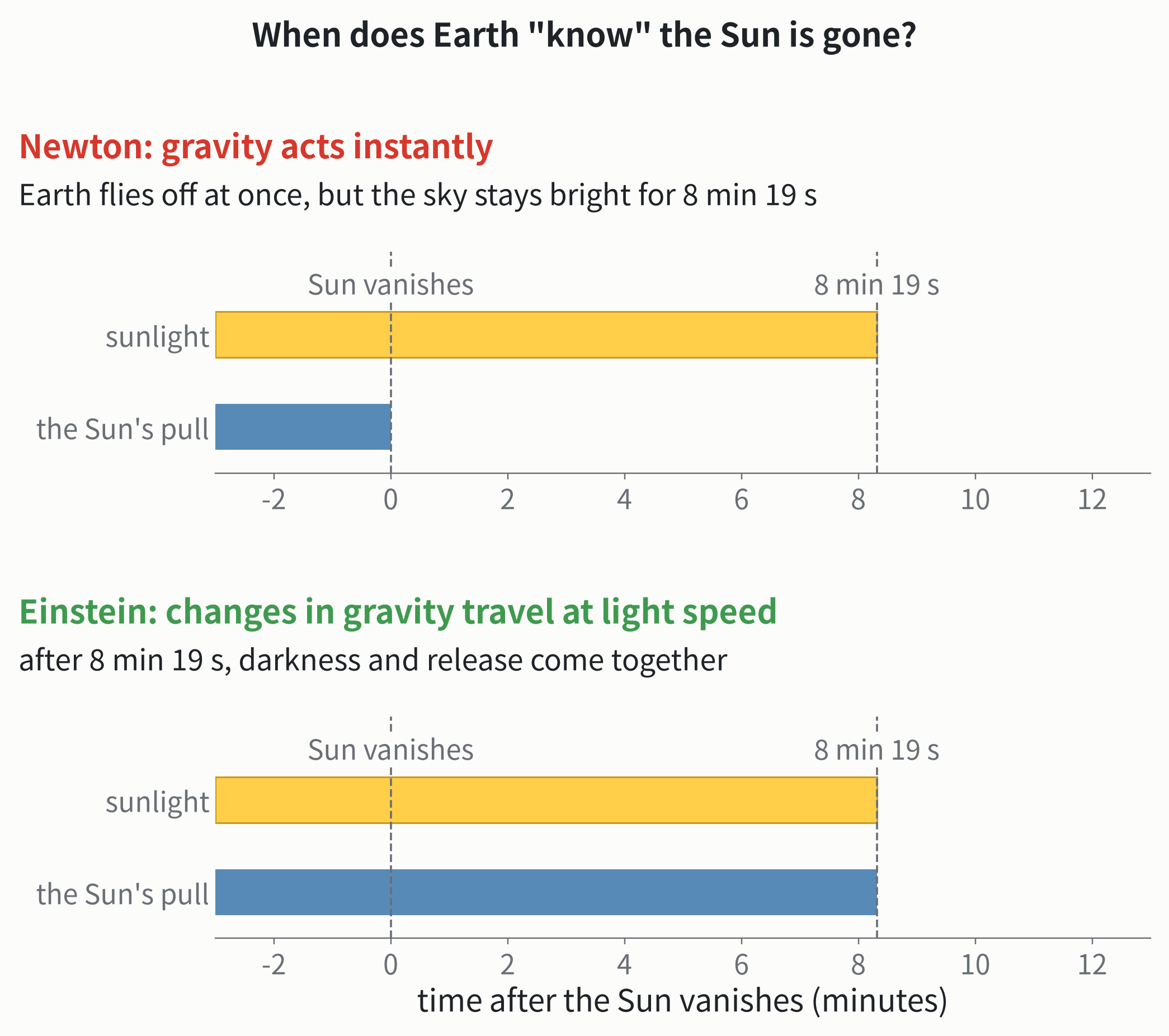
So for 8 minutes 19 seconds after the Sun vanishes, Earth keeps circling the Sun’s old position and stays in sunlight, noticing nothing. Then darkness and “letting go” happen together, and Earth flies off along its tangent. In those 8 minutes Earth has already moved about 15,000 km along its orbit, more than one Earth diameter.
What about the Moon? The pull between Earth and Moon hasn’t changed, so the Moon keeps circling Earth and flies off with it. The farther a planet is from the Sun, the later it finds out: Mercury after 3 min 13 s, Venus 6 min 1 s, Mars 12 min 40 s, Jupiter 43 minutes.
Why can’t it be faster than light? In relativity, the speed of light is the speed limit for every kind of “news”: if some influence travelled faster than light, some observers would see the effect before its cause (see also Can Time Really Slow Down?).
Laplace’s puzzle
But is there no problem with gravity travelling only at light speed? Back in 1805 the French mathematician Laplace saw a difficulty. It has to do with something light does.
Stand still in the rain and it falls straight down; start running and it seems to come at you slanted from the front, more so the faster you run. Starlight does the same: Earth runs around the Sun at 30 km a second, into the starlight, so the starlight’s direction tilts a little forward. By how much? About the ratio of Earth’s speed to the speed of light, a ten-thousandth of a radian, or 20.5 arcseconds. An arcsecond is a tiny angle: a degree is divided into 60 arcminutes and each arcminute into 60 arcseconds; 20.5 arcseconds is about the width of a small coin seen from 250 metres away. This is “aberration,” discovered by the English astronomer James Bradley while measuring the positions of stars and published in 1729.
Laplace imagined that gravity, too, might be “shot” from the Sun like raindrops and fall on Earth at a finite speed. Then the Sun’s pull would also tilt a little forward. That tilt adds a forward push which speeds Earth up orbit after orbit, so Earth would spiral outward. On this assumption, we calculate that the Earth-Sun distance would double in about 1200 years. Laplace himself looked at the Moon: such a push would change the Moon’s motion in a way that could be observed, and nothing of the kind had been seen. From this he concluded that gravity must travel at least 7 million times faster than light.
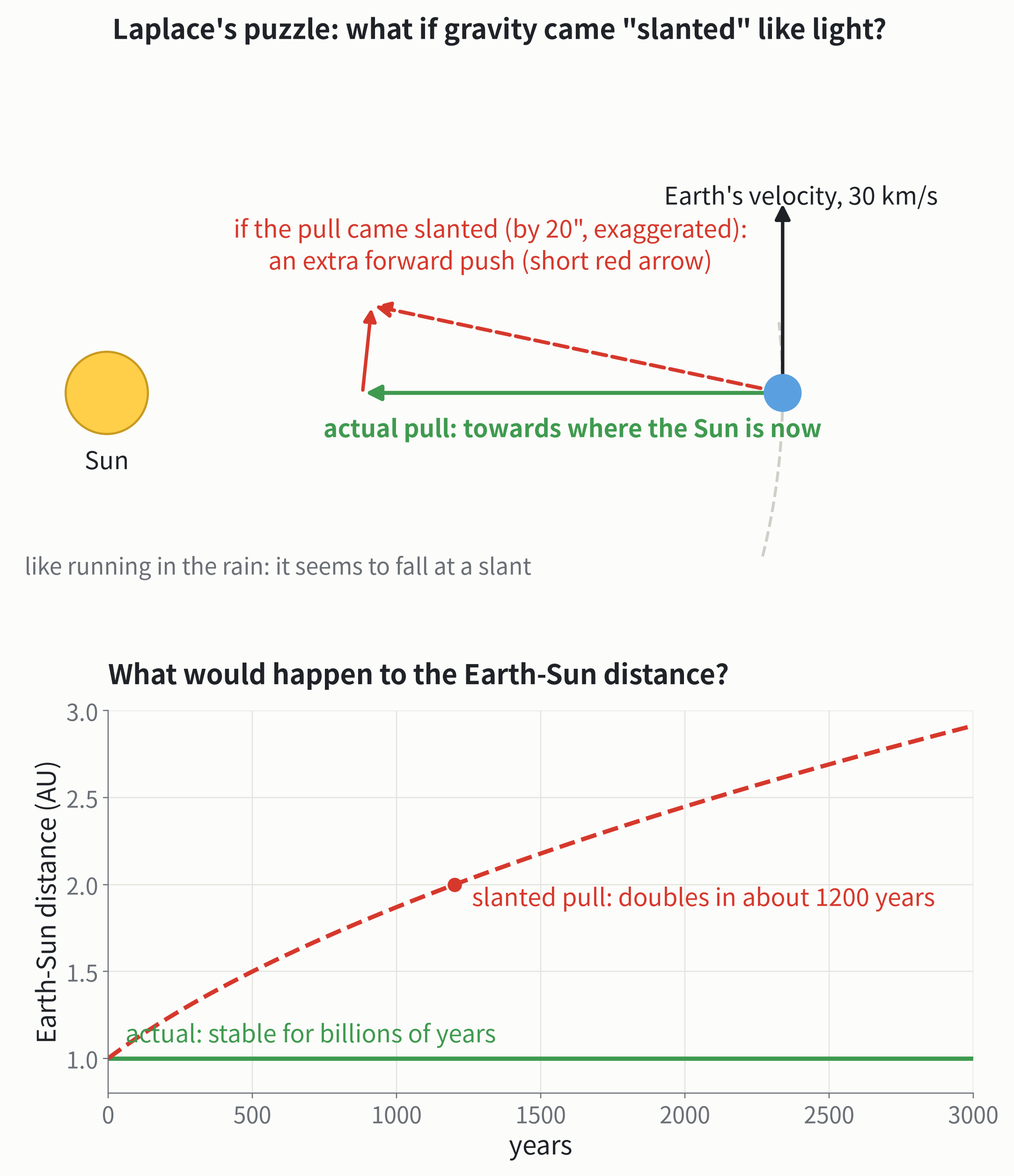
Laplace’s calculation was right; picturing gravity as raindrops was wrong. Gravity is not something shot out of the Sun, each bit travelling on its own; it is the Sun’s gravitational field, like a landscape the Sun carries around with it. Seen from the Sun, this landscape never changes, and Earth running across it feels a force that depends only on where it is, always pointing at the Sun, not tilted because Earth is moving. Starlight is different: it is something flying in from far away, and only because Earth runs into it does it seem to come at a slant.
Now look at it another way: what if the Sun itself moves at a steady speed? The laws of physics don’t change just because you look from a viewpoint moving at a steady speed; this is the principle of relativity. So the field of a steadily moving Sun moves along with it and points to where it is now. Only when the Sun’s motion changes, such as a sudden acceleration or a sudden disappearance, does that change in the field take time, spreading out ring by ring at the speed of light. Electricity works the same way: the electric field of a charge moving at a steady speed also points to where it is now.
So “gravity travels at the speed of light” really means: any change in the gravitational field spreads out at the speed of light. The “news” of the Sun’s disappearance is such a change; so are the gravitational waves we turn to next.
Ripples in spacetime: gravitational waves
When two heavy bodies orbit each other, their gravitational field keeps changing and sends out ripple after ripple: gravitational waves. Einstein predicted them in 1916, but thought they were too weak ever to be measured.
Earth orbiting the Sun sends out gravitational waves too, with a power of only about 200 watts, enough for two or three old-fashioned light bulbs. Only very heavy, very compact bodies such as two black holes or two neutron stars, whirling extremely fast and close in their last moments before merging, give off waves strong enough to detect.
On 14 September 2015 the American LIGO detectors caught gravitational waves directly for the first time: 1.3 billion years ago, two black holes of about 36 and 29 solar masses merged, and about 3 solar masses turned into gravitational-wave energy. Arriving at Earth, the waves changed the length of LIGO’s 4 km laser arms by about m, hundreds of times smaller than a proton. The discovery won the 2017 Nobel Prize in Physics. By early 2024, LIGO, Europe’s Virgo and Japan’s KAGRA had recorded 218 credible gravitational-wave events, most of them two black holes merging.
GW250114, on 14 January 2025, was the clearest yet. It confirmed a prediction Hawking made in 1971: when black holes merge, the total area of their “horizons” can only grow, never shrink. The horizon is a black hole’s boundary: once past it, not even light can escape. Its size is set by the black hole’s mass and spin, bigger for heavier black holes. Before the merger, the masses and spins of the two black holes were measured from the “chirp” part of the signal, giving horizons with a combined area of about 240,000 square kilometres. After the merger, the new black hole rang briefly at particular frequencies as it settled down; those frequencies gave its mass and spin, and a horizon area of about 400,000 square kilometres. Some mass turned into gravitational-wave energy, so the new black hole was lighter than the two together, yet its horizon area was larger.
A race lasting 130 million years
How fast do gravitational waves really travel? On 17 August 2017, LIGO’s two detectors and Virgo first “heard” gravitational waves from two merging neutron stars (GW170817). In the frequencies the detectors can hear (above about 24 Hz), the signal lasted about 100 seconds, oscillating faster and faster until the merger. 1.7 seconds after the merger, NASA’s Fermi Gamma-ray Space Telescope independently caught a burst of gamma rays. The three gravitational-wave detectors narrowed the source down to a patch of about 30 square degrees of sky, roughly 140 full Moons; about 11 hours later, a telescope in Chile found a new point of light there, in the galaxy NGC 4993. About 70 telescopes around the world then followed it.
Why do neutron stars give off light when black holes don’t? A neutron star is the extremely dense remnant of a big star; a teaspoon of it would weigh about a billion tonnes. When two neutron stars merge, some of their matter is torn apart and flung out, whirls around the newborn object, and shoots out jets at nearly the speed of light along the poles, producing gamma rays; the neutron-rich matter thrown out quickly forms heavy elements such as gold and platinum, and glows in visible and infrared light. When two black holes merge, there is usually no matter around them, and no light.
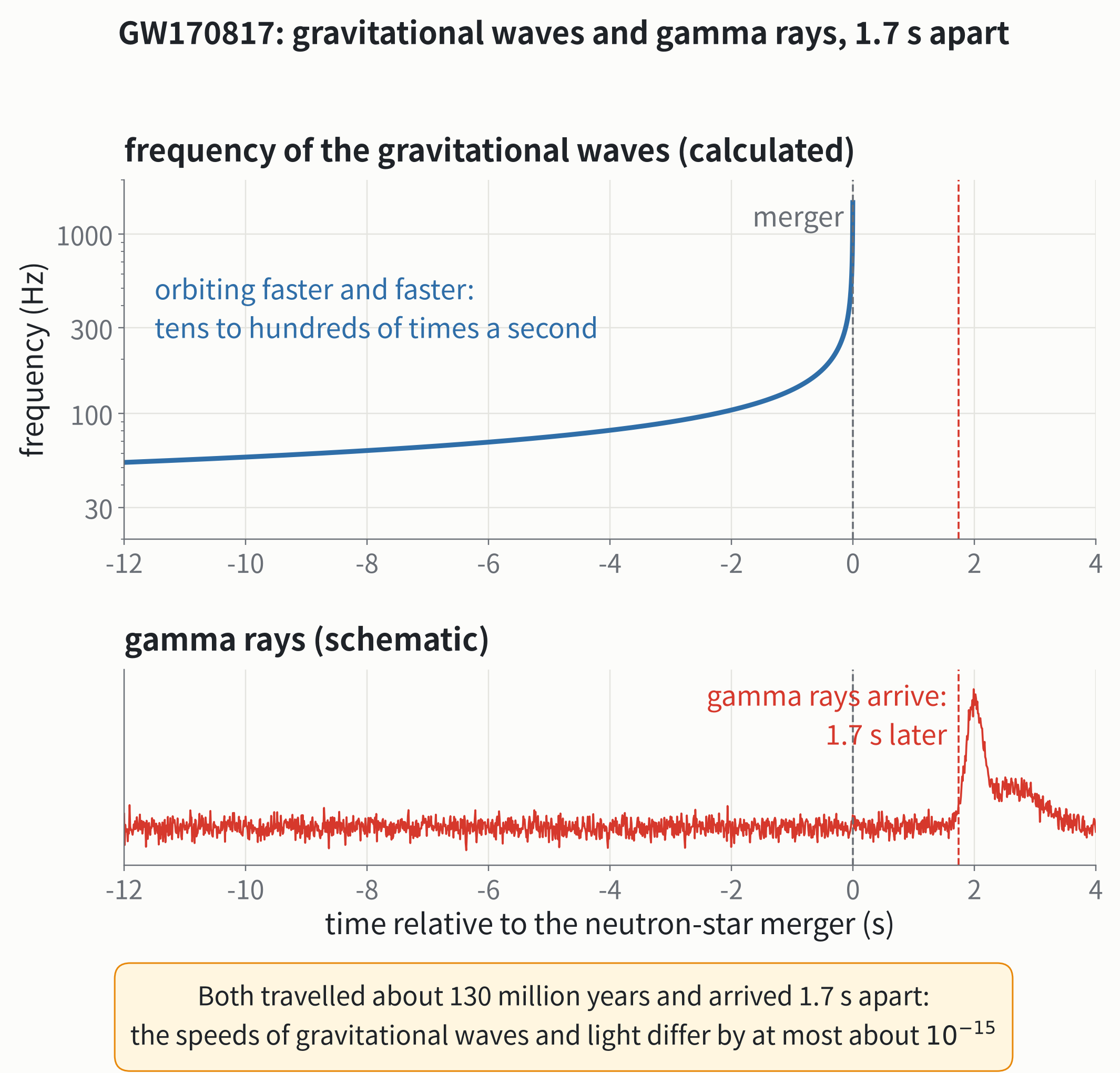
When the waves set out 130 million years ago, dinosaurs still walked on Earth. After so long a journey the gravitational waves and the light arrived only 1.7 seconds apart, and those 1.7 seconds are most likely because the gamma rays were emitted a little later. Working it out, their speeds differ by at most about . So if the Sun really vanished, darkness and Earth’s release would come at most seconds apart.
So far GW170817 is the only event seen in both gravitational waves and light. That itself is worth thinking about:
- most events are two black holes merging, with no matter and no light;
- events involving neutron stars are rarer, and most are farther and fainter. GW190425 in 2019 was also two neutron stars, but four times farther away; only one detector saw it clearly at the time, so its source could only be placed somewhere in about 8000 square degrees of sky, far too much for telescopes to search;
- when a black hole and a neutron star merge, the black hole may swallow the neutron star whole before it can be torn apart;
- gamma-ray jets are narrow, so we only see them if they point at us.
After dark: how fast would Earth cool?
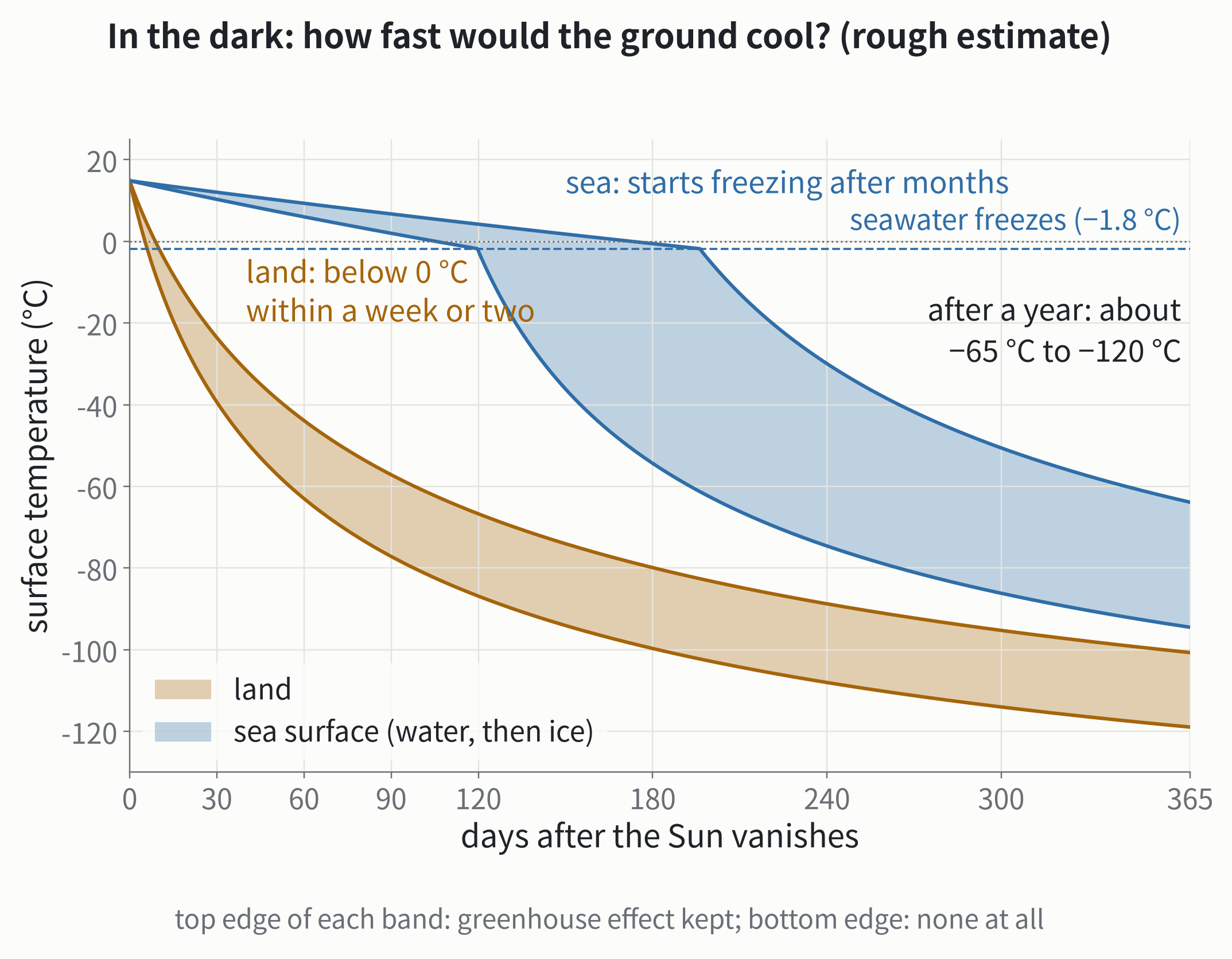
Besides flying off, Earth would get colder day by day: the ground keeps radiating heat into space and nothing replaces it. We estimated the first year with a simple model:
- land stores little heat and falls below 0 °C within a week or two;
- seawater stores far more, and the sea surface takes 4 to 6 months to cool to −1.8 °C and start freezing (longer, if deeper water also turned over and brought up heat);
- after a year, land is at about −100 to −120 °C and the ice surface at about −65 to −95 °C.
After that, the ice acts like a blanket that gets thicker and thicker, and the thicker it is, the more slowly the water below freezes; its thickness grows roughly as the square root of time: about 300 m after a thousand years, and, estimating from how ice conducts heat, a hundred thousand years or more to freeze oceans several kilometres deep. In the end only Earth’s internal heat seeps out, less than 0.1 watt per square metre, and after millions of years the surface would settle at about −237 °C (36 K).
Could the Sun really vanish?
No. The Sun will keep burning steadily for about another 5 billion years, then swell into a red giant and finally leave a white dwarf with a little over half its present mass. It will fade, but it cannot simply disappear: as long as the mass is there, so is the gravity. Mass “suddenly vanishing” would break the conservation of energy, and the equations of general relativity themselves don’t allow it, so this can only ever be a thought experiment. But it asks a real question, how fast changes in gravity travel, and that question was only answered by direct measurement in 2017.
In a sentence: after the Sun vanishes, sunlight keeps coming for 8 minutes 19 seconds; changes in the gravitational field also spread at the speed of light, so Earth goes dark and flies off along its tangent at the same moment, then grows colder day by day. Laplace thought gravity had to be millions of times faster than light, but the field of a steadily moving Sun moves with it and points to where it is now; only changes in the field take time to spread, and those changes, travelling far, are gravitational waves. In 2017, gravitational waves and light travelled for 130 million years and arrived 1.7 seconds apart.
Try it yourself
- Work it out: divide distance by the speed of light (300,000 km a second) to find how long the news takes to reach the Moon (380,000 km), Jupiter (about 780 million km) and Neptune (about 4.5 billion km).
- Count the seconds in a thunderstorm: you see the lightning first and hear the thunder later; every 3 seconds means about 1 km. The same event, carried by messengers of different speeds, reaches you at different times.
- Walk in the rain with an umbrella: even when rain falls straight down, the faster you walk, the more you tilt the umbrella forward. That is the idea behind aberration.
What we don’t know yet
That changes in the gravitational field travel at the speed of light has been measured to . But what gravity really is still has no complete answer: light is made of photons; are gravitational waves made of “gravitons”? General relativity and quantum mechanics have still not been brought together. The next time we catch both gravitational waves and light will need more sensitive detectors and another neutron-star merger close enough. Future space-based detectors, such as Europe’s LISA and China’s Taiji and TianQin, will also hear lower-frequency gravitational waves that detectors on the ground cannot.
Going further: numbers, formulas and sources
Light travel times. One astronomical unit (149.6 million km) divided by the speed of light is 499.0 s. Using semi-major axes: Mercury 0.387 AU, 3.22 min; Venus 0.723, 6.01 min; Mars 1.524, 12.67 min; Jupiter 5.203, 43.3 min. In Figure 2 each planet moves on a circular orbit until the news arrives, then in a straight line at its velocity at that moment; pulls between planets are ignored. Earth’s orbital speed is 29.8 km/s, so in 499 s it moves km; leaving along the tangent, its distance from the Sun’s old position grows by only km, about 2.5 µs of extra light travel.
Geodesics and the speed of light in the equations. In general relativity a body subject to no other forces follows a geodesic of spacetime; for a body like Earth, the geodesic is the path along which its own elapsed time (proper time) is longest. Einstein’s equations are ; in the weak-field approximation, small perturbations of the metric obey , a wave equation with wave speed .
Aberration and Laplace’s estimate. rad, or 20.5 arcseconds; a 25 mm coin at 250 m subtends about rad. If gravity had aberration like light, the pull would tilt forward by , adding a tangential component . Averaged over a circular orbit, , i.e. : the Earth-Sun distance doubles in about 1200 years. Checked by numerical integration (with scaled up 10 times, the distance after 120 years agrees with the formula to 0.1%). In volume 4 of his Celestial Mechanics (1805), Laplace concluded from the Moon’s motion that gravity must travel at least about times the speed of light; modern observations later pushed such a bound to . All of these assume gravity has aberration like light; in general relativity, velocity-dependent terms almost exactly cancel this aberration, so gravity travelling at light speed agrees with observation (Carlip 2000).
Earth’s gravitational waves. Two masses and in a circular orbit of separation radiate ; for the Sun and Earth about 196 W.
Figure 4. Diagram units. The orbital angular frequency rises with the time to merger by the lowest-order formula ; the amplitude goes as ; the pattern in the plane is at the retarded time , with amplitude drawn as (really ) to keep it visible. After the merger, a damped oscillation stands in for the ringdown.
Gravitational-wave events. GW150914’s peak strain was about , times 4 km, about m; a proton is about m across. The 218 events are the cumulative count of the GWTC-4.0 catalogue released in August 2025 (up to January 2024, probability of astrophysical origin at least 50%). Horizon area: for a non-spinning black hole and for a spinning one, with the dimensionless spin; the 240,000 and 400,000 km² for GW250114 are from LIGO’s press release of 10 September 2025.
GW170817. The top of Figure 5 uses the lowest-order chirp formula with chirp mass solar masses: about 57 Hz 10 s before the merger and 136 Hz 1 s before; from 24 Hz to the merger takes about 100 s and some 3900 cycles. The sky area was about 28 square degrees (the full Moon covers about 0.2); 10.9 hours after the merger the Swope telescope at Las Campanas Observatory in Chile found the optical counterpart. The gamma-ray burst GRB 170817A triggered 1.74 s after the merger. Taking a conservative distance of 26 megaparsecs (about 85 million light years) and allowing the gamma rays to be emitted up to 10 s late gives . GW190425: about 160 megaparsecs, sky area about 8300 square degrees.
The model in Figure 6. Land: a layer of air ( J per square metre per kelvin) over soil that conducts heat up from below (conductivity 1 W/m/K, diffusivity m²/s). Ocean: air plus a 50 m mixed layer, which freezes once it reaches −1.8 °C; the ice then thickens by conduction ( W/m/K), with the ice-surface temperature set by radiative balance. Radiation to space is with (today’s greenhouse effect kept) or 1 (no greenhouse effect), the two edges of each band. No winds, currents or deeper ocean, so it is an order-of-magnitude estimate. Ice thickness ( is the latent heat of freezing per unit volume of ice, taken as 170 K): about 280 m after a thousand years, and about 180,000 years to freeze through 3.7 km (somewhat faster in reality, since ice conducts better when very cold). Caltech’s David Stevenson estimated in 1999: the ocean surface starts freezing within days to a week, the surface is about 200 K after a year, the deepest water freezes in about a thousand years, and the surface reaches about 30 K after millions of years; our model freezes the sea surface later and takes much longer to freeze the oceans through. Earth’s internal heat flow is about 47 TW, on average 0.092 W per square metre, which balances at K.
Sources. Newton to Bentley, 25 February 1693. Laplace and the aberration of gravity: S. Carlip, Physics Letters A 267, 81 (2000). GW150914: LIGO and Virgo Collaborations, Physical Review Letters 116, 061102 (2016). GWTC-4.0: LIGO, Virgo and KAGRA Collaborations, arXiv:2508.18082 (2025). GW170817: Physical Review Letters 119, 161101 (2017); multi-messenger observations: Astrophysical Journal Letters 848, L12 (2017); speed of gravitational waves vs light: Astrophysical Journal Letters 848, L13 (2017). GW190425: Astrophysical Journal Letters 892, L3 (2020). GW250114: Physical Review Letters 135, 111403 (2025); LIGO press release, 10 September 2025. Earth cooling without the Sun: D. Stevenson, Caltech “Question of the Month,” July 1999.