Why Do Tea Leaves Gather in the Middle of the Cup When You Stir?
If you like tea, you may have noticed this: make a cup of loose-leaf tea, stir it a few times with a spoon, and take the spoon out. The tea keeps spinning. The leaves at the bottom spin along with it at first, but then slowly drift together, and end up resting quietly in a little heap at the very centre of the bottom.
That’s the odd part. Things that spin get flung outward, don’t they? In a spin dryer the clothes are pressed against the drum; on a swing ride at the fair, the seats fly further out the faster it turns. So why do the tea leaves go inward?
A guess first
There are two common guesses:
- “The leaves are flung outward by centrifugal force.” That’s the opposite of what we see.
- “There’s a whirlpool in the middle that sucks them in.” That’s half right. A current does carry the leaves to the middle, but it isn’t the whirlpool at the surface. It’s a thin layer of water right against the bottom of the cup.
It sounds like a child’s question. Yet a hundred years ago, in 1926, it got Einstein to write a paper.
The tea is turning in two ways
The obvious motion of stirred tea is round and round the cup. But there is another one you can’t see: the tea also slowly turns over, up and down.
- At the bottom, the water runs along the floor of the cup from the edge to the middle;
- in the middle, it rises;
- at the top, it flows back out to the edge;
- and then it runs down the wall back to the bottom.
The animation below is a cup of tea we simulated on a computer: stirred, spoon taken out, slowly coming to rest. On the left you look down from above; the white dots are bits of froth on the surface, the green shapes are leaves on the bottom. On the right the cup is cut open down the middle; the blue lines show the overturning flow.
The leaves are heavier than water and lie on the bottom, right in that inward current, which pushes them bit by bit to the middle. There the current turns upward, but the leaves are too heavy to rise. They stay behind, and the heap grows.
Why does the water at the bottom flow inward?
Look first at the shape of the surface when the tea spins: low in the middle, high at the edge, like a shallow bowl. In a cup 4 cm in radius, turning once a second, the middle is about 3 mm lower than the rim.
Near the rim the surface is higher, so there is more water pressing down and the pressure is higher; in the middle the surface is lower and the pressure is lower. That difference keeps pushing the water inward. And the few extra millimetres of water at the rim press on every depth below them, so this inward push is the same at every height, from the surface all the way to the bottom.
At the same time, the spinning water tends to fly outward, and the faster it spins, the harder the outward push. Over most of the cup these two pushes are exactly equal. The surface bends itself into a bowl precisely so that they cancel. So the water just goes round in circles, neither in nor out.
At the bottom, things are different. The cup itself isn’t moving, so the water touching the bottom is held back by it and spins more slowly than the water above, which weakens its outward push. The inward push from the pressure, though, isn’t any weaker.
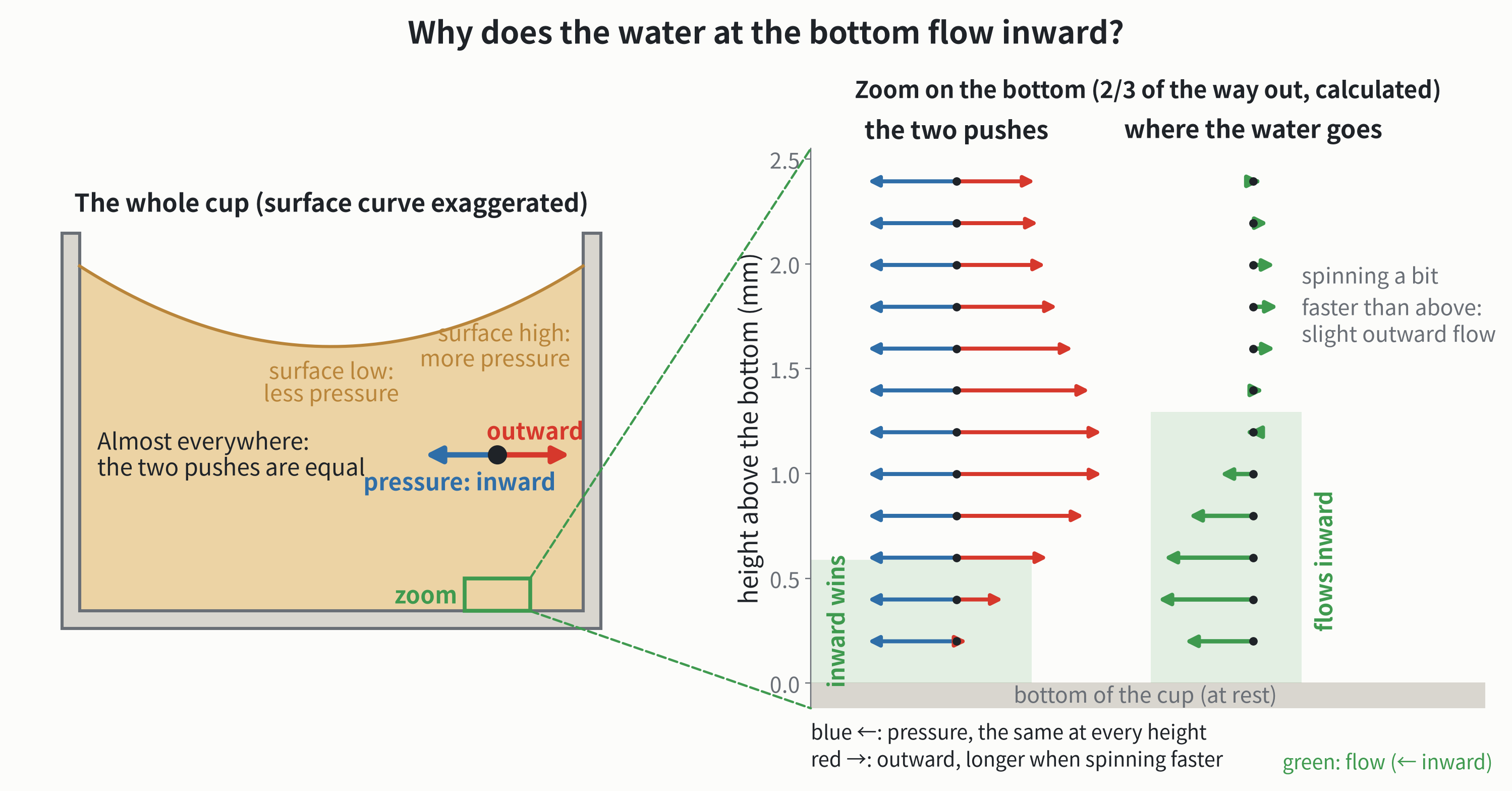
The right panel magnifies a small patch of the bottom, with heights in millimetres. Each black dot is a little parcel of water at that height.
- Left column, the two pushes: the water closest to the bottom hardly spins, so its red arrow is short; higher up the water spins faster and the red arrow grows; at about 0.6 mm above the bottom red and blue are equal. Within those 0.6 mm, the inward push wins.
- Right column, where the water goes: the layer flowing inward is thicker, about 1.3 mm. Once the water has been set moving inward, its momentum carries it a little further.
- A bit higher up: here the water actually spins slightly faster than the water above, the red arrow is longer than the blue, and there is a very weak outward flow. It is much weaker than the inward flow, so overall there is a current toward the middle along the bottom.
This layer is only a millimetre or two thick, about as thick as a tea leaf, so the leaves lying on the bottom sit right in that current.
The overturning has another effect: it stops the tea quickly. Within about half a minute, stirred tea has lost most of its spin. If the drag of the cup’s walls and bottom only spread inward through the water’s viscosity, it would take nearly half an hour, and more than an hour for hot tea. It’s the overturning flow, carrying the slow water from the bottom into the body of the tea, that brakes the whole cup so fast.
Einstein, Mrs. Schrödinger and a cup of tea
In March 1926, Einstein published a two-page note in the German journal Die Naturwissenschaften, titled “The cause of the formation of meanders in the courses of rivers and of the so-called Baer’s law.” Right at the start he asks the reader to try an experiment:
Imagine a flat-bottomed cup full of tea. At the bottom there are some tea leaves… If the liquid is made to rotate by a spoon, the leaves will soon collect in the center of the bottom of the cup.
His explanation is the one above: the water at the bottom is slowed, and the inward pressure wins. Then he turns to rivers, and says that the same thing is going on wherever a river bends.
A little over a month later, on 23 April 1926, Erwin Schrödinger wrote to Einstein:
I very much enjoyed your delightful explanation of the formation of meanders. It just happens that my wife had asked me about the “teacup phenomenon” a few days earlier, but I did not know a rational explanation. She says that she will never stir her tea again without thinking of you.
In those very months, Schrödinger was publishing one paper after another on his wave equation, one of the central equations of quantum mechanics. A physicist who was rewriting the world of the atom was stumped by his wife’s question about a cup of tea.
Einstein wasn’t the first to work it out, though. Back in 1857, the Scottish engineer James Thomson, talking about the circulation of the atmosphere, had pointed out that this kind of overturning comes from “friction on the bottom.” He was the elder brother of Lord Kelvin, the same Kelvin who appears in Why Is the Night Sky Dark?. In the summer of 1876, James also built a small model “river,” about 20 cm wide, a few centimetres deep, with a 180-degree bend, and watched the water along the bed flow at an angle toward the inside of the bend (more on why below).
One more coincidence: Einstein’s elder son, Hans Albert Einstein, became a professor of hydraulic engineering at the University of California, Berkeley, and spent his life studying how rivers carry sediment. Yet his writings never seem to mention his father’s paper about rivers.
Why do rivers grow ever more winding?
First, the two sides of a bend: the bank on the outside of the bend is the outer bank, also called the concave bank, because seen from the river it curves away; the bank on the inside is the inner bank, or convex bank.
A river bend is like half a teacup. As the water goes round the bend it is thrown toward the outer bank, so the surface there is a little higher than at the inner bank. Just as in the cup, the water near the bed is slowed by friction, its outward push weakens, and the pressure difference pushes it toward the inner bank. So the river turns over across its width as well: the surface water heads for the outer bank, dives down it, and flows back along the bed to the inner bank.
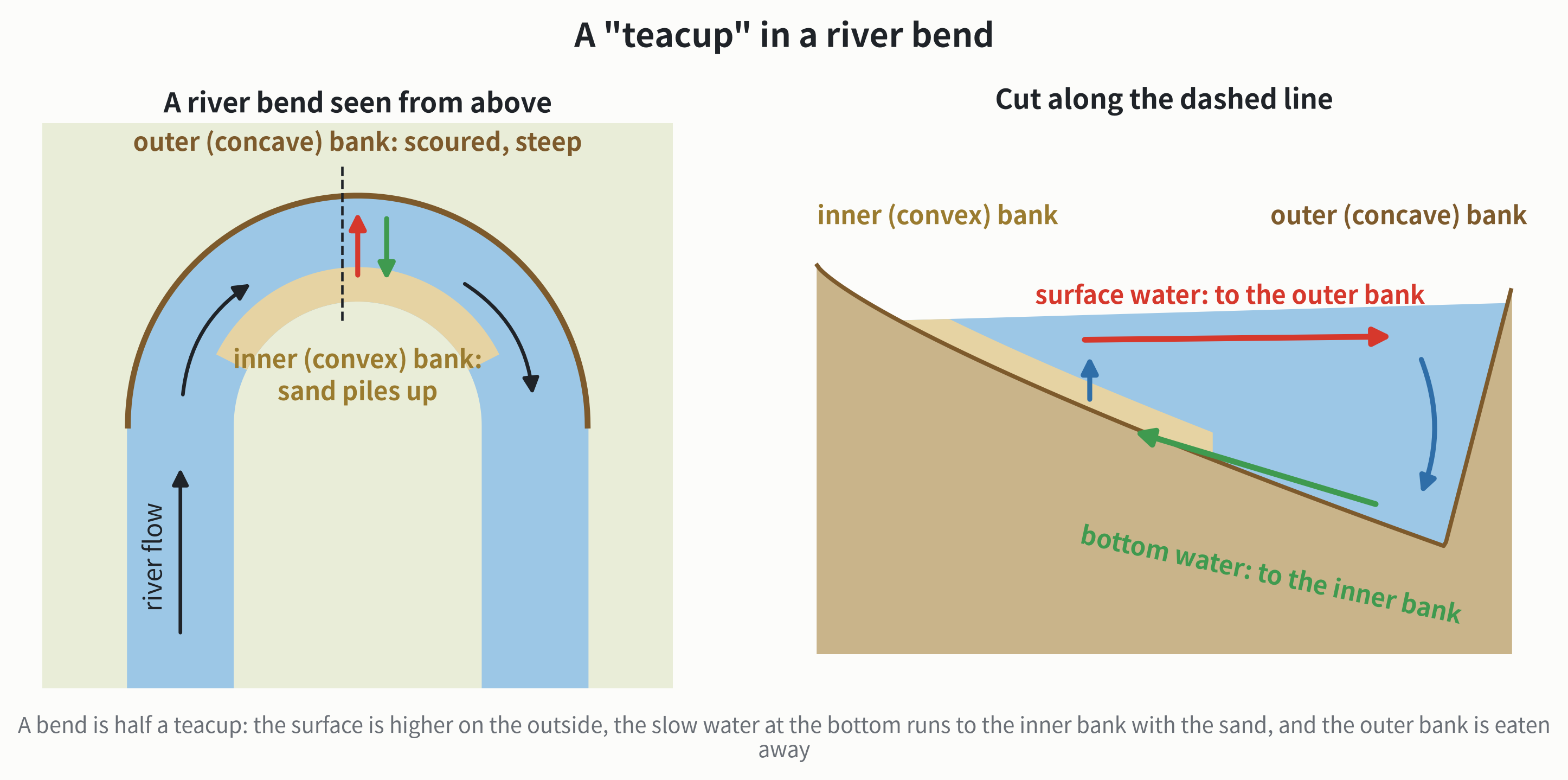
The outer bank is eaten away and retreats; sand piles up on the inner bank, which grows outward. Geographers sum it up as “the concave bank erodes, the convex bank builds up,” and so the bend becomes more and more curved. People make use of this: ports are often built on concave banks, where the water is deep and big ships can come close, while the flat, fertile land built up on convex banks is good for farms and towns.
As the bends grow, neighbouring bends squeeze closer together. Eventually, in a flood, the river breaks through the narrow “neck” between two bends and takes the shortcut; this is called a cutoff. The abandoned stretch of old channel gets plugged with sediment at both ends and becomes a crescent-shaped lake, an oxbow lake.
An oxbow is the U-shaped wooden collar of the yoke that lets an ox pull a plough or a cart. The old channel curves into a U like that collar, hence the name; the Chinese name, 牛轭湖 (niú è hú, “ox-yoke lake”), means the same. Lakes form in many ways: dug out by glaciers, filling volcanic craters, sinking along faults in the Earth’s crust… but the little crescent-shaped lakes along big lowland rivers were mostly “walked” into existence by the river like this.
A real river takes hundreds or thousands of years to do what happens in the animation. The lower Jingjiang reach of the Yangtze is famous in China for its endless loops. In 1967 and 1969, engineers dug new channels across the necks of the Zhongzhouzi and Shangchewan bends, cutting them off; in July 1972 the river broke through the neck at Shatanzi by itself. Together the three cutoffs shortened the river by about 78 km. The loop abandoned at Shatanzi is today’s Tian’ezhou oxbow, a real oxbow lake that is now a reserve for the Yangtze finless porpoise.
Einstein’s paper also discussed “Baer’s law”: in the 19th century the naturalist Karl Ernst von Baer, working in Russia, argued that because the Earth spins, rivers in the Northern Hemisphere erode their right banks more. Einstein showed that the Earth’s spin does give river water a little overturning, by the same mechanism as in the teacup. Today, though, that effect is known to be far weaker than the overturning caused by the bends themselves: which bank a river cuts into depends mostly on which way it turns.
The same overturning, elsewhere
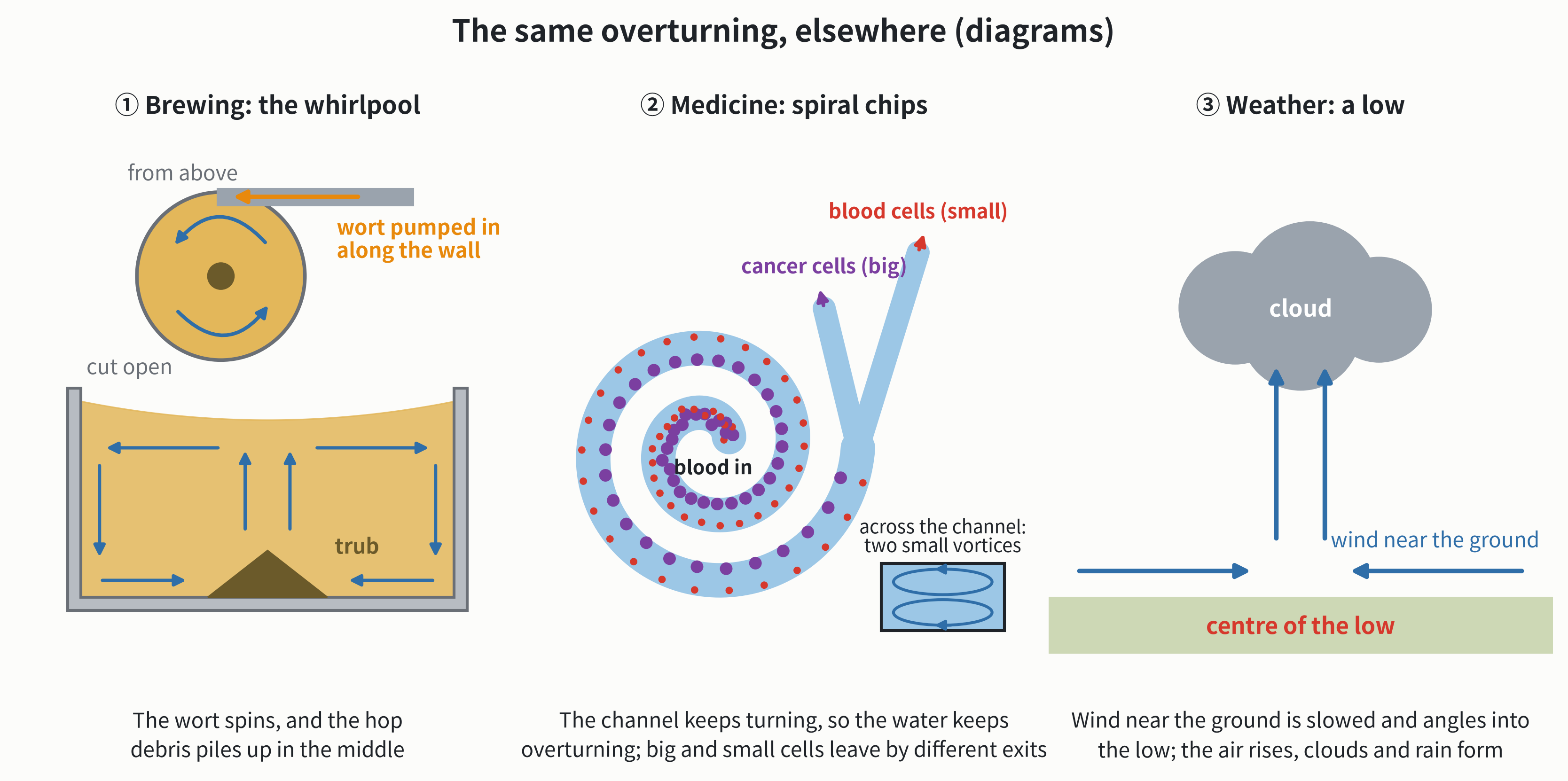
- ① Brewing beer. After the wort is boiled, it is full of bits of hops and clumped protein. Breweries pump it into a big round vessel, but not aimed at the centre: the inlet runs along the wall, pointing the way the wall curves (“along the tangent,” in mathematical terms), just like stirring a cup by running the spoon along its side. The whole vessel starts to spin (① top). After the pump stops, the wort stands for about twenty minutes and the debris settles into a little cone in the middle of the bottom (① bottom), and the clear wort is drawn off from the side. Molson in Canada is said to have started doing this around 1960; today almost every brewery has a “whirlpool,” and it works by the teacup’s physics.
- ② Medicine. In 2006, researchers at Monash University in Australia put a drop of blood in a tiny round chamber and made its surface spin with an “ionic wind” blown from a charged needle tip. The red blood cells were swept to the middle of the bottom like tea leaves, leaving clear plasma above, with no centrifuge. A step further is finding cancer cells: blood occasionally carries cancer cells shed from a tumour, a handful among billions of blood cells. A team from the National University of Singapore and MIT sent blood into a spiral-shaped channel from the middle (②). Because the channel keeps turning, there are always two overturning vortices across it (the small box at bottom right), the same thing as in a river bend. The big cancer cells are pushed to the inner side and the small blood cells are carried to the outer side, so at the end they leave by two different exits. Chips like this are now sold as commercial instruments.
- ③ Weather. In the Northern Hemisphere, the wind around a low-pressure system blows counterclockwise around it. But near the ground the wind is slowed by friction, and, just like the tea at the bottom of the cup, it angles in toward the centre of the low (③). The air piling up in the middle has nowhere to go but up; as it rises it cools, its water vapour condenses into clouds, and rain is likely. That’s why a “low” in the weather forecast usually means grey, wet weather. Typhoons and hurricanes do the same: the wind skimming the sea spirals in toward the eye, then rises around the eyewall in a towering wall of cloud.
In the ocean and in pipes
From 1893 to 1896, the Norwegian explorer Fridtjof Nansen let his ship Fram freeze into the Arctic pack ice and drift with it for three years. He noticed that the ice always drifted 20 to 40 degrees to the right of the wind. Nansen asked the physicists, and a young Swede named Walfrid Ekman worked out the reason in 1905: the Earth’s rotation, combined with friction between layers of seawater. Since then, the thin layer that rotating fluid forms against a boundary has been called an “Ekman layer,” and the thin layer at the bottom of the teacup belongs to the same family.
These layers feed a lot of people. Winds blowing along the coast of Peru, acting through such a layer, push the surface water away from the shore, and cold, nutrient-rich water wells up from the deep, sustaining one of the largest fisheries in the world.
Pipes are full of overturning too. When water flows round a bend in a pipe, two overturning vortices appear across the pipe (James Thomson’s 1876 paper already had “the flow of water round bends in pipes” in its title). This overturning mixes the water in the middle of the pipe with the water near the wall, so heat is exchanged faster, which is why the tubes in many heat exchangers and water heaters are coiled into spirals.
Does it happen in space?
Galaxies spin too. Does their shape have anything to do with the overturning in a teacup? Essentially no. A galaxy is made of billions to hundreds of billions of stars plus a lot of gas, and the stars are so far apart that they almost never collide; there is no “bottom of the cup” to rub against. Most astronomers think a galaxy’s spiral arms are “density waves”: stars and gas crowd together as they pass through them, like a traffic jam on a motorway, where cars keep entering and leaving but the jam stays put. What a galaxy looks like is set by its own gravity and rotation, and has nothing to do with whether the universe is finite or infinite.
Around newborn stars, though, there is something very like the tea leaves. A young star is circled by a disc of gas and dust, where planets form. The gas in the disc is propped up slightly by its own pressure, so it orbits a little slower than the speed that would keep it from falling in (by a few parts in a thousand). The dust grains have no pressure to prop them up, yet the gas drags them back to its slower speed, like the slowed water at the bottom of the cup; gravity wins, and they spiral inward toward the star. A metre-sized boulder at the Earth’s distance from the Sun would fall into the star in about a hundred years, long before it could grow into a planet. This is a famous puzzle in the theory of planet formation.
The way out is also a bit like the teacup: where the disc has a ring of especially high gas pressure, the gas there orbits at exactly the right speed, so the dust stops drifting inward and piles up in a bright ring, just as the tea leaves pile up where the flow stops.
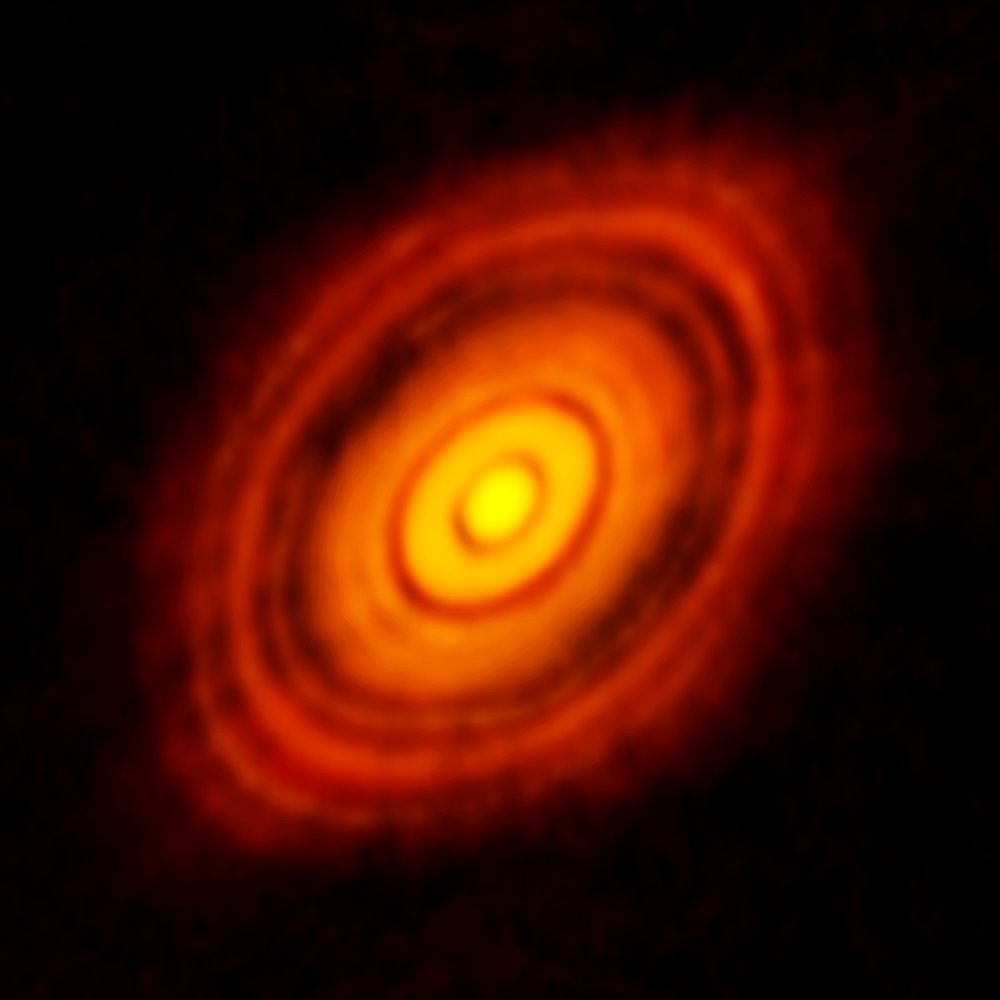
In 2014, the Atacama Large Millimeter/submillimeter Array (ALMA) in Chile imaged the dust disc around HL Tauri, its bright rings and dark gaps sharply visible. Whether the rings are swept out by forming planets or are dust trapped at pressure peaks is still being studied; most likely both play a part.
In one sentence: stirred tea spins round the cup with its surface low in the middle and high at the edge, so the pressure pushes the water inward, exactly balancing its outward push; only the thin layer at the bottom is slowed, its outward push weakens, and the pressure drives it to the middle. So the tea turns over as it spins, and sweeps the leaves on the bottom to the centre. A river overturns the same way at every bend, scouring the concave bank and building up the convex one, so it grows ever more winding and leaves oxbow lakes behind.
Try it yourself
- Watch the leaves gather: Fill a clear glass with water, add a pinch of broken tea leaves (or a few soaked leaves, or a pinch of sand), stir a dozen times, take out the spoon, and watch from the side and from above.
- See the flow along the bottom: When the leaves start moving inward, use a dropper to put a drop of ink or food colouring on the bottom near the wall. Watch it run along the bottom to the middle and rise there.
- Spin it the other way: Put the glass of water on a turntable (a lazy Susan or a record player) and spin the glass instead of stirring the water. Now the bottom moves faster than the water, the thin layer at the bottom is flung outward, and the leaves go to the edge. When the turntable stops but the water is still turning, the leaves come back to the middle.
What we still don’t know
The physics of tea leaves gathering in the middle is settled. But exactly how river bends grow, why one full meander is about ten times as long as the river is wide, and how plants and sediment shape rivers are still being worked on by geologists and engineers. How the overturning flow pushes individual grains of sand or flakes of tea along is also hard to calculate, because flow and grains act on each other. And out in space, whether dust rings really are the nurseries where planets grow is still an open question.
Going deeper: numbers, calculations, simulations and sources
How far the surface dips. Water spinning at (radians per second) has a parabolic surface whose centre is lower than at radius . For cm and one turn per second ( per second), mm.
Why the pressure push is the same at every height. The pressure in the water is plus a constant, where is the height of the surface at radius . So , independent of the height . Almost everywhere it equals the outward push , which is what sets the shape of the surface.
The bottom layer: an exact solution. The right panel of Figure 2 uses an exact solution: fluid rotating as a solid body above a flat plate at rest (Bödewadt, 1940). With and velocities (radial), (around), , the Navier–Stokes equations become
with at the bottom and above. The inward pressure push is at every height and the outward push is , so the ratio of the red to the blue arrow is . Numerically: , ; at , changes sign at , and peaks at 1.28 (). In real heights: for water at 20 °C, m²/s, and at one turn a second mm, so the layer where the inward push wins is about 0.6 mm thick, the inward-flowing layer about 1.3 mm, and the fastest spin is about 1.1 mm up. For hot tea at 80 °C, and every layer is about 0.6 times as thick.
Why tea stops so quickly. If the braking only spread through the tea by viscous diffusion, it would take about : some 27 minutes at 20 °C and 74 minutes at 80 °C. With the overturning, the time becomes about ( is the depth of the tea): for cm, about 32 s at 20 °C and 53 s at 80 °C.
The teacup simulation. Figure 1 solves the axisymmetric Navier–Stokes equations: cup radius 1, tea depth 1.2, the tea initially spinning as a solid body (just stirred, spoon out), the bottom and wall at rest, and the surface taken flat and stress-free. The variables are the angular momentum , the azimuthal vorticity and the stream function , on a 100 × 120 grid. A real cup has a Reynolds number of ten to thirty thousand; the simulation uses , so that the grid resolves the bottom layer and the overturning stays a single clean loop, at the cost of a thicker bottom layer than in real tea. The leaves sit 0.012 cup radii above the bottom and circle with the water there; they move inward at 0.22 times the water’s speed, standing in for their friction with the bottom.
The river simulation. Figure 4 uses the channel-migration model of Howard and Knutson (1984), as in the open-source meanderpy (Sylvester et al., 2019): each point of the centreline moves sideways at a rate given by a weighted sum of the local and upstream curvature, , with , , and . When two bends come closer than one channel width, the neck is cut, and the abandoned loop is drawn as an oxbow lake that slowly fades.
Dust drifting inward. Pressure support makes the gas orbit slower than the Keplerian speed by about , with a few parts in a thousand (near the Earth’s orbit, a difference of a few tens of metres per second). Grains that are neither tightly nor loosely coupled to the gas (about a metre across near the Earth’s orbit) drift fastest, reaching the star in about a hundred years (Weidenschilling, 1977). At a pressure maximum, , the gas orbits at exactly the Keplerian speed, and the dust stops there.
Sources. Einstein: Die Ursache der Mäanderbildung der Flußläufe und des sogenannten Baerschen Gesetzes, Die Naturwissenschaften 14, 223–224 (1926). Schrödinger’s letter of 23 April 1926, quoted in a paper by Z. K. Silagadze (arXiv:2503.23847). James Thomson: On the grand currents of atmospheric circulation (1857); On the origin of windings of rivers in alluvial plains, with remarks on the flow of water round bends in pipes, Proc. R. Soc. 25, 5–8 (1876); Experimental demonstration in respect to the origin of windings of rivers, Proc. R. Soc. 26, 356–357 (1877). Bödewadt: ZAMM 20, 241–253 (1940). Ekman: On the influence of the earth’s rotation on ocean-currents, Arkiv för Matematik, Astronomi och Fysik 2, 11 (1905). Whirlpool: Craft Beer & Brewing, “Whirlpooling: The Tea Leaf Paradox.” Plasma separation: Arifin, Yeo and Friend, Biomicrofluidics 1, 014103 (2007). Spiral chips: Hou et al., Scientific Reports 3, 1259 (2013). Lows: Tandon and Marshall, “Einstein’s Tea Leaves and Pressure Systems in the Atmosphere,” The Physics Teacher 48, 292 (2010). Jingjiang cutoffs: river-evolution studies by the Changjiang River Scientific Research Institute and records of the lower Jingjiang cutoff project. Dust drift: Weidenschilling, MNRAS 180, 57 (1977); van der Marel, Dust trapping in protoplanetary disks (arXiv:1902.00005). HL Tauri: ALMA Partnership, ApJ Letters 808, L3 (2015); image from ESO.